
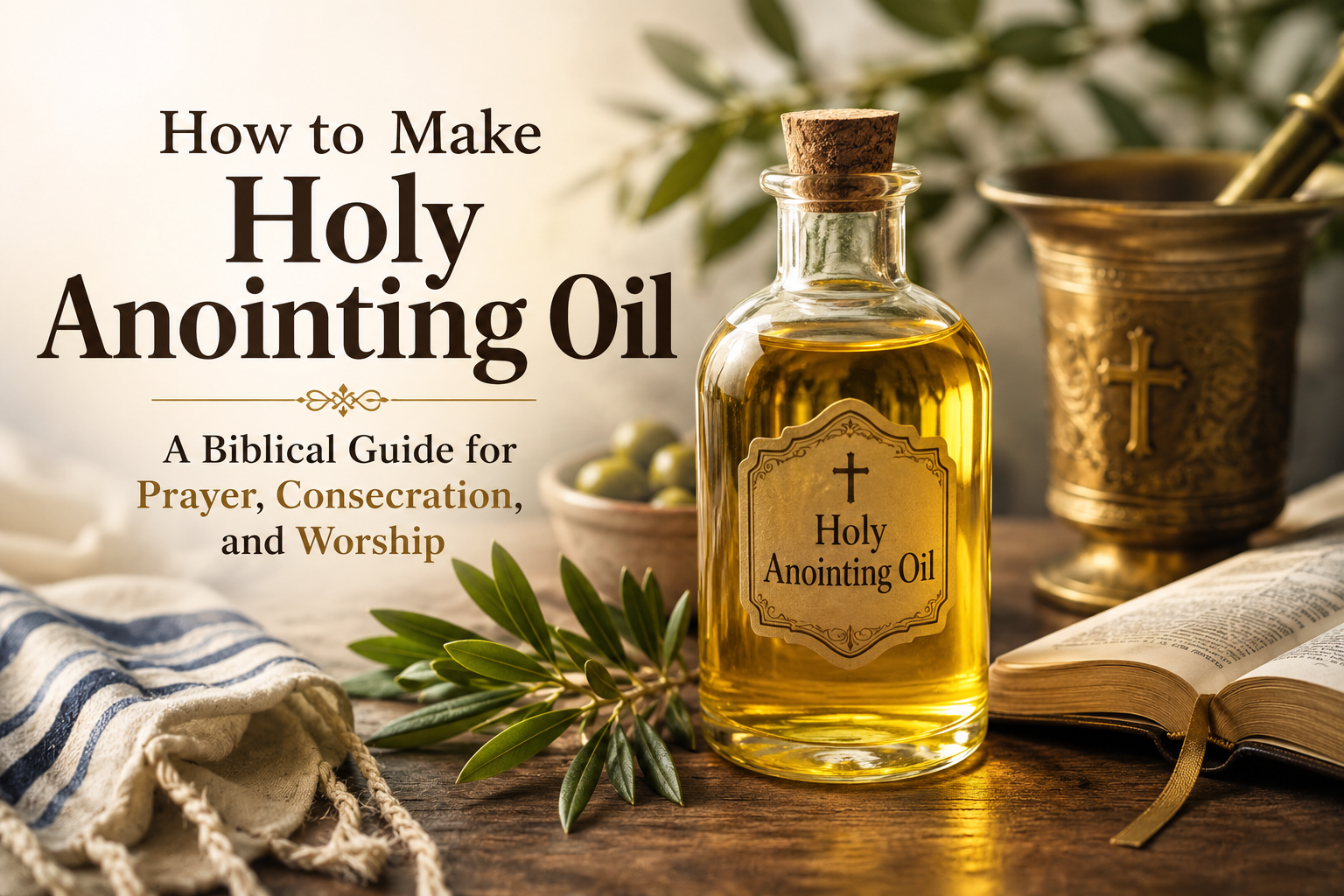
Have you ever wondered if you can make holy anointing oil at home However, there is often confusion about what anointing oil is, how it should be prepared, and whether there is a biblical way to make it.
Throughout the Bible, oil is far more than an everyday household item. It is a powerful symbol of God’s blessing, consecration, healing, and the work of the Holy Spirit. From the anointing of kings like David to the consecration of priests and the prayers of the early church for the sick, anointing oil appears repeatedly throughout Scripture as a visible reminder of God’s presence and His calling upon His people.
Today, many Christians keep a small bottle of anointing oil in their homes and use it during personal prayer, family devotions, intercession, or when praying for someone who is ill. Yet one question continues to arise among believers: How do you make holy anointing oil in a way that honors God and aligns with the Bible?
The answer is both simple and profound.
While the Bible records a sacred anointing oil prepared under God’s direct instruction for the tabernacle and priesthood (Exodus 30:22–33), the New Testament places the emphasis not on a specific formula but on faith in Jesus Christ. The oil itself does not possess supernatural power, nor does it guarantee miracles. Instead, it serves as a physical symbol that points believers to the Lord, reminding them to trust His promises, seek His presence, and depend on the Holy Spirit.
Unfortunately, there are many misconceptions surrounding anointing oil today. Some people believe that simply possessing a bottle of oil will automatically bring blessings, prosperity, protection, or healing. Others purchase expensive “miracle oils,” hoping they contain special spiritual power. Still others avoid anointing oil altogether because they fear it belongs only to Old Testament rituals.
The Bible encourages a balanced understanding. God alone is the source of every miracle, every healing, every answered prayer, and every spiritual blessing. Oil has never replaced God’s power. Rather, it has always been a symbolic act of faith and obedience. Just as baptism uses water and the Lord’s Supper uses bread and wine as visible signs of spiritual realities, anointing oil reminds believers of God’s holiness, His presence, and their dedication to Him.
For Christians, making anointing oil is not about creating a magical substance or following a secret recipe. It is about preparing a simple oil with reverence, dedicating it to God through prayer, and using it in a way that glorifies Christ. Whether you are praying for healing, dedicating your home, blessing a family member, or seeking God’s guidance, the focus should always remain on the Lord—not on the oil itself.
This guide is designed to provide a clear, biblically grounded understanding of holy anointing oil. You will discover:
- What holy anointing oil is and why it was used in Scripture.
- The Old Testament recipe and what it symbolized.
- Whether Christians today should make or use anointing oil.
- A simple step-by-step guide to preparing anointing oil at home.
- The spiritual meaning behind commonly used ingredients.
- How to dedicate or consecrate anointing oil through prayer.
- Biblical ways to use anointing oil without superstition.
- Common mistakes and misconceptions to avoid.
- Frequently asked questions about anointing oil.
- Bible verses that explain God’s purpose for anointing.
- A heartfelt prayer asking God to bless your walk with Him.
As you read, remember that the greatest anointing every believer needs is not found in a bottle but in the abiding presence of the Holy Spirit. The Apostle John reminds Christians that they have received an anointing from God through Christ, enabling them to know the truth and remain faithful to Him. This spiritual anointing is far greater than any physical oil, for it is God’s own Spirit living within those who trust in Jesus.
If you choose to prepare holy anointing oil for personal prayer or family worship, do so with humility, faith, and a heart that desires to honor God above all else. Let each drop remind you that the Lord is holy, faithful, and worthy of your complete devotion.
By the end of this guide, you will not only know how to make holy anointing oil but also understand its biblical purpose, avoid common misunderstandings, and use it in a way that strengthens your faith while giving all glory to God.
What Is Holy Anointing Oil? (Biblical Meaning, Purpose, and Symbolism)
To understand how to make holy anointing oil, it is first important to understand what it is and why God established its use in Scripture. Without this biblical foundation, it is easy to misunderstand its purpose or place undue confidence in the oil itself.
Simply put, holy anointing oil is oil that has been set apart and dedicated to God for sacred use. In both the Old and New Testaments, it symbolizes consecration, God’s blessing, the presence of the Holy Spirit, healing, and being set apart for God’s service.
The word “anoint” means to apply oil to a person or object for a sacred purpose. In biblical times, this act was performed as a visible sign that someone or something belonged to God and was being dedicated to His work.
The oil itself was never worshiped, nor was it believed to possess independent supernatural power. Instead, it pointed people toward God’s authority, His covenant, and His presence. The true source of power has always been the Lord.
The Meaning of Consecration
One of the primary purposes of anointing oil is consecration.
To consecrate means to set apart something or someone exclusively for God. Throughout the Bible, God instructed His people to dedicate certain individuals, places, and objects for His holy purposes.
When Moses completed the Tabernacle, God commanded him to anoint it along with its furnishings. This act symbolized that everything used in worship belonged to the Lord. Likewise, Aaron and his sons were anointed before beginning their priestly ministry, demonstrating that they were chosen to serve God rather than themselves.
This principle still speaks to believers today. Although Christians are no longer under the ceremonial laws of the Old Testament, the call to live lives set apart for God remains unchanged. Using anointing oil during prayer can be a meaningful reminder of that commitment.
Anointing Oil as a Symbol of the Holy Spirit
Another important biblical meaning of anointing oil is its connection to the work of the Holy Spirit.
Oil was often used to represent God’s Spirit empowering someone for a specific task. When the prophet Samuel anointed David as king, Scripture says that the Spirit of the Lord came powerfully upon him from that day forward. The oil did not give David strength by itself; rather, it symbolized God’s choice and the Spirit’s empowering presence.
For Christians, this symbolism points beyond the physical act of anointing. Every believer who trusts in Jesus Christ receives the Holy Spirit, who guides, comforts, teaches, and transforms them into Christ’s likeness. Therefore, while anointing oil can be a helpful symbol during prayer, it is the Holy Spirit—not the oil—who works in the believer’s life.
A Symbol of Joy, Blessing, and Favor
In the Bible, oil also represents joy, abundance, and God’s favor.
Olive oil was an essential part of daily life in ancient Israel. It was used for cooking, lighting lamps, caring for the skin, and even treating wounds. Because it was valuable and life-sustaining, it naturally became a symbol of God’s provision and blessing.
Several psalms speak of oil in this way. A head anointed with oil signified welcome, honor, and celebration. It reflected the generous hospitality and overflowing goodness of God.
When Christians use anointing oil today, it can serve as a reminder that every good gift comes from the Lord and that His blessings flow from His grace rather than human effort.
Anointing Oil and Healing
One of the most familiar New Testament references to anointing oil appears in James 5:14–15, where believers who are sick are encouraged to call the elders of the church to pray over them, anointing them with oil in the name of the Lord.
This passage emphasizes two important truths.
First, the healing comes from God—not from the oil.
Second, prayer offered in faith is central. The oil accompanies the prayer as a visible expression of trust in God’s power and mercy.
Christians should therefore avoid viewing anointing oil as a substitute for faith, medical care, or God’s sovereign will. Instead, it can be used as a humble symbol while seeking the Lord’s healing and comfort.
Anointing Objects and Places
In the Old Testament, sacred objects within the Tabernacle were anointed because they were devoted to God’s service.
Today, some believers choose to pray over their homes, ministries, or other places while applying a small amount of anointing oil. This practice is not commanded in the New Testament, but many Christians find it to be a meaningful way of dedicating their homes, families, and work to the Lord.
What matters most is the prayer of dedication and the heart behind it—not the physical act itself.
What Holy Anointing Oil Is Not
A biblical understanding also requires recognizing what anointing oil is not.
Holy anointing oil is not:
- A magical substance that guarantees miracles.
- A charm that automatically protects against evil.
- A replacement for genuine faith in Jesus Christ.
- A product that becomes more powerful because it is expensive or imported.
- An object to be worshiped or treated superstitiously.
Throughout Scripture, God consistently calls His people to place their confidence in Him alone. Any use of anointing oil that shifts attention away from Christ and toward the oil itself misses its true purpose.
The Heart Matters Most
The Bible repeatedly teaches that God looks at the heart. A bottle of carefully prepared anointing oil has little value if it is used without faith, repentance, obedience, and love for God.
Conversely, a simple bottle of olive oil, prayerfully dedicated to the Lord and used with sincere faith, can serve as a beautiful reminder of His presence and His promises.
As you continue learning how to make holy anointing oil, remember that the goal is not merely to prepare oil but to cultivate a deeper relationship with God. The outward act should always reflect an inward commitment to honor Christ, follow His Word, and depend daily on the Holy Spirit.
This biblical perspective lays the foundation for everything else you will learn in this guide, ensuring that your understanding of anointing oil remains rooted in Scripture rather than tradition or superstition.
The History of Holy Anointing Oil in the Bible
The history of holy anointing oil is deeply connected to God’s relationship with His people throughout Scripture. From the wilderness journey of Israel to the ministry of Jesus Christ and the early church, anointing oil has represented dedication, divine calling, honor, and the presence of God.
Understanding this history helps believers recognize why anointing oil has remained meaningful in Christian worship and prayer. The Bible does not present oil as a magical substance but as a sacred symbol used during important moments when God set people or things apart for His purposes.
The First Biblical Instructions for Holy Anointing Oil
The first detailed instructions for making holy anointing oil are found in Exodus 30:22–33. God gave Moses a specific recipe to prepare oil that would be used exclusively for the worship of the Lord.
This special oil was not created for ordinary purposes. It was called the holy anointing oil because it was separated from common use and dedicated entirely to God’s service.
God instructed Moses to combine:
- Pure myrrh
- Sweet cinnamon
- Fragrant cane
- Cassia
- Olive oil
The ingredients were carefully measured, mixed together, and prepared as a sacred oil for the tabernacle.
God then commanded that this oil be used to anoint:
- The Tabernacle
- The Ark of the Covenant
- The altar
- The lampstand
- Other sacred furnishings
- Aaron and his sons, who served as priests
Through this act, everything connected to worship was marked as belonging to God.
Anointing Oil and the Tabernacle
The Tabernacle was the place where God’s presence was represented among the Israelites during their journey through the wilderness.
Before the priests could begin their ministry, and before the objects used in worship could be used, they had to be consecrated through anointing.
This teaches an important spiritual principle: God’s work must be approached with reverence and dedication.
The anointing oil did not make the Tabernacle holy by itself. Rather, it was a visible sign that God had chosen that place for His glory.
The same principle applies today. A physical object, building, or material item does not automatically become powerful because oil is applied to it. Instead, prayer and dedication express a believer’s desire to honor God.
The Anointing of Priests
One of the most significant uses of holy anointing oil in Scripture was the consecration of priests.
Aaron, the first high priest of Israel, was anointed before beginning his sacred responsibilities. His sons were also anointed as priests who would serve before God.
The priestly anointing showed that their ministry was not based on personal ambition but on God’s calling.
They were chosen to:
- Represent the people before God
- Offer sacrifices according to God’s commands
- Teach God’s law
- Maintain worship in the tabernacle
The oil symbolized that they had been separated for a holy assignment.
For Christians today, this reminds us that every believer is called to serve God. The New Testament describes believers as a “royal priesthood,” called to represent Christ and share His love with the world.
The Anointing of Kings
Another major use of anointing oil in Scripture was the appointment of kings.
When God selected someone to lead Israel, prophets often used oil as part of the ceremony that recognized God’s choice.
Saul: Israel’s First King
The prophet Samuel anointed Saul as the first king of Israel.
This demonstrated that Saul’s authority came from God. However, Scripture later shows that leadership requires obedience, not merely an outward ceremony.
Saul’s story teaches that being chosen for a position is not enough; a person must remain faithful to the Lord.
David: A King Chosen by God
Perhaps the most famous biblical anointing is David’s.
When God rejected Saul because of his disobedience, He sent Samuel to the house of Jesse. There, Samuel anointed the young shepherd David.
Although David was not immediately placed on the throne, the anointing represented God’s promise and calling over his life.
The Bible says that after David was anointed, the Spirit of the Lord came upon him.
David’s life demonstrates that God’s calling may begin long before the fulfillment of His promises. The anointing represented God’s purpose, preparation, and empowerment.
Anointing Prophets
Prophets were also associated with God’s calling and empowerment.
Although the Bible mentions fewer examples of prophets being physically anointed with oil, the concept of being chosen and empowered by God was central to their ministry.
Prophets were people appointed to:
- Speak God’s truth
- Correct wrongdoing
- Encourage repentance
- Guide God’s people
Their authority came from God’s calling, not from human approval.
Anointing in the Ministry of Jesus
The concept of anointing reaches its ultimate fulfillment in Jesus Christ.
The title Christ comes from the Greek word meaning “Anointed One.” The Hebrew equivalent is Messiah, meaning the One chosen and appointed by God.
Jesus was not simply another person who received oil; He was the fulfillment of God’s promise to send the ultimate Anointed Savior.
At the beginning of His ministry, Jesus declared:
“The Spirit of the Lord is upon Me, because He has anointed Me to proclaim good news to the poor.”
Jesus’ anointing was connected to the power and presence of the Holy Spirit. Through Him, God’s salvation came to humanity.
Anointing Oil in the Early Church
In the New Testament Church, anointing oil continued to appear in connection with prayer and ministry.
The disciples anointed the sick with oil and prayed for healing. The practice showed compassion, faith, and dependence on God.
James later instructed believers to call the elders of the church to pray over the sick and anoint them with oil in the name of the Lord.
This demonstrates that anointing oil remained a meaningful symbol, but the emphasis remained on prayer and God’s power.
The Continuing Meaning of Anointing Oil Today
Throughout biblical history, anointing oil has consistently pointed to several important truths:
- God chooses and calls people for His purposes.
- God’s presence empowers His servants.
- Sacred things should be treated with reverence.
- Prayer should be offered with faith and humility.
- God alone is the source of blessing and healing.
When Christians prepare anointing oil today, they participate in a practice that has deep biblical roots. However, they should always remember the central message of Scripture: the greatest blessing is not the oil itself but a life fully surrendered to God.
Understanding this history allows believers to use anointing oil with wisdom, respect, and faith while keeping Jesus Christ at the center of their worship.
The Original Holy Anointing Oil Recipe in Exodus 30: Ingredients, Measurements, and Spiritual Meaning
One of the most fascinating passages about anointing oil in the Bible is found in Exodus 30:22–33, where God gives Moses specific instructions for creating the holy anointing oil that would be used in worship.
Unlike ordinary oils used for daily life, this oil was created for a sacred purpose. It was not simply a mixture of pleasant fragrances; it represented something much deeper—the holiness of God, the dedication of His servants, and the importance of approaching Him with reverence.
Studying this biblical recipe helps us understand the spiritual meaning behind anointing oil and why it continues to be a powerful symbol for many Christians today.
The Biblical Recipe for Holy Anointing Oil
God instructed Moses to gather several precious ingredients and combine them with pure olive oil.
Exodus 30:23–25 describes the ingredients:
- 500 shekels of liquid myrrh
- 250 shekels of fragrant cinnamon
- 250 shekels of fragrant cane
- 500 shekels of cassia
- A hin of olive oil
These ingredients created a unique and holy mixture that was reserved only for sacred purposes.
The exact measurements were given by God, showing that this oil was not something to be prepared casually. It was created according to divine instruction and was treated with great respect.
1. Olive Oil: A Foundation of the Anointing
The main base of the holy anointing oil was olive oil.
Throughout Scripture, olive oil was associated with:
- Provision
- Healing
- Light
- Blessing
- Abundance
- Consecration
Olive trees were extremely valuable in ancient Israel. Their fruit provided oil for cooking, lamps, medicine, and religious ceremonies.
The use of olive oil as the foundation of anointing oil carries an important message: God’s blessings sustain and strengthen His people.
Olive oil also connects symbolically with the Holy Spirit. Just as oil flows and covers, the Holy Spirit fills and empowers believers.
2. Myrrh: Symbol of Sacrifice and Purity
Myrrh was one of the most valuable spices in biblical times.
It was used for:
- Perfume
- Anointing preparations
- Burial practices
- Special offerings
One of the most memorable mentions of myrrh occurs when the wise men brought gifts to the infant Jesus, including gold, frankincense, and myrrh.
Because myrrh was connected with sacrifice and burial, many biblical scholars associate it with humility, suffering, and dedication.
In the anointing oil, myrrh reminds believers that serving God requires surrender and a heart willing to follow Him completely.
3. Cinnamon: Symbol of Fragrance and Beauty
Cinnamon was a rare and valuable spice in the ancient world.
Its inclusion in the holy anointing oil added a sweet fragrance, representing the beauty and excellence associated with God’s holiness.
In Scripture, fragrance often represents something pleasing before God.
The apostle Paul used the language of fragrance when describing believers whose lives reflect Christ.
A life dedicated to God should produce spiritual qualities that are pleasing—not through human perfection but through the transforming work of the Holy Spirit.
4. Fragrant Cane: Symbol of God’s Sweet Presence
Fragrant cane, sometimes translated as calamus, was another precious ingredient used in sacred preparations.
This aromatic plant contributed to the unique fragrance of the anointing oil.
Its inclusion reminds believers that God’s presence brings sweetness, comfort, and spiritual refreshment.
Just as a beautiful fragrance fills a room, the presence of God influences the lives of those who seek Him.
5. Cassia: Symbol of Strength and Humility
Cassia was another spice included in the holy anointing oil.
It came from a plant related to cinnamon and was valued for its strong fragrance.
Some biblical interpretations connect cassia with humility because of its association with lowering or bending.
This provides a meaningful spiritual lesson: those who are used by God must remain humble.
God does not seek people who rely on their own strength and pride. He works through those who surrender themselves to Him.
Why Was This Oil Called “Holy”?
The oil was called holy because it was set apart for God.
The word “holy” means something that is separated from ordinary use and dedicated to a sacred purpose.
God commanded that this oil should not be used for common purposes. It was reserved for the tabernacle, priests, and things connected to worship.
Anyone who attempted to recreate it for personal use in the same way was violating God’s command.
This teaches an important lesson: sacred things should be treated with honor and respect.
Can Christians Recreate the Exact Exodus 30 Formula Today?
This is an important question.
The Old Testament holy anointing oil was specifically connected to Israel’s tabernacle worship and priesthood. The Bible does not command Christians today to reproduce that exact mixture.
The covenant and ceremonial system of the Old Testament were fulfilled through Jesus Christ.
Therefore, believers should not view a modern mixture of oils as the exact same holy anointing oil described in Exodus.
Instead, many Christians prepare simple prayer oils as symbolic reminders of faith, dedication, and dependence on God.
The focus should always remain on Christ, who is the true Anointed One.
The Deeper Spiritual Lesson of the Recipe
The ingredients of the holy anointing oil reveal a greater truth: God desires His people and His worship to be set apart.
The oil teaches us that:
- God deserves our best.
- Our lives should be dedicated to Him.
- Spiritual service requires humility.
- God’s presence transforms ordinary things into instruments for His purpose.
- True anointing comes from God, not from human methods.
The recipe in Exodus 30 is not merely about mixing ingredients. It is about understanding the holiness of God and the privilege of being called into His service.
A Modern Christian Perspective
Today, when believers make anointing oil for prayer, they should remember the lessons from Exodus.
The preparation should be approached with:
- Reverence instead of superstition
- Faith instead of fear
- Prayer instead of ritual
- Humility instead of pride
- Focus on God instead of the object itself
A simple bottle of olive oil dedicated to prayer can serve as a meaningful reminder that every part of our lives belongs to the Lord.
The greatest “anointing” is not found in physical oil but in the presence of the Holy Spirit working within believers.
As we continue exploring how to make holy anointing oil, the next section will examine whether Christians today should make anointing oil, how different traditions view it, and how to approach this practice biblically.
Ingredients for Making Holy Anointing Oil: Biblical Meaning and How to Choose Them
When learning how to make holy anointing oil, one of the most important steps is understanding the ingredients and their significance. Throughout Scripture, oils and fragrances were not chosen randomly. They often carried deep symbolic meanings connected to worship, purity, dedication, healing, and God’s presence.
Today, many Christians prepare simple anointing oil using olive oil as the base and may add natural fragrances such as frankincense, myrrh, or other essential oils. While these modern preparations are not identical to the sacred oil described in Exodus 30, they can serve as meaningful reminders of faith and devotion when used properly.
The most important ingredient is not the oil itself but the heart of the person preparing and using it. Anointing oil should always point believers toward God, prayer, and dependence on the Holy Spirit.
1. Olive Oil: The Traditional Foundation
Olive oil is the most common base used for Christian anointing oil because of its strong connection to biblical history.
In ancient Israel, olive oil was valuable and widely used for:
- Cooking
- Lighting lamps
- Treating wounds
- Preparing fragrances
- Religious ceremonies
The olive tree was considered a symbol of blessing, peace, and prosperity.
Spiritual Meaning of Olive Oil
Olive oil can represent:
God’s Provision
Olive oil was a gift from the land God provided for His people. It reminds believers that every good thing comes from the Lord.
The Holy Spirit
Throughout Christian teaching, oil is often associated symbolically with the Holy Spirit because of its ability to cover, flow, and nourish.
Healing and Restoration
The Bible describes oil being used in connection with healing and care. This reminds believers to seek God’s comfort and restoration.
A Life Dedicated to God
Using olive oil in prayer can symbolize a desire to surrender one’s life completely to God’s purpose.
For a simple prayer anointing oil, high-quality extra virgin olive oil is a common choice.
2. Frankincense: Symbol of Worship and Prayer
Frankincense is one of the most recognized biblical fragrances.
It was used in temple worship and was part of the gifts brought by the wise men to Jesus after His birth.
Frankincense is often associated with:
- Prayer
- Worship
- Holiness
- Reverence toward God
The Bible compares prayer to incense rising before God, creating a powerful connection between fragrance and devotion.
Spiritual Reflection
Adding frankincense fragrance to anointing oil can remind believers that their prayers are precious before God.
It represents a heart that seeks God’s presence and desires to worship Him sincerely.
3. Myrrh: Symbol of Sacrifice and Devotion
Myrrh was one of the ingredients included in the original holy anointing oil described in Exodus.
It was also one of the gifts presented to Jesus by the wise men.
Myrrh was used for:
- Sacred perfumes
- Anointing preparations
- Burial customs
Because of its connection with sacrifice and suffering, myrrh often symbolizes:
- Surrender
- Humility
- Faithfulness
- Dedication
Spiritual Reflection
Myrrh reminds believers that following God involves surrendering personal desires and choosing obedience.
True spiritual growth comes through a life devoted to Christ.
4. Cinnamon: Symbol of Sweetness and Excellence
Cinnamon was another ingredient in the biblical holy anointing oil.
Its sweet fragrance represented beauty and value.
In a spiritual sense, cinnamon can remind believers that a life transformed by God should produce qualities that reflect His goodness.
These qualities include:
- Love
- Kindness
- Patience
- Compassion
- Faithfulness
A believer’s life should become a pleasing fragrance that points others toward Christ.
5. Cassia: Symbol of Humility and Strength
Cassia was included in the original Exodus 30 formula.
This fragrant spice is often connected with humility and strength.
It provides a reminder that God works through people who remain humble before Him.
The Bible repeatedly teaches that pride separates people from God, while humility allows His grace to work in their lives.
Spiritual Reflection
Cassia reminds believers:
- Depend on God’s strength, not your own.
- Serve others with humility.
- Give God credit for every blessing.
6. Fragrant Cane: Symbol of Purity and God’s Presence
Fragrant cane, also known as calamus, was another ingredient mentioned in Scripture.
This aromatic plant contributed to the unique fragrance of the holy anointing oil.
It symbolizes:
- Purity
- Sweetness
- Spiritual growth
- A desire to remain close to God
Just as a beautiful fragrance spreads throughout a space, God’s presence should influence every area of a believer’s life.
Choosing Ingredients for Modern Anointing Oil
When preparing anointing oil today, simplicity is often best.
A basic preparation may include:
- Extra virgin olive oil as the base
- One or two natural essential oils for fragrance (optional)
There is no biblical requirement that modern prayer oil must contain a specific combination.
The purpose is not to recreate the Old Testament priestly oil but to create a meaningful symbol for prayer and devotion.
Quality Matters
When selecting ingredients:
Choose Clean Products
Use pure oils from reliable sources.
Avoid Harmful Additives
Avoid unnecessary chemicals or artificial fragrances when possible.
Use Small Amounts
A gentle fragrance is usually preferable to an overpowering scent.
Store Properly
Keep your oil in a clean, sealed glass container away from heat and direct sunlight.
The Most Important Ingredient: Faith in God
While physical ingredients can create a meaningful symbol, the most important “ingredient” is a heart surrendered to God.
Without faith, prayer, and obedience, anointing oil becomes only a physical substance.
But when prepared with humility and used to honor God, it can serve as a powerful reminder of:
- God’s holiness
- The presence of the Holy Spirit
- The importance of prayer
- Our commitment to follow Christ
The purpose of holy anointing oil is not to make something ordinary become powerful. It is to remind believers that God is the One who makes lives holy, strengthens faith, and answers prayer.
How to Make Holy Anointing Oil at Home: Step-by-Step Preparation Guide
Making holy anointing oil at home can be a meaningful practice for Christians who want a physical reminder of prayer, dedication, and their relationship with God. However, it is important to approach this process with biblical understanding.
The purpose of making anointing oil is not to create a magical substance or a special product with independent power. The oil is simply a symbol that points believers toward God, His promises, and the work of the Holy Spirit.
When prepared with prayer and reverence, a simple bottle of oil can become a meaningful part of personal devotion, family worship, and prayer ministry.
This section provides a simple step-by-step guide for preparing anointing oil while keeping Christ at the center.
Step 1: Prepare Your Heart Through Prayer
Before preparing the oil, begin with prayer.
The most important preparation is not the bottle, ingredients, or measurements—it is your heart before God.
Take time to:
- Thank God for His goodness.
- Ask for wisdom and understanding.
- Surrender your intentions to Him.
- Ask the Holy Spirit to guide your prayers.
- Remember that all power belongs to God alone.
A prayerful attitude helps keep the focus where it belongs: on the Lord.
You are not preparing oil to control circumstances or force God’s blessings. You are preparing a symbol of faith and devotion.
Step 2: Gather Your Materials
For a simple Christian prayer anointing oil, you may prepare:
Basic Ingredients:
- Extra virgin olive oil
- A clean glass bottle or container
- A small funnel (optional)
Optional Fragrances:
Some believers add natural essential oils such as:
- Frankincense
- Myrrh
- Cinnamon
- Cassia
These fragrances are optional and are used mainly because of their biblical associations and pleasant aroma.
Remember: the Bible does not require a specific modern recipe for personal prayer oil.
Step 3: Clean and Prepare the Container
Before adding oil, make sure your container is clean and dry.
A glass bottle is often preferred because:
- It helps preserve the oil.
- It does not easily react with the contents.
- It provides a clean storage option.
Choose a container that can be sealed properly.
Some believers also choose a small bottle because anointing oil is usually used in small amounts.
Step 4: Add the Olive Oil
Pour your olive oil carefully into the container.
You do not need a large amount. A small bottle can last for many prayer moments.
As you pour the oil, you may reflect on biblical truths connected to oil:
- God’s provision
- The Holy Spirit’s presence
- Spiritual dedication
- God’s healing and comfort
The physical act can become a moment of worship and remembrance.
Step 5: Add Optional Essential Oils
If you choose to add fragrance, use only a small amount.
Essential oils are highly concentrated, so a few drops are usually enough.
For example:
- Frankincense may represent prayer and worship.
- Myrrh may represent surrender and devotion.
- Cinnamon may represent sweetness and spiritual excellence.
The fragrance does not make the oil more powerful. It simply adds symbolic meaning and a pleasant scent.
Step 6: Mix the Oil With Prayer
After adding your ingredients, gently mix the oil.
While doing so, pray and dedicate it to God’s purposes.
You may pray:
“Lord, I dedicate this oil to You. May it always remind me that my trust is in You alone. Let every prayer offered with this oil bring glory to Your name. Help me walk in faith, obedience, and love through Jesus Christ. Amen.”
The prayer is not a formula that changes the oil into something supernatural. Instead, it is an expression of faith and commitment to God.
Step 7: Label and Store the Oil Properly
After preparing your oil, store it in a safe and clean location.
You may label the bottle:
- “Prayer Anointing Oil”
- “Dedicated to God”
- “Anointing Oil”
Store it:
- Away from direct sunlight
- In a cool place
- With the lid tightly closed
Proper storage helps maintain the quality of the oil.
Step 8: Use the Oil With Biblical Understanding
When using your anointing oil, remember these important principles:
Pray First
Prayer should always come before the use of oil.
Use a Small Amount
A tiny amount is sufficient. The purpose is symbolic, not excessive use.
Keep Christ as the Focus
The oil should remind you of God’s presence, not become the center of attention.
Trust God Completely
Your faith should rest in the Lord, not in the physical object.
Example Prayer Before Using Anointing Oil
“Father God, I come before You in the name of Jesus Christ. I recognize that You alone are my source of strength, healing, and blessing. As I use this oil as a symbol of faith and dedication, help me draw closer to You. Let my life be set apart for Your glory. Guide me by Your Holy Spirit and strengthen my trust in Your promises. Amen.”
Common Questions About Making Anointing Oil at Home
Do I Need Special Training to Make Anointing Oil?
No. The Bible does not require special training for a believer to prepare a simple prayer oil.
The important things are faith, understanding, and reverence toward God.
Do I Need a Specific Brand of Oil?
No. The focus is not on a particular brand. A clean, quality olive oil is commonly used.
Does Adding More Ingredients Make It More Powerful?
No. More ingredients do not create more spiritual power.
God’s power does not come from a recipe.
Should I Sell Homemade Anointing Oil?
Christians should be careful about commercializing sacred symbols. The Bible warns against using spiritual things for personal gain or manipulation.
The purpose of anointing oil should remain prayer, worship, and dedication.
A Simple Reminder Before Using Anointing Oil
The greatest blessing is not the oil in your hands but the God you are seeking with your heart.
A person can have the finest oils and fragrances but still miss the purpose if they do not pursue God.
But someone with a humble heart, sincere faith, and genuine love for Christ can use even a simple bottle of olive oil as a meaningful reminder of God’s presence.
Holy anointing oil is ultimately about pointing beyond the physical to the spiritual—to a life surrendered to God and guided by the Holy Spirit.
How to Consecrate Holy Anointing Oil Through Prayer: Biblical Dedication and Scriptures
After preparing anointing oil, many Christians choose to dedicate it through prayer. This process is often called consecrating anointing oil or setting apart anointing oil for God’s purposes.
However, it is important to understand what consecration means from a biblical perspective.
To consecrate something means to dedicate it to God and separate it for a specific purpose that honors Him. The act of prayer does not transform ordinary oil into a magical substance. Instead, it expresses a believer’s desire to use the oil as a reminder of faith, prayer, and devotion to the Lord.
The true power is always found in God—not in the oil, the container, or the prayer itself.
Why Pray Over Anointing Oil?
Prayer is the foundation of every Christian practice.
When believers pray over anointing oil, they are acknowledging several important truths:
- God is the source of all power.
- Jesus Christ is the center of their faith.
- The Holy Spirit guides and strengthens believers.
- Physical symbols should always point to spiritual realities.
The purpose of dedicating oil through prayer is to bring glory to God and remind the believer that every blessing comes from Him.
Biblical Principles of Consecration
Throughout Scripture, God called His people to dedicate certain things for His purposes.
Examples include:
- The Tabernacle and its furnishings
- Priests who served in worship
- Offerings brought before God
- The lives of those called to serve Him
Consecration was always connected to obedience, holiness, and devotion.
The lesson for believers today is that God desires not only dedicated objects but dedicated hearts.
A bottle of oil is meaningful only when it reflects a life committed to following Christ.
A Prayer to Consecrate Anointing Oil
You may use a prayer like this when dedicating your oil:
Heavenly Father,
I come before You in the name of Jesus Christ. I acknowledge that You alone are holy, powerful, and worthy of all praise.
I dedicate this oil to You as a symbol of faith, prayer, and devotion. May it remind me and others that our hope is not in physical things but in You alone.
Lord, use every prayer offered with this oil according to Your perfect will. Strengthen my faith, guide me by Your Holy Spirit, and help me live a life that honors You.
May my home, my family, my work, and my heart always belong to You.
In Jesus’ name, Amen.
Bible Verses to Pray Over Anointing Oil
The following Scriptures can encourage your faith when dedicating or using anointing oil.
1. James 5:14–15 — Prayer and Healing
“Is anyone among you sick? Let him call for the elders of the church, and let them pray over him, anointing him with oil in the name of the Lord.”
This passage connects anointing oil with prayer, faith, and dependence on God.
The focus is not the oil but the Lord who hears and answers prayer.
2. Psalm 23:5 — God’s Blessing and Care
“You anoint my head with oil; my cup overflows.”
David used the picture of anointing oil to describe God’s kindness, protection, and abundant goodness.
3. Exodus 30:31 — God’s Holy Anointing Oil
“This shall be My holy anointing oil throughout your generations.”
This verse reminds us that the original anointing oil was specifically connected to God’s covenant with Israel.
4. 1 John 2:20 — Spiritual Anointing
“But you have an anointing from the Holy One, and all of you know the truth.”
For Christians, the greatest anointing comes through the Holy Spirit received through Christ.
5. Isaiah 61:1 — The Anointing of God’s Spirit
“The Spirit of the Lord God is upon me, because the Lord has anointed me…”
This prophecy points to the ministry of Jesus, the ultimate Anointed One.
How to Pray When Using Anointing Oil
When applying anointing oil during prayer, focus on God’s promises.
You may pray:
For Yourself
“Lord, strengthen my faith and help me walk in obedience. Let my life reflect Your holiness and love.”
For Your Family
“Father, guide and protect my family. Help us grow closer to You and live according to Your Word.”
For Healing
“Lord, You are the source of healing and restoration. I place my trust in Your wisdom and mercy.”
For Your Home
“God, may this home be filled with peace, love, prayer, and worship. Help everyone who enters experience Your kindness.”
The Importance of Faith and Humility
A major danger in spiritual practices is focusing more on the practice than on God.
A person can carefully prepare oil, say the right words, and perform religious actions while having a heart far from the Lord.
Jesus repeatedly taught that God desires sincere worship, not empty rituals.
The most important preparation is always:
- A humble heart
- Genuine faith
- Repentance
- Love for God
- Obedience to His Word
Anointing oil should support your relationship with God, not replace it.
Can You Pray Over Oil Without a Pastor or Church Leader?
Many Christians ask whether a pastor, elder, or spiritual leader must dedicate anointing oil.
The Bible does not provide a specific command requiring a certain person to pray over oil before it can be used.
Many believers pray over their own oil as part of personal devotion.
However, in situations involving church ministry, healing prayer, or public worship, many Christians choose to involve church leaders for guidance and accountability.
The important thing is maintaining biblical wisdom and keeping Christ at the center.
A Final Prayer of Dedication
Lord Jesus,
Thank You for the gift of Your grace and the presence of Your Holy Spirit. Teach me to seek You above all things.
As I use this oil as a symbol of prayer and dedication, remind me that my strength, protection, healing, and hope come from You alone.
Set apart my heart, my thoughts, my words, and my actions for Your glory.
May my life become a living testimony of Your love and faithfulness.
Amen.
Final Reflection
Consecrating anointing oil is ultimately an act of worship. The purpose is not to create a powerful object but to create a moment of surrender, prayer, and remembrance.
The oil points to something greater—the presence of God, the work of the Holy Spirit, and the believer’s commitment to follow Jesus Christ.
How to Use Holy Anointing Oil: Biblical Practices for Prayer, Healing, and Dedication
After learning how to make and dedicate holy anointing oil, the next important question is: How should Christians use anointing oil according to the Bible?
Throughout Scripture, anointing oil was used during significant spiritual moments. It represented dedication, God’s calling, prayer, and dependence on Him. However, the Bible never teaches that the oil itself contains automatic power.
The correct use of anointing oil always involves faith, prayer, humility, and trust in God.
The purpose of using anointing oil is not to perform a ritual but to create a meaningful expression of faith that points the heart toward the Lord.
1. Using Anointing Oil During Prayer
One of the most common uses of anointing oil today is during personal prayer.
A believer may apply a small amount of oil while praying as a physical reminder of God’s presence and promises.
During prayer, the focus should be on:
- Seeking God’s will
- Growing closer to Him
- Asking for wisdom
- Surrendering personal concerns
- Trusting God’s faithfulness
The oil serves as a reminder that your life belongs to God.
A simple prayer may be:
“Lord, I surrender my thoughts, my plans, and my desires to You. Guide me by Your Holy Spirit and help me walk according to Your purpose.”
2. Using Anointing Oil for Healing Prayer
One of the clearest New Testament references to anointing oil is found in James 5:14–15.
The passage describes believers calling the elders of the church to pray over someone who is sick and anoint them with oil in the name of the Lord.
This teaches several important lessons:
Healing Comes From God
The oil is not the healer.
God is the One who gives life, restores strength, and provides comfort.
Prayer Is Essential
The emphasis in James is on prayer offered in faith.
The oil accompanies the prayer as a symbol of trust and dependence on God.
God’s Will Matters
Christians can confidently pray for healing while recognizing that God remains sovereign and wise.
3. Anointing Yourself During Personal Devotion
Some Christians use anointing oil during private worship or devotion.
For example, someone may place a small amount of oil on their forehead or hands while praying.
This can serve as a personal reminder:
- “I belong to God.”
- “My life is dedicated to Christ.”
- “I need the Holy Spirit’s guidance.”
- “God is my source of strength.”
This practice should always remain personal and focused on worship rather than becoming a public display.
Jesus taught believers to avoid religious actions performed only to impress others.
4. Anointing Your Home Through Prayer
Many Christians pray over their homes and use anointing oil as a symbol of dedicating their household to God.
While the New Testament does not command believers to anoint their homes, many find it meaningful as an act of prayer.
A prayer of dedication may include:
- Asking God to fill the home with peace.
- Praying for wisdom among family members.
- Asking for protection from evil.
- Committing the household to serve God.
The important thing is remembering that God’s presence comes through faith and obedience, not through the oil itself.
5. Praying Over Family Members
Parents and family members sometimes use anointing oil while praying blessings over their loved ones.
This practice can represent:
- Love and spiritual support
- Commitment to pray
- A desire for God’s guidance
- Encouragement in faith
A parent may pray:
“Lord, guide my child. Give them wisdom, protect their heart, and help them follow Your ways.”
The greatest blessing a family can receive is not oil but a life centered on God.
6. Using Anointing Oil for Ministry and Service
In biblical times, priests, prophets, and kings were anointed before important assignments.
Today, some Christians use anointing oil when praying for people entering ministry, leadership, or service.
The purpose is to recognize:
- God’s calling
- Dependence on the Holy Spirit
- The responsibility of serving others
The oil does not create a calling. God is the One who calls and equips His people.
7. Anointing During Times of Spiritual Struggle
Life often brings moments of fear, uncertainty, temptation, and difficulty.
Some believers use anointing oil during prayer as a reminder that:
- God is present.
- Christ has overcome.
- The Holy Spirit strengthens believers.
- God’s promises remain true.
The oil becomes a physical reminder to place trust in God rather than fear.
How Much Oil Should You Use?
The Bible does not provide instructions about how much oil to apply.
In most cases, a very small amount is appropriate.
Remember:
- More oil does not mean more faith.
- A larger amount does not create a stronger blessing.
- The value is in prayer and devotion, not quantity.
A single drop can represent a meaningful act of faith.
Where Should Anointing Oil Be Applied?
There is no universal biblical command for where oil must be placed.
Common practices include:
- Forehead
- Hands
- Head
- Objects being dedicated in prayer
However, believers should avoid creating strict rules where Scripture does not provide them.
The purpose is symbolic, not mechanical.
What Attitude Should You Have When Using Anointing Oil?
The right attitude matters more than the physical action.
Approach anointing oil with:
Faith
Trust God, not the oil.
Humility
Recognize that every blessing comes from Him.
Reverence
Honor God and His holiness.
Love
Use prayer to encourage and support others.
Wisdom
Follow biblical truth rather than superstition.
What Should You Avoid When Using Anointing Oil?
Christians should avoid:
- Treating oil like a magic object.
- Promising guaranteed miracles.
- Using it to manipulate people.
- Believing expensive oil is more powerful.
- Replacing prayer with rituals.
- Focusing more on the oil than on Jesus.
The purpose of every spiritual practice should be to bring people closer to God.
The Greatest Anointing Is a Life Transformed by God
While anointing oil can be a meaningful symbol, the greatest evidence of God’s work is a transformed life.
The Holy Spirit produces:
- Love
- Joy
- Peace
- Patience
- Kindness
- Faithfulness
- Self-control
These qualities reveal God’s presence more than any outward practice.
A person who seeks God sincerely and walks in obedience carries the true evidence of spiritual anointing.
Final Thoughts on Using Holy Anointing Oil
Holy anointing oil can be a beautiful reminder of prayer, dedication, and God’s presence when used with biblical understanding.
Whether you use it while praying for healing, dedicating your home, blessing your family, or seeking spiritual growth, always remember:
The oil is only a symbol.
Jesus Christ is the source of hope, healing, salvation, and every spiritual blessing.
Common Mistakes About Holy Anointing Oil: What the Bible Really Teaches
Holy anointing oil has been an important symbol in biblical history for thousands of years. However, because of its spiritual significance, many misunderstandings have developed about what anointing oil can and cannot do.
Some people view anointing oil as a powerful spiritual object that automatically brings blessings, protection, healing, or success. Others may avoid it completely because they believe it is only an Old Testament practice.
A biblical understanding helps believers avoid both extremes.
Anointing oil can be a meaningful expression of faith when used correctly, but it should never replace trust in God, prayer, obedience, or a relationship with Jesus Christ.
Below are some common mistakes Christians should avoid.
Mistake 1: Believing the Oil Itself Has Power
One of the biggest misunderstandings about anointing oil is believing that the oil itself contains supernatural power.
The Bible never teaches that oil has independent spiritual power.
When people were healed, blessed, or empowered in Scripture, the source was always God.
The oil was simply a symbol of:
- God’s presence
- Faith
- Dedication
- Prayer
- The work of the Holy Spirit
A bottle of oil cannot replace God.
The believer’s confidence should always be in the Lord, not in a physical object.
Mistake 2: Treating Anointing Oil Like a Magical Protection Tool
Some people use anointing oil as if it works like a spiritual shield that automatically prevents problems.
They may believe:
- Applying oil guarantees safety.
- Anointing a house removes all difficulties.
- Carrying oil provides automatic protection.
However, Scripture teaches that our ultimate protection comes from God Himself.
Faith is not based on objects but on a relationship with the Lord.
Christians can pray for protection, but they should trust God’s wisdom and power rather than depend on a bottle of oil.
Mistake 3: Thinking More Expensive Oil Is More Powerful
Another common mistake is believing that expensive, rare, or imported oils have greater spiritual value.
Some people may assume that oil from a certain location or a special brand carries extra blessing.
But God’s power is not determined by price, location, or appearance.
A simple bottle of olive oil used with sincere faith is just as meaningful as any expensive preparation.
God looks at the heart, not the cost of the oil.
Mistake 4: Using Oil Without Prayer and Faith
Anointing oil is not meant to become an empty religious routine.
A person can apply oil repeatedly while having no desire to seek God, obey His Word, or grow spiritually.
The Bible consistently teaches that God desires sincere hearts.
The value of anointing oil comes from what it represents:
- Dependence on God
- Prayerful surrender
- Faith in His promises
- Desire to honor Him
The physical action should reflect an inward relationship with God.
Mistake 5: Selling Anointing Oil as a Guaranteed Miracle Product
Throughout history, some people have misused spiritual practices for personal gain.
Selling oil with promises such as guaranteed healing, guaranteed wealth, or guaranteed protection can lead people away from biblical truth.
The Bible teaches that God’s grace cannot be bought or controlled.
Spiritual blessings come from God’s mercy, not from purchasing a product.
Anointing oil should always be handled with humility and respect.
Mistake 6: Focusing More on the Oil Than on Jesus
The greatest danger is allowing a symbol to replace the Savior.
Anointing oil exists to point people toward God.
If someone becomes more focused on:
- The bottle
- The ingredients
- The method
- The ritual
than on Jesus Christ, the purpose has been lost.
Christ must always remain the center of Christian faith.
Mistake 7: Believing There Is Only One Modern Recipe
Some believers search for a single “correct” recipe for modern anointing oil.
However, Scripture only provides a specific recipe for the Old Testament holy anointing oil used for Israel’s tabernacle worship.
The Bible does not give Christians a required modern formula.
Many believers use:
- Olive oil alone
- Olive oil with frankincense
- Olive oil with myrrh
- Other simple prayer oil preparations
The important issue is not the recipe but the biblical understanding behind its use.
Mistake 8: Ignoring the Importance of the Holy Spirit
The physical symbol of oil is meaningful because it points to a greater spiritual reality.
The Bible teaches that believers receive the Holy Spirit through faith in Jesus Christ.
The Holy Spirit:
- Guides believers
- Comforts believers
- Teaches truth
- Produces spiritual growth
- Gives strength for Christian living
No physical oil can replace the work of the Holy Spirit.
Mistake 9: Using Anointing Oil to Judge Other Believers
Christians may have different views about the use of anointing oil.
Some churches use it regularly, while others rarely or never use it.
Believers should show grace and respect toward one another.
The central truths of Christianity remain:
- Jesus is Lord.
- Salvation comes through faith in Him.
- God’s Word is the foundation of truth.
- The Holy Spirit works in believers’ lives.
Anointing oil should never become a reason for division.
Mistake 10: Forgetting That God Wants a Holy Life
Perhaps the greatest misunderstanding is thinking that anointing is mainly about a physical action.
Biblically, God’s greatest desire is not simply that people use oil but that they live lives dedicated to Him.
True spiritual anointing is reflected through:
- Love for God
- Obedience
- Compassion
- Humility
- Faithfulness
- A desire to follow Christ
A transformed heart is far more valuable than any physical symbol.
How to Maintain a Biblical View of Anointing Oil
To use anointing oil correctly, remember these principles:
Keep God First
The Lord is the source of every blessing.
Use It as a Symbol
Let it remind you of faith and dedication.
Pray With Sincerity
Seek God genuinely.
Follow Scripture
Do not add beliefs that the Bible does not teach.
Honor Jesus Christ
Make Him the focus of every spiritual practice.
Final Reflection
Holy anointing oil is a beautiful biblical symbol when understood properly. It reminds believers of God’s holiness, the work of the Holy Spirit, and the importance of prayer.
But the power is never in the oil.
The power belongs to God.
A believer who understands this can use anointing oil with wisdom, faith, and humility—always remembering that the greatest blessing is a life surrendered completely to Jesus Christ.
Benefits and Spiritual Significance of Holy Anointing Oil
Throughout the Bible, anointing oil has represented some of the most meaningful aspects of faith: dedication to God, prayer, healing, spiritual empowerment, and the presence of the Holy Spirit.
While anointing oil itself does not possess supernatural power, its proper use can provide believers with a powerful spiritual reminder. It can encourage a deeper prayer life, strengthen devotion, and help Christians focus their hearts on God.
The true benefit of anointing oil is not found in the physical substance but in what it represents.
When used with biblical understanding, anointing oil can become a meaningful expression of faith and worship.
1. Anointing Oil Encourages Deeper Prayer
One of the greatest benefits of using anointing oil is that it can serve as a reminder to spend time with God.
In a busy world filled with distractions, physical reminders can help believers create moments of prayer and reflection.
When a Christian sees or uses anointing oil, it can remind them:
- God is present.
- Prayer matters.
- Their life belongs to Christ.
- They should seek God’s guidance daily.
The oil becomes a simple symbol that redirects attention from worldly concerns toward spiritual devotion.
2. Anointing Oil Reminds Believers of God’s Presence
Throughout Scripture, oil was associated with God’s blessing and calling.
The act of anointing reminded people that they were not relying only on human ability but on God’s power.
Today, anointing oil can remind believers that:
- God walks with them.
- The Holy Spirit strengthens them.
- They are called to live for His purpose.
- They are never alone.
The physical act points to a spiritual reality: God’s presence in the life of a believer.
3. Anointing Oil Symbolizes Dedication to God
In biblical times, priests and sacred objects were anointed because they were set apart for God’s service.
This symbolism remains meaningful today.
A Christian may use anointing oil while praying:
- “Lord, my life belongs to You.”
- “Use my gifts for Your glory.”
- “Guide my decisions.”
- “Help me serve others.”
The oil becomes a reminder of surrender and commitment.
A dedicated life is the greatest offering a believer can give to God.
4. Anointing Oil Can Strengthen Faith During Prayer
Faith often grows through intentional moments of worship and reflection.
Using anointing oil during prayer can create a meaningful spiritual experience that helps believers focus their hearts on God.
For example, during difficult seasons, a person may use oil while praying and remember:
- God’s promises remain true.
- God hears their prayers.
- God provides strength during trials.
- Their hope is in Christ.
The oil does not change God’s willingness to answer prayer, but it can help the believer approach Him with greater focus and faith.
5. Anointing Oil Represents Healing and Comfort
The Bible connects oil with care and healing.
In ancient times, oil was used for practical purposes such as treating wounds and caring for the body.
In James 5:14–15, oil is connected with prayer for the sick.
For Christians today, anointing oil may serve as a reminder that God is the ultimate source of healing and comfort.
When praying for someone who is sick, believers can use oil as a symbol while asking God for:
- Physical healing
- Emotional strength
- Spiritual peace
- God’s comfort during difficult circumstances
6. Anointing Oil Represents the Work of the Holy Spirit
One of the deepest meanings of anointing is its connection to the Holy Spirit.
The Bible often describes God’s Spirit as the One who empowers people for His purposes.
The Holy Spirit:
- Gives wisdom
- Provides strength
- Produces spiritual fruit
- Guides believers into truth
- Helps believers overcome challenges
Anointing oil can remind Christians that they need God’s Spirit every day.
7. Anointing Oil Can Encourage Family Prayer
Many families use prayer practices to strengthen their relationship with God.
Anointing oil may become part of family devotion when used appropriately.
Parents may pray over their children, couples may pray together, and families may dedicate their homes to God.
These moments can encourage:
- Stronger faith
- Unity
- Spiritual growth
- A deeper relationship with God
The most powerful blessing a family can receive is not the oil but a household centered on Christ.
8. Anointing Oil Can Remind Believers of Their Identity in Christ
Many people struggle with fear, insecurity, and uncertainty.
Biblical anointing reminds believers that God has called them and given them purpose.
Through Christ, believers are:
- Loved by God
- Forgiven
- Chosen
- Strengthened by the Holy Spirit
- Called to live differently
Anointing oil can serve as a reminder of this spiritual identity.
9. Anointing Oil Encourages Worship and Gratitude
The fragrances used in biblical oils were often associated with worship and offerings.
A pleasant fragrance can remind believers to offer their lives to God in worship.
Romans 12:1 teaches believers to present themselves as living sacrifices to God.
True worship is not only something done in a church building. It is a daily lifestyle of obedience, gratitude, and love.
10. Anointing Oil Points Believers Toward Jesus Christ
The greatest purpose of biblical anointing is ultimately found in Jesus.
Jesus is the Anointed One—the Messiah sent by God.
Every use of anointing oil should point believers toward Him.
The oil reminds Christians that:
- Jesus saves.
- Jesus heals.
- Jesus leads.
- Jesus gives the Holy Spirit.
- Jesus is worthy of worship.
Without Christ, the practice loses its meaning.
A Balanced Understanding of the Benefits
It is important to maintain a biblical balance.
Anointing oil can:
✓ Encourage prayer
✓ Remind believers of God’s presence
✓ Symbolize dedication
✓ Support meaningful worship
✓ Strengthen spiritual focus
But it cannot:
✗ Replace faith
✗ Guarantee outcomes
✗ Control God’s will
✗ Substitute for obedience
✗ Take the place of Jesus
The greatest benefit comes when the symbol leads the believer closer to God.
Final Thoughts
Holy anointing oil remains a meaningful symbol for many Christians because it connects them with powerful biblical truths.
When used with humility and faith, it can remind believers of God’s presence, the importance of prayer, and their calling to live for His glory.
But the greatest anointing is not found in a bottle.
It is found in a life transformed by God, guided by the Holy Spirit, and committed to following Jesus Christ.
25 Powerful Bible Verses About Anointing Oil and Their Meaning
The Bible contains many passages that reveal the meaning and purpose of anointing. From the Old Testament priests and kings to Jesus Christ and the early church, anointing represents God’s calling, empowerment, blessing, and the work of the Holy Spirit.
While physical oil was used in many biblical situations, Scripture makes it clear that the ultimate source of power is God Himself.
These Bible verses about anointing oil provide encouragement, wisdom, and a deeper understanding of why anointing has remained meaningful throughout Christian history.
1. Exodus 30:25 — The Holy Anointing Oil
“Make these into a sacred anointing oil, a fragrant blend—the work of a perfumer. It will be the sacred anointing oil.”
Meaning:
God gave Moses specific instructions for creating the holy anointing oil used in the tabernacle. This oil was set apart for sacred purposes and represented God’s holiness.
This verse reminds believers that anything dedicated to God should be treated with reverence.
2. Exodus 30:30 — Anointing the Priests
“Anoint Aaron and his sons and consecrate them so they may serve me as priests.”
Meaning:
The priests were anointed before serving God because their ministry was a sacred responsibility.
This teaches that serving God requires dedication, humility, and dependence on Him.
3. Exodus 40:9 — Anointing the Tabernacle
“Take the anointing oil and anoint the tabernacle and everything in it; consecrate it and all its furnishings, and it will be holy.”
Meaning:
The tabernacle and its objects were dedicated to God’s worship.
This shows the importance of setting apart what belongs to the Lord.
4. 1 Samuel 16:13 — David Is Anointed
“Then Samuel took the horn of oil and anointed him in the presence of his brothers, and from that day on the Spirit of the Lord came powerfully upon David.”
Meaning:
David’s anointing represented God’s choice and calling.
The oil symbolized God’s empowerment, but the true source of strength was the Spirit of the Lord.
5. 1 Samuel 10:1 — Saul Is Anointed King
“Then Samuel took a flask of olive oil and poured it on Saul’s head…”
Meaning:
Saul’s anointing showed that leadership comes from God’s appointment.
It also teaches that receiving a calling requires faithfulness and obedience.
6. Psalm 23:5 — Anointed With Oil
“You anoint my head with oil; my cup overflows.”
Meaning:
David used anointing oil as a picture of God’s goodness, care, and abundant blessing.
This verse reminds believers that God provides and watches over His people.
7. Psalm 92:10 — Fresh Anointing
“You have exalted my horn like that of a wild ox; fine oils have been poured on me.”
Meaning:
This verse represents renewed strength and God’s favor.
It reminds believers that God can refresh and strengthen them spiritually.
8. Psalm 133:2 — Unity and Anointing
“It is like precious oil poured on the head, running down on the beard…”
Meaning:
This psalm compares unity among God’s people to precious anointing oil.
It shows that God’s blessing is connected with love, harmony, and fellowship.
9. Isaiah 61:1 — The Anointing of God’s Spirit
“The Spirit of the Sovereign Lord is on me, because the Lord has anointed me…”
Meaning:
This prophecy points to the mission of Jesus Christ.
Jesus came empowered by God’s Spirit to bring salvation, freedom, and hope.
10. Luke 4:18 — Jesus’ Ministry
“The Spirit of the Lord is on me, because he has anointed me to proclaim good news to the poor.”
Meaning:
Jesus identified Himself as the fulfillment of Isaiah’s prophecy.
His anointing was connected with the power of the Holy Spirit and His mission of redemption.
11. Mark 6:13 — Anointing the Sick
“They drove out many demons and anointed many sick people with oil and healed them.”
Meaning:
The disciples used oil while ministering and praying for the sick.
The focus was God’s power working through faith.
12. James 5:14 — Prayer and Anointing
“Is anyone among you sick? Let them call the elders of the church to pray over them and anoint them with oil in the name of the Lord.”
Meaning:
This verse connects anointing oil with prayer, faith, and God’s care.
The healing comes from the Lord, not the oil itself.
13. James 5:15 — Faith in God’s Power
“And the prayer offered in faith will make the sick person well; the Lord will raise them up.”
Meaning:
This verse clearly identifies God as the source of healing.
Anointing oil is a symbol accompanying prayer.
14. 1 John 2:20 — An Anointing From the Holy One
“But you have an anointing from the Holy One, and all of you know the truth.”
Meaning:
Believers receive spiritual anointing through their relationship with Christ.
The Holy Spirit guides believers into truth.
15. 1 John 2:27 — The Spirit’s Teaching
“The anointing you received from him remains in you…”
Meaning:
This refers to the spiritual work of God within believers.
The greatest anointing is the presence of the Holy Spirit.
16. 2 Corinthians 1:21 — God Establishes Believers
“Now it is God who makes both us and you stand firm in Christ. He anointed us.”
Meaning:
God Himself strengthens and establishes believers through Christ.
17. Acts 10:38 — Jesus Was Anointed
“God anointed Jesus of Nazareth with the Holy Spirit and power…”
Meaning:
Jesus’ ministry was empowered by the Holy Spirit.
This demonstrates that true spiritual power comes from God.
18. Hebrews 1:9 — The Anointed King
“Therefore God, your God, has set you above your companions by anointing you with the oil of joy.”
Meaning:
This verse describes Christ’s unique position and authority.
19. Ecclesiastes 9:8 — Enjoying God’s Gifts
“Always be clothed in white, and always anoint your head with oil.”
Meaning:
In this context, oil represents celebration and the enjoyment of God’s blessings.
20. Ruth 3:3 — Preparing With Oil
“Wash, put on perfume, and get dressed in your best clothes.”
Meaning:
Oil and fragrance were connected with preparation and honor in biblical culture.
21. Matthew 6:17 — Private Spiritual Devotion
“When you fast, put oil on your head and wash your face.”
Meaning:
Jesus taught His followers to seek God sincerely rather than perform religious acts for attention.
22. Genesis 28:18 — Oil as Dedication
“He took the stone he had placed under his head and set it up as a pillar and poured oil on top of it.”
Meaning:
Jacob used oil as a symbol of dedication and remembrance.
23. Leviticus 8:12 — Priestly Consecration
“He poured some of the anointing oil on Aaron’s head and anointed him to consecrate him.”
Meaning:
Aaron’s anointing showed that God sets apart people for His purposes.
24. Numbers 7:1 — Dedicated Offerings
“Moses finished setting up the tabernacle; he anointed and consecrated it.”
Meaning:
God’s work requires dedication and reverence.
25. Zechariah 4:6 — God’s Spirit Gives Power
“Not by might nor by power, but by my Spirit, says the Lord Almighty.”
Meaning:
This verse summarizes the heart of biblical anointing.
True spiritual power comes from God’s Spirit, not human effort or physical objects.
Final Reflection on Biblical Anointing
These Scriptures reveal an important truth: anointing is ultimately about God’s presence and purpose.
Oil was a meaningful symbol, but the Bible always points beyond the symbol to the Lord Himself.
The greatest anointing believers can receive is the work of the Holy Spirit, transforming their hearts and empowering them to live for God.
Frequently Asked Questions About Holy Anointing Oil (20+ Biblical Answers)
Many Christians have questions about holy anointing oil, its biblical meaning, how to make it, and how it should be used today.
Because anointing oil has deep spiritual significance, it is important to answer these questions with wisdom and biblical understanding.
Below are some of the most common questions believers ask about holy anointing oil.
1. What is holy anointing oil?
Holy anointing oil is oil that has been dedicated for sacred purposes through prayer and devotion.
In the Bible, the original holy anointing oil was a specific mixture commanded by God in Exodus 30 and was used for priests, the tabernacle, and sacred objects.
Today, many Christians use anointing oil as a symbol of prayer, faith, dedication, and dependence on God.
2. What is the purpose of anointing oil?
The purpose of anointing oil is to represent spiritual truths such as:
- God’s presence
- Consecration
- Prayer
- Healing
- The Holy Spirit’s work
- Dedication to God’s service
The oil itself is not the source of power. It points believers toward God.
3. Can Christians make holy anointing oil at home?
Yes, many Christians prepare simple prayer anointing oil at home.
However, modern prayer oil should not be considered the exact same as the Old Testament holy anointing oil from Exodus 30.
A simple preparation often uses olive oil and optional natural fragrances.
The focus should remain on prayer and devotion.
4. What ingredients are used to make anointing oil?
A simple modern prayer oil may include:
- Olive oil as the base
- Frankincense
- Myrrh
- Cinnamon
- Other natural fragrances
The Old Testament holy anointing oil included:
- Myrrh
- Cinnamon
- Fragrant cane
- Cassia
- Olive oil
5. Does the Bible give a recipe for anointing oil?
Yes, the Bible gives a specific recipe in Exodus 30:22–25.
However, that recipe was specifically for Israel’s tabernacle worship and priesthood.
The New Testament does not command Christians to recreate that exact formula today.
6. Does anointing oil have supernatural power?
No.
The Bible teaches that power belongs to God alone.
Anointing oil is a symbol of faith and prayer. It does not control God’s actions or guarantee specific outcomes.
7. Can anointing oil heal sickness?
The Bible connects anointing oil with prayer for the sick in James 5:14–15.
However, healing comes from God, not from the oil itself.
Christians may use oil while praying for healing, but they should always trust God’s wisdom and will.
8. How do you pray over anointing oil?
A prayer over anointing oil may include:
- Thanking God
- Acknowledging His power
- Dedicating the oil as a symbol of faith
- Asking for guidance and wisdom
The prayer is an act of devotion, not a formula that gives the oil special power.
9. Can I anoint myself with oil?
Many Christians use anointing oil during personal prayer and devotion.
If done with humility and understanding, it can serve as a reminder of God’s presence and their commitment to Him.
10. Can I anoint my house with oil?
Some Christians pray over their homes and use oil as a symbol of dedication to God.
Although Scripture does not command Christians to anoint houses, many believers find it meaningful as an act of prayer.
The true blessing comes from God’s presence, not the oil.
11. Where should anointing oil be applied?
The Bible does not give a specific rule for modern believers.
Common practices include applying a small amount to:
- The forehead
- Hands
- Head
The important thing is the prayer and faith behind the action.
12. How much anointing oil should I use?
Only a small amount is needed.
The Bible does not teach that using more oil creates greater spiritual results.
Faith is not measured by quantity.
13. Can I use regular olive oil as anointing oil?
Yes, many Christians use olive oil as a simple prayer oil.
Olive oil has strong biblical connections and was commonly used in ancient Israel.
14. Should I add essential oils to anointing oil?
Adding essential oils is optional.
Some believers add fragrances such as frankincense or myrrh because of their biblical associations.
However, the fragrance does not make the oil spiritually more powerful.
15. Can anyone make anointing oil?
A believer can prepare a simple prayer oil.
The Bible does not require a special person to create oil for personal devotion.
However, church leaders may be involved in certain ministry settings.
16. Should anointing oil be sold?
Christians should be careful about commercializing sacred symbols.
The Bible warns against using spiritual things for manipulation or personal gain.
Anointing oil should be treated with respect.
17. Is anointing oil the same as the Holy Spirit?
No.
Oil is a symbol.
The Holy Spirit is God’s presence working within believers.
The greatest anointing is spiritual transformation through Christ.
18. Why is oil used as a symbol in the Bible?
Oil was valuable and important in biblical culture.
It was connected with:
- Healing
- Light
- Celebration
- Blessing
- Consecration
Because of these meanings, oil became a powerful spiritual symbol.
19. What is the difference between Old Testament and New Testament anointing?
In the Old Testament, physical anointing with oil was often connected with priests, kings, prophets, and sacred objects.
In the New Testament, the focus shifts toward the spiritual anointing believers receive through the Holy Spirit.
20. Can anointing oil protect me from evil?
Anointing oil itself does not provide automatic protection.
Christians trust God for protection through faith, prayer, and obedience.
The Lord—not the oil—is the source of safety.
21. Can I pray for someone using anointing oil?
Yes, many Christians pray for others while using oil as a symbol of faith.
This should always be done with humility, compassion, and dependence on God.
22. What is the most important thing about anointing oil?
The most important thing is understanding that the oil points to God.
The purpose is not the physical substance but the spiritual truth it represents.
23. Is there a special prayer that makes oil holy?
There is no biblical formula that magically changes ordinary oil into a powerful substance.
Prayer dedicates the oil as a symbol of devotion, but God’s power remains with Him alone.
24. How long does homemade anointing oil last?
The lifespan depends on the ingredients and storage conditions.
Keeping the oil in a clean, sealed container away from heat and sunlight can help preserve it.
Discard it if it develops an unusual smell or appears spoiled.
25. What is the greatest anointing a Christian can receive?
The greatest anointing is the presence and work of the Holy Spirit through Jesus Christ.
Physical oil can remind believers of God, but the Holy Spirit transforms hearts and empowers lives.
Final Reflection
Holy anointing oil is a beautiful symbol with deep biblical roots. When understood correctly, it can strengthen prayer, encourage faith, and remind believers of God’s presence.
However, the focus must always remain on Jesus Christ.
The oil is only a reminder.
God is the source.
Final Conclusion and Powerful Closing Prayer: How to Walk in God’s Anointing
After exploring the meaning, history, ingredients, preparation, and biblical purpose of holy anointing oil, one truth stands above everything else:
The greatest anointing is not found in a bottle of oil—it is found in a life completely surrendered to God.
Throughout Scripture, oil was used as a powerful symbol of dedication, calling, blessing, and the presence of God. Priests were anointed before serving, kings were anointed before leading, and the sick were anointed while prayers were offered in faith.
Yet the Bible consistently points beyond the physical symbol to a greater spiritual reality: God Himself is the source of every blessing, every healing, every calling, and every transformation.
Holy anointing oil can be a meaningful reminder of faith, but it should never replace a relationship with Jesus Christ.
The True Meaning of Anointing
Biblical anointing is ultimately about being chosen, empowered, and guided by God.
David was anointed with oil, but it was God’s Spirit that gave him strength.
The priests were anointed with oil, but their true calling came from God’s purpose.
The disciples used oil while praying for the sick, but healing came from the Lord.
Jesus Himself is called the Anointed One because He perfectly fulfilled God’s plan of salvation.
Every example in Scripture teaches the same lesson:
God is the One who anoints.
The oil is only a symbol pointing toward His power and presence.
Living Under God’s Anointing Every Day
While anointing oil may be used during prayer, the believer’s greatest calling is to live a life that reflects God’s presence.
Walking in God’s anointing means:
Seeking God Daily
A life connected to God through prayer and His Word becomes strengthened by His presence.
Following the Holy Spirit
The Holy Spirit guides believers into truth, produces spiritual growth, and helps them live according to God’s will.
Serving Others With Love
True spiritual anointing is demonstrated through compassion, humility, and service.
Remaining Faithful During Difficult Seasons
God’s presence does not mean life will always be easy, but it means believers never walk alone.
The Danger of Seeking the Gift Instead of the Giver
One of the greatest spiritual dangers is becoming more interested in God’s blessings than in God Himself.
A person may desire:
- Healing without seeking the Healer.
- Protection without obedience.
- Blessings without surrender.
- Anointing without relationship.
But true faith seeks God above everything else.
The purpose of anointing oil is to draw our attention back to the Lord—not to replace Him.
A Final Encouragement for Believers
If you choose to make holy anointing oil for prayer, approach it with humility and faith.
Remember:
- The oil is a symbol.
- Prayer is an expression of trust.
- God is the source of power.
- Jesus Christ is the center of faith.
- The Holy Spirit is the true anointing within believers.
Whether you use anointing oil in personal devotion, family prayer, or times of seeking God, let it remind you of His goodness and faithfulness.
A simple drop of oil can become a powerful reminder that your life belongs to God.
Final Prayer for God’s Anointing
Heavenly Father,
I come before You with a humble heart and a desire to know You more deeply.
Thank You for Your love, Your mercy, and the gift of salvation through Jesus Christ.
Lord, I recognize that all power belongs to You alone. Help me never place my trust in physical things, but always place my faith in Your unfailing promises.
Teach me to walk in the guidance of Your Holy Spirit. Set apart my thoughts, my words, my actions, and my entire life for Your glory.
When I pray, remind me of Your presence.
When I face difficulties, strengthen my faith.
When I feel weak, renew my spirit.
When I serve others, help me reflect the love of Christ.
Lord, bless my home, my family, and my journey with You. May my life become a testimony of Your grace and faithfulness.
Let me walk in wisdom, humility, and obedience.
May I always seek the greatest anointing of all—the presence of Your Holy Spirit working within me.
In the powerful name of Jesus Christ, I pray.
Amen.
Final Thoughts
Learning how to make holy anointing oil is not only about preparing a mixture of oils. It is about understanding a biblical symbol that points to deeper spiritual truths.
The oil reminds us of:
- God’s holiness
- His calling upon our lives
- The power of prayer
- The work of the Holy Spirit
- Our need for Jesus Christ
When used with biblical understanding, anointing oil can be a beautiful reminder of faith and devotion.
But the greatest treasure is not the oil in your hands.
It is the God who holds your life.
May you continue to seek Him, trust Him, and walk daily in His grace and presence.