
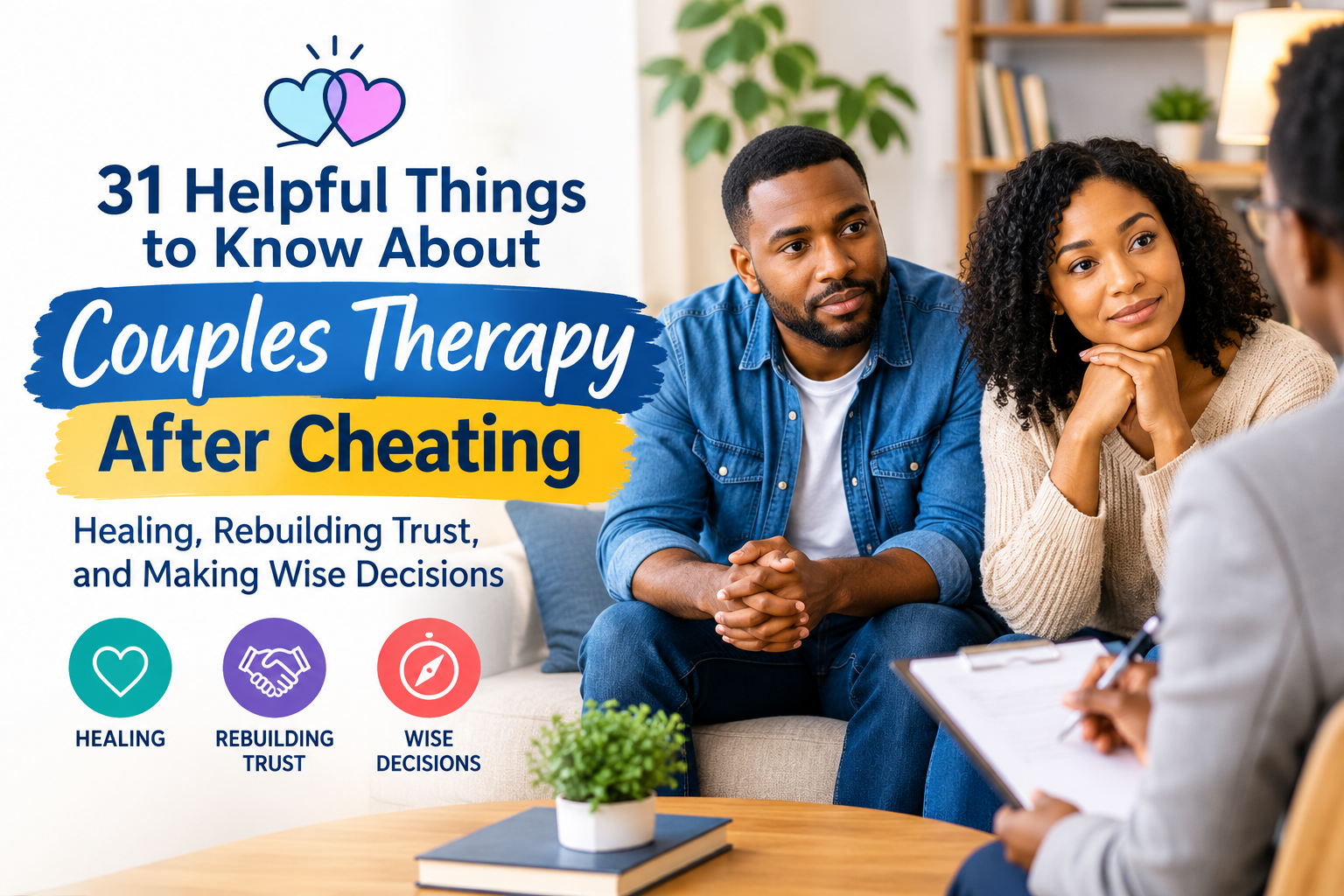
Discovering that a partner has cheated can be deeply painful. It can bring shock, anger, sadness, confusion, insecurity, and difficult questions about the future of the relationship. Some couples decide to separate, while others choose to work toward rebuilding their relationship.
Couples therapy after cheating can provide a structured environment for addressing what happened, understanding the damage caused, rebuilding communication, and deciding whether the relationship can move forward.
Therapy cannot erase betrayal, and it cannot guarantee reconciliation. Instead, it can help both partners understand what happened, establish healthier boundaries, process emotions, and make informed decisions about the future.
This guide explains what couples therapy for cheating may involve, when it can help, what both partners need to contribute, and what realistic healing can look like.
What Is Couples Therapy After Cheating?
Couples therapy after infidelity is professional relationship counseling focused on helping partners address the impact of an affair or other form of betrayal.
Depending on the situation, therapy may address:
- What happened and how it affected each partner.
- Broken trust.
- Communication problems.
- Emotional pain and anger.
- Accountability.
- Boundaries.
- Rebuilding emotional safety.
- Sexual and emotional intimacy.
- Repeated conflict.
- Individual needs within the relationship.
- Whether reconciliation is realistic.
- Whether separation may be healthier.
The purpose is not necessarily to convince a couple to stay together. A qualified therapist can help partners make thoughtful decisions based on their circumstances.
31 Important Things to Know About Couples Therapy After Cheating
1. Therapy Cannot Undo the Betrayal
One of the most important realities is that counseling cannot make the affair disappear.
The goal is not to pretend nothing happened. Instead, therapy can help the couple understand the consequences of the betrayal and determine how to respond to them.
Healing usually begins when both partners can acknowledge the seriousness of what happened.
2. The Unfaithful Partner Must Take Responsibility
Rebuilding trust becomes extremely difficult when the person who cheated refuses to acknowledge responsibility.
A healthier process involves taking responsibility without continually blaming the betrayed partner for the decision to be unfaithful.
Relationship problems may have existed before the affair, but relationship problems do not automatically excuse cheating.
Therapy can help distinguish between relationship problems that need attention and personal responsibility for the decision to betray trust.
3. The Betrayed Partner Needs Space to Process Emotions
After discovering infidelity, emotions can change rapidly.
One day a person may want to repair the relationship. The next day they may feel angry, doubtful, or uncertain.
That does not necessarily mean therapy is failing.
Betrayal can disrupt a person’s sense of security, so emotional processing may take time.
4. Trust Is Rebuilt Through Consistency
Trust rarely returns because of one apology or one counseling session.
It is usually rebuilt through repeated experiences of honesty, reliability, transparency, and responsible behavior.
Promises can matter, but consistent behavior carries greater weight over time.
5. The Affair Must Usually End if Reconciliation Is the Goal
If a couple chooses to attempt reconciliation, continuing an affair or maintaining a secret romantic relationship with another person makes rebuilding trust substantially more difficult.
A therapist can help couples establish appropriate boundaries around outside relationships.
6. Honesty Matters
A relationship cannot rebuild genuine trust while significant deception continues.
However, conversations about the affair can be emotionally intense. A qualified therapist can help couples discuss difficult facts in a structured way rather than turning every conversation into an uncontrolled confrontation.
7. Couples Therapy Is Not Individual Therapy
Couples therapy focuses primarily on the relationship.
However, one or both partners may also benefit from individual counseling, particularly when they are dealing with intense emotions, personal history, compulsive behaviors, grief, anxiety, or other individual concerns.
The appropriate combination depends on the circumstances.
8. Cheating Is Not Always a Sign That the Relationship Must End
Infidelity can cause serious damage, but it does not automatically determine the final outcome.
Some couples eventually rebuild their relationship, while others conclude that separation is healthier.
There is no universal answer.
The important question is whether both people are willing and able to create the conditions necessary for a healthier relationship.
9. Forgiveness Is Not the Same as Trust
A person can decide to work toward forgiveness while still having difficulty trusting their partner.
Forgiveness does not require pretending the betrayal was acceptable.
Likewise, rebuilding trust requires evidence of changed behavior rather than simply demanding that the betrayed partner “move on.”
10. Apologies Need to Be Meaningful
A meaningful apology generally involves acknowledging the harm caused rather than minimizing it.
Statements such as “I am sorry you feel hurt” can sound very different from taking responsibility for one’s own actions.
Therapy can help couples learn how to communicate remorse, responsibility, needs, and boundaries more effectively.
11. Blaming the Relationship Can Make Healing Harder
Relationship problems may have contributed to dissatisfaction, distance, or conflict.
Those issues deserve attention.
However, saying that relationship problems caused someone to cheat can shift responsibility away from the person who made the decision.
Healthy therapy can address both realities without confusing them.
12. Rebuilding Emotional Safety Is Important
After infidelity, ordinary events may suddenly trigger suspicion.
A late arrival, unexplained absence, or change in communication can create anxiety.
Couples therapy can help establish reasonable behaviors and communication patterns that make the relationship feel safer again.
13. Boundaries Become Especially Important
After cheating, couples may need to discuss boundaries involving:
- Communication with former romantic partners.
- Social media.
- Work relationships.
- Travel.
- Friendships.
- Privacy.
- Financial decisions.
- Time spent apart.
- Alcohol or other situations connected to previous problems.
Healthy boundaries should be discussed openly rather than imposed through intimidation or control.
14. Transparency Should Have a Purpose
Some couples temporarily increase transparency while rebuilding trust.
For example, partners might agree to communicate more clearly about schedules or important interactions.
However, transparency should not automatically become permanent surveillance or coercive control.
A therapist can help couples distinguish between reasonable trust-building measures and unhealthy monitoring.
15. Intimacy May Change After Infidelity
Cheating can affect emotional and physical intimacy.
One partner may want closeness while the other feels uncomfortable or withdrawn.
Neither partner should be pressured into intimacy as proof that the relationship is healing.
Emotional safety and consent remain important throughout the process.
16. Arguments About the Affair May Repeat
Couples sometimes revisit the same questions repeatedly.
The betrayed partner may need clarification or reassurance, while the unfaithful partner may feel frustrated by recurring discussions.
A therapist can help establish healthier ways to process the subject without allowing every disagreement to become a complete replay of the betrayal.
17. Healing Does Not Follow a Straight Line
A couple might make progress for several weeks and then experience a difficult setback.
A reminder, anniversary, social media post, or unexpected event can bring old emotions back.
Setbacks do not necessarily mean that all progress has disappeared.
They can become opportunities to identify unresolved issues and improve coping strategies.
18. The Couple Should Define What Reconciliation Means
“Staying together” can mean different things.
For one couple, reconciliation may mean rebuilding emotional intimacy. For another, it may involve restoring family stability while determining whether the relationship can eventually become healthy again.
Therapy can help partners define concrete goals rather than relying on vague promises.
19. The Unfaithful Partner May Need Individual Accountability
Sometimes infidelity involves personal patterns that need attention beyond the relationship.
These may include poor boundaries, dishonesty, impulsive decisions, difficulty handling conflict, or unhealthy relationship patterns.
Individual therapy can sometimes complement couples counseling.
20. The Betrayed Partner Does Not Have to Decide Immediately
A person who discovers cheating may feel pressured to make an immediate decision about divorce, reconciliation, or separation.
In many circumstances, taking reasonable time to process the situation can be helpful.
A therapist can help the person evaluate options without making a decision purely from shock or pressure.
21. Children Should Not Be Used as Messengers
If children are involved, parents should avoid making them responsible for communicating between adults.
Children can be affected by parental conflict even when they do not know the details.
Parents should consider age-appropriate communication and protect children from unnecessary adult relationship disputes.
22. Couples Therapy Should Not Become a Blame Competition
Therapy is most productive when both people are willing to examine their own behavior.
The person who cheated needs to address the betrayal.
The other partner may also need to examine their own communication, boundaries, expectations, or behaviors.
However, self-reflection should never be confused with taking responsibility for someone else’s decision to cheat.
23. The Therapist Should Remain Neutral About Reconciliation
A qualified couples therapist should generally help partners explore their options rather than forcing them to stay together or separate.
The goal is to create a safer and more constructive environment for decision-making.
24. Safety Comes First
If a relationship involves threats, physical violence, coercive control, stalking, intimidation, or fear of serious harm, ordinary couples therapy may not be the appropriate first step.
Safety planning and specialized professional support may be more appropriate.
No one should be pressured to participate in joint counseling when doing so creates significant danger.
25. Healing Requires More Than Saying “I Forgive You”
Forgiveness can be meaningful, but rebuilding a relationship also requires practical change.
Couples may need to improve:
- Communication.
- Conflict resolution.
- Boundaries.
- Emotional connection.
- Honesty.
- Responsibility.
- Time together.
- Individual habits.
Forgiveness without meaningful change can leave underlying problems unresolved.
26. Trust Can Be Rebuilt Without Becoming Perfect
A healthy relationship does not require absolute certainty about every action a partner takes.
The goal is not to create a relationship based on permanent suspicion.
Instead, partners can work toward a relationship where honesty, communication, reliability, and healthy boundaries become normal.
27. The Couple Needs to Identify Why the Relationship Broke Down
Understanding the circumstances surrounding infidelity can be useful.
This does not mean excusing cheating.
Instead, therapy may explore questions such as:
- Were there long-term communication problems?
- Were boundaries unclear?
- Were conflicts avoided?
- Was emotional intimacy neglected?
- Were individual issues left untreated?
- How did each partner respond to relationship dissatisfaction?
Understanding contributing factors can help prevent repeating unhealthy patterns.
28. Reconciliation Requires Two Willing People
One person cannot rebuild a relationship alone.
The betrayed partner cannot restore trust by themselves, and the unfaithful partner cannot demand forgiveness on a particular schedule.
Both people need to participate in the rebuilding process if reconciliation is the goal.
29. Separation Can Also Be Discussed in Therapy
Couples therapy does not have to mean staying together.
Sometimes counseling helps partners determine that ending the relationship is the healthier option.
Therapy can provide a structured environment for discussing separation, communication, boundaries, and family responsibilities.
30. Progress Should Be Measured by Behavior
Instead of asking only, “Do I feel better yet?” couples can look at practical signs of progress.
For example:
- Are conversations becoming more respectful?
- Is honesty increasing?
- Are agreed boundaries being respected?
- Are conflicts being handled differently?
- Is emotional safety improving?
- Is responsibility being demonstrated consistently?
These behaviors can provide more useful information than promises alone.
31. Healing Requires Patience, Honesty, and Consistent Effort
Recovering from infidelity is rarely a quick process.
There may be painful conversations, difficult decisions, unexpected emotions, and periods of uncertainty.
A couple attempting reconciliation should focus on consistent progress rather than demanding instant restoration of trust.
How Couples Therapy Can Help After Cheating
A therapist may help a couple work through several stages.
Stage 1: Stabilizing the Relationship
The immediate goal may be reducing destructive conflict and creating enough emotional safety for productive conversations.
Stage 2: Understanding What Happened
The couple can begin exploring the circumstances surrounding the infidelity while maintaining appropriate boundaries around difficult discussions.
Stage 3: Taking Responsibility
The partner who cheated may need to demonstrate accountability and address behaviors that contributed to the betrayal.
Stage 4: Rebuilding Trust
This can involve consistent honesty, reliability, communication, boundaries, and transparency agreed upon by both partners.
Stage 5: Addressing Underlying Problems
The couple can work on communication, emotional intimacy, conflict resolution, expectations, and other relationship issues.
Stage 6: Deciding the Future
Ultimately, the couple must determine whether reconciliation, separation, or another path is appropriate.
Questions to Ask a Couples Therapist About Infidelity
Before beginning therapy, couples may want to ask:
- Do you regularly work with couples recovering from infidelity?
- How do you structure the early sessions?
- How do you handle situations where one partner is not ready to reconcile?
- How do you approach trust rebuilding?
- Do you recommend individual therapy alongside couples therapy?
- How do you handle ongoing conflict?
- What role do boundaries and transparency play in treatment?
- How do you protect each person’s emotional safety during difficult conversations?
- How do you work with couples who are considering separation?
- What should we realistically expect from the therapy process?
What the Partner Who Cheated Can Do
If reconciliation is the goal, the unfaithful partner can begin by focusing on responsibility rather than demanding quick forgiveness.
Helpful steps may include:
- Acknowledge the harm.
- Stop ongoing deception.
- Respect reasonable boundaries.
- Answer appropriate questions honestly.
- Avoid blaming the betrayed partner for the decision to cheat.
- Attend therapy consistently.
- Examine personal patterns that contributed to the behavior.
- Demonstrate change through actions.
- Be patient with the healing process.
What the Betrayed Partner Can Do
The betrayed partner also has choices and responsibilities during recovery.
They may:
- Express feelings honestly.
- Establish reasonable boundaries.
- Ask for clarification when appropriate.
- Avoid making decisions solely from immediate emotional pressure.
- Seek individual support when needed.
- Pay attention to behavior rather than promises alone.
- Decide what conditions would be necessary for rebuilding trust.
- Give themselves permission to determine what they can and cannot accept.
None of these steps require the betrayed partner to remain in the relationship.
What Not to Do After Cheating
Certain responses can make an already painful situation worse.
Do Not Pretend Nothing Happened
Ignoring the betrayal rarely resolves the underlying trust problem.
Do Not Use Revenge as a Solution
Retaliation may create additional damage without repairing the relationship.
Do Not Force Immediate Forgiveness
Healing cannot be placed on an artificial deadline.
Do Not Use Children as Weapons
Children should not be manipulated to punish the other parent.
Do Not Ignore Safety Concerns
If there is abuse, intimidation, or fear of violence, prioritize safety and specialized support.
Do Not Expect One Conversation to Fix Everything
Rebuilding trust usually requires consistent behavior over time.
How Long Does Couples Therapy Take After Cheating?
There is no universal timeline.
The length of therapy can depend on factors such as:
- How long the infidelity lasted.
- Whether the affair has ended.
- Whether deception is continuing.
- The couple’s communication patterns.
- The willingness of both partners to participate.
- Whether there are additional relationship problems.
- Whether individual counseling is also needed.
- Whether the couple is attempting reconciliation or considering separation.
Some couples may benefit from a relatively short period of structured counseling, while others may need longer-term support.
The quality and consistency of the work generally matter more than trying to reach a specific deadline.
Can a Relationship Survive Cheating?
Yes, some relationships survive infidelity, but survival is not guaranteed.
A couple’s outcome can depend on many factors, including whether the cheating has stopped, whether responsibility is accepted, whether both people genuinely want to work on the relationship, and whether healthier patterns can be established.
The goal should not simply be to return to the relationship exactly as it was before.
In many cases, successful reconciliation requires building a different and healthier relationship with clearer communication and stronger boundaries.
When Couples Therapy May Not Be Appropriate
Couples counseling may need to be reconsidered or supplemented with other professional support when there is:
- Ongoing physical violence.
- Serious threats.
- Coercive control.
- Fear of retaliation.
- Stalking.
- Severe intimidation.
- Active substance-related instability that makes sessions unsafe.
- Continued deception that prevents meaningful participation.
If you or someone else is in immediate danger, contact local emergency services or an appropriate domestic-violence support organization.
Frequently Asked Questions About Couples Therapy and Cheating
Is couples therapy worth it after cheating?
It can be helpful for couples who genuinely want to understand what happened and determine whether rebuilding the relationship is possible. It can also help couples make a healthier decision about separation when reconciliation is not appropriate.
Should you go to couples therapy if your partner cheated?
Couples therapy can be considered if both people can participate safely and are willing to address the betrayal honestly. Individual counseling may also be valuable, particularly for the betrayed partner or the person who cheated.
How do you rebuild trust after cheating?
Trust is generally rebuilt through consistent honesty, accountability, reliable behavior, clear boundaries, respectful communication, and time. Promises alone are usually insufficient.
Can therapy make someone stop cheating?
Therapy cannot guarantee that another person will change. A person who wants to change must take responsibility for their choices and demonstrate that change through consistent behavior.
Should I forgive my partner for cheating?
Forgiveness is a personal decision and should not be forced. You can work toward healing without immediately forgiving, and forgiveness does not necessarily mean remaining in the relationship.
Does cheating always mean the relationship is over?
No. Some couples rebuild after infidelity, while others decide to separate. The appropriate decision depends on the specific circumstances, safety, willingness to change, and needs of the people involved.
Conclusion
Cheating can deeply damage a relationship, but it does not mean that every couple must make the same decision about the future. Some partners choose to rebuild their relationship, while others discover that separation is healthier. Couples therapy can provide a structured place to understand the betrayal, process painful emotions, rebuild communication, establish boundaries, and make an informed decision about what comes next.
If reconciliation is the goal, it usually requires more than an apology. The partner who cheated must take responsibility, demonstrate consistent change, and respect the healing process. The betrayed partner deserves space to process what happened, establish boundaries, and decide what they need to feel safe and respected.
Most importantly, healing should not be rushed. Trust is rebuilt through repeated actions, honesty, accountability, patience, and meaningful change.
Whether the ultimate outcome is reconciliation or separation, professional support can help both people move toward a healthier future with greater clarity and dignity.