Knowing the books of the Bible in order makes Bible reading, study, memorization, and finding Scripture much easier.
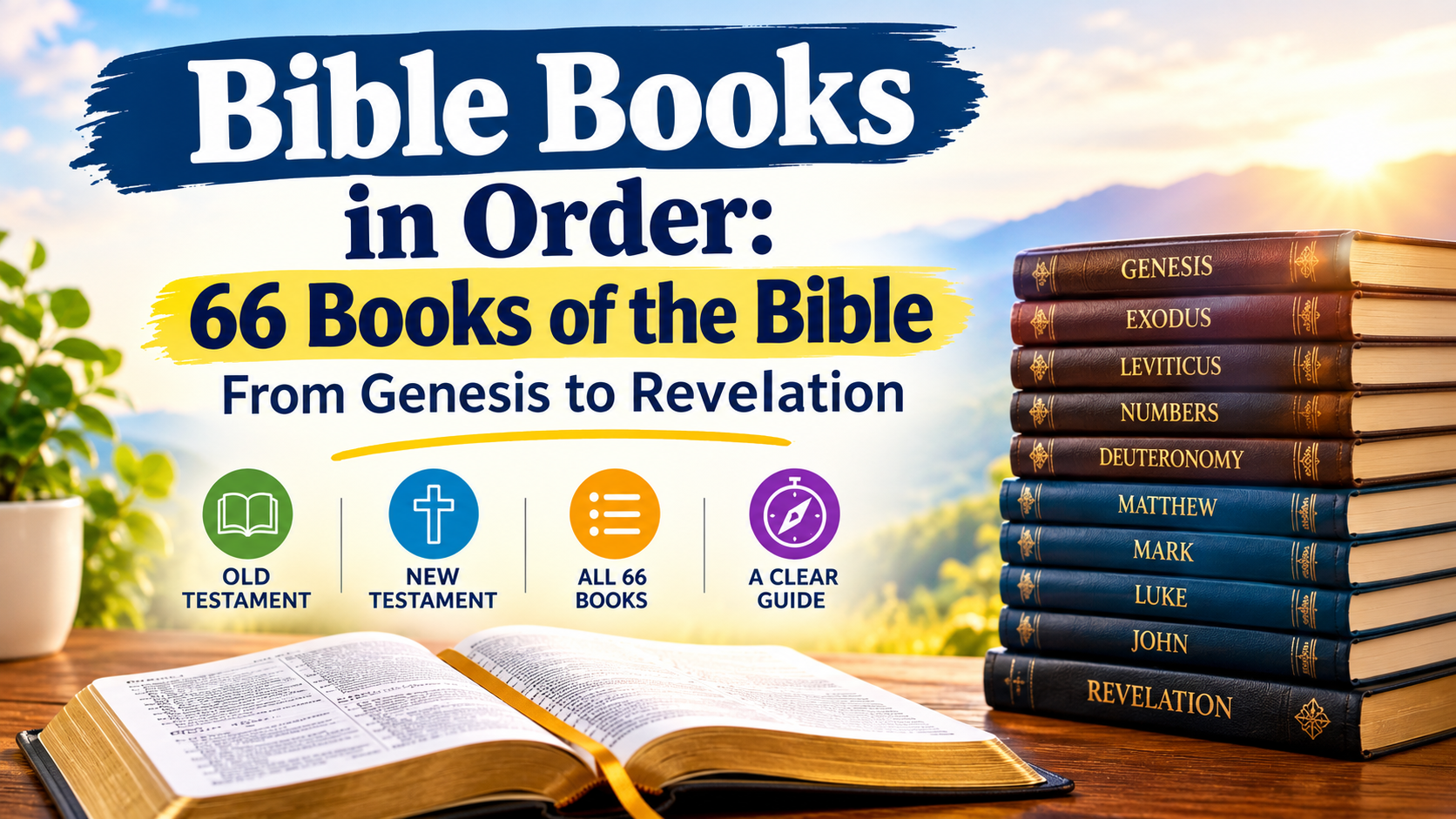
The Bible contains 66 books in the standard Protestant canon: 39 books in the Old Testament and 27 books in the New Testament. These books were written by different authors across many centuries, yet together they tell the unfolding story of God’s relationship with humanity, His covenant promises, redemption, and salvation through Jesus Christ.
If you sometimes remember a Bible verse but struggle to find the book, or you want to become more confident navigating Scripture, learning the books in order is a simple but valuable skill.
This guide lists all 66 books of the Bible in order, explains how they are grouped, and provides practical ways to memorize them.
The 66 Books of the Bible in Order
Here is the complete list of the books of the Bible from Genesis to Revelation.
Old Testament: 39 Books
The Old Testament contains 39 books.
The Law — 5 Books
- Genesis
- Exodus
- Leviticus
- Numbers
- Deuteronomy
History — 12 Books
- Joshua
- Judges
- Ruth
- 1 Samuel
- 2 Samuel
- 1 Kings
- 2 Kings
- 1 Chronicles
- 2 Chronicles
- Ezra
- Nehemiah
- Esther
Poetry and Wisdom — 5 Books
- Job
- Psalms
- Proverbs
- Ecclesiastes
- Song of Solomon
Major Prophets — 5 Books
- Isaiah
- Jeremiah
- Lamentations
- Ezekiel
- Daniel
Minor Prophets — 12 Books
- Hosea
- Joel
- Amos
- Obadiah
- Jonah
- Micah
- Nahum
- Habakkuk
- Zephaniah
- Haggai
- Zechariah
- Malachi
New Testament: 27 Books
The New Testament contains 27 books.
The Gospels — 4 Books
- Matthew
- Mark
- Luke
- John
History — 1 Book
- Acts
Paul’s Letters — 13 Books
- Romans
- 1 Corinthians
- 2 Corinthians
- Galatians
- Ephesians
- Philippians
- Colossians
- 1 Thessalonians
- 2 Thessalonians
- 1 Timothy
- 2 Timothy
- Titus
- Philemon
General Letters — 8 Books
- Hebrews
- James
- 1 Peter
- 2 Peter
- 1 John
- 2 John
- 3 John
- Jude
Prophecy — 1 Book
- Revelation
Complete Bible Books List in One Sequence
If you want to memorize the books without their categories, here they are in one continuous sequence:
Genesis, Exodus, Leviticus, Numbers, Deuteronomy, Joshua, Judges, Ruth, 1 Samuel, 2 Samuel, 1 Kings, 2 Kings, 1 Chronicles, 2 Chronicles, Ezra, Nehemiah, Esther, Job, Psalms, Proverbs, Ecclesiastes, Song of Solomon, Isaiah, Jeremiah, Lamentations, Ezekiel, Daniel, Hosea, Joel, Amos, Obadiah, Jonah, Micah, Nahum, Habakkuk, Zephaniah, Haggai, Zechariah, Malachi, Matthew, Mark, Luke, John, Acts, Romans, 1 Corinthians, 2 Corinthians, Galatians, Ephesians, Philippians, Colossians, 1 Thessalonians, 2 Thessalonians, 1 Timothy, 2 Timothy, Titus, Philemon, Hebrews, James, 1 Peter, 2 Peter, 1 John, 2 John, 3 John, Jude, Revelation.
Understanding the Order of the Bible
The order of the Bible is not simply a chronological timeline.
For example, the Old Testament places the books of the prophets toward the end, but many of the prophetic books describe events that occurred during periods covered by the historical books.
Similarly, the New Testament begins with the four Gospels, followed by Acts and the letters.
The arrangement helps organize the biblical library by literary type and traditional structure.
Understanding these groupings makes the complete list much easier to remember.
The 5 Books of the Law
The first five books are traditionally called the Pentateuch, meaning the five books.
They are:
- Genesis
- Exodus
- Leviticus
- Numbers
- Deuteronomy
These books establish foundational biblical themes including creation, humanity’s fall, God’s covenant, Abraham and his descendants, Israel’s deliverance from Egypt, the Law, and Israel’s journey toward the Promised Land.
Genesis
Genesis introduces creation, humanity, the fall, the flood, the nations, Abraham, Isaac, Jacob, and Joseph.
Exodus
Exodus tells the story of Israel’s deliverance from Egypt and includes the giving of the Law and the construction of the tabernacle.
Leviticus
Leviticus contains laws and instructions concerning worship, sacrifices, holiness, priests, and Israel’s relationship with God.
Numbers
Numbers follows Israel through its wilderness journey and records significant events involving the nation’s rebellion, testing, and preparation for entering Canaan.
Deuteronomy
Deuteronomy records Moses’ final instructions to Israel before they entered the Promised Land.
The 12 Historical Books
The historical books continue the story of Israel after the Pentateuch.
They are:
- Joshua
- Judges
- Ruth
- 1 Samuel
- 2 Samuel
- 1 Kings
- 2 Kings
- 1 Chronicles
- 2 Chronicles
- Ezra
- Nehemiah
- Esther
These books cover major periods involving Israel’s settlement in the Promised Land, the judges, the monarchy, the division of the kingdom, exile, return, and restoration.
They include important biblical figures such as Joshua, Deborah, Samson, Samuel, Saul, David, Solomon, Elijah, Elisha, Ezra, Nehemiah, and Esther.
The 5 Books of Poetry and Wisdom
The Bible’s wisdom and poetry books are:
- Job
- Psalms
- Proverbs
- Ecclesiastes
- Song of Solomon
These books explore suffering, worship, wisdom, relationships, work, purpose, love, and the meaning of life.
Job
Job explores suffering, faith, human limitations, and God’s sovereignty.
Psalms
Psalms contains prayers, songs, worship, lament, thanksgiving, confession, and expressions of trust in God.
Proverbs
Proverbs provides practical wisdom concerning speech, work, relationships, money, discipline, morality, and the fear of the Lord.
Ecclesiastes
Ecclesiastes examines the meaning of life and the limitations of pursuing fulfillment through earthly achievements.
Song of Solomon
Song of Solomon celebrates love and marital affection through poetic language.
The 5 Major Prophets
The Major Prophets are:
- Isaiah
- Jeremiah
- Lamentations
- Ezekiel
- Daniel
The term Major Prophets refers primarily to the length and scope of these books, not to greater spiritual importance.
Isaiah
Isaiah contains messages concerning judgment, repentance, God’s holiness, hope, restoration, and the coming Messiah.
Jeremiah
Jeremiah records prophetic warnings to Judah, calls for repentance, and promises concerning restoration and a new covenant.
Lamentations
Lamentations expresses grief over Jerusalem’s destruction while continuing to recognize God’s mercy.
Ezekiel
Ezekiel contains visions and messages concerning judgment, restoration, God’s glory, and Israel’s future.
Daniel
Daniel combines historical narratives and prophetic visions and emphasizes God’s sovereignty over earthly kingdoms.
The 12 Minor Prophets
The Minor Prophets are the final 12 books of the Old Testament:
- Hosea
- Joel
- Amos
- Obadiah
- Jonah
- Micah
- Nahum
- Habakkuk
- Zephaniah
- Haggai
- Zechariah
- Malachi
They are called “Minor Prophets” because their books are generally shorter than the Major Prophets.
They are not less important.
Their messages address themes such as repentance, justice, judgment, God’s faithfulness, restoration, and hope.
The 4 Gospels
The New Testament begins with four accounts of Jesus’ life and ministry:
- Matthew
- Mark
- Luke
- John
These are called the Gospels.
Each presents the story of Jesus from its own perspective while proclaiming His life, teachings, death, and resurrection.
Matthew
Matthew emphasizes Jesus as the promised Messiah and connects His ministry with Old Testament prophecy.
Mark
Mark presents a fast-moving account of Jesus’ ministry, emphasizing His actions, authority, suffering, death, and resurrection.
Luke
Luke provides a detailed account of Jesus’ life and emphasizes God’s salvation, compassion, and the inclusion of people from different backgrounds.
John
John presents Jesus’ identity and mission with a strong emphasis on His divine Sonship and belief in Him for eternal life.
Acts: The History of the Early Church
Acts is the only historical book in the New Testament after the Gospels.
It continues the story after Jesus’ resurrection and ascension.
Acts describes the coming of the Holy Spirit, the growth of the early Christian community, the preaching of the apostles, and the spread of the gospel from Jerusalem outward.
The book includes important figures such as Peter and Paul.
Paul’s 13 Letters
The next major group consists of letters traditionally attributed to the apostle Paul:
- Romans
- 1 Corinthians
- 2 Corinthians
- Galatians
- Ephesians
- Philippians
- Colossians
- 1 Thessalonians
- 2 Thessalonians
- 1 Timothy
- 2 Timothy
- Titus
- Philemon
These letters address Christian doctrine, church life, spiritual growth, Christian conduct, leadership, relationships, salvation, and perseverance.
A Helpful Way to Remember Paul’s Letters
The first nine letters are commonly associated with churches:
Romans → Corinthians → Galatians → Ephesians → Philippians → Colossians → Thessalonians
The final four are commonly associated with individuals:
Timothy → Timothy → Titus → Philemon
This gives you a useful mental structure:
Churches first, individuals afterward.
The 8 General Letters
After Paul’s letters come the General Letters:
- Hebrews
- James
- 1 Peter
- 2 Peter
- 1 John
- 2 John
- 3 John
- Jude
These letters are traditionally grouped separately from Paul’s letters because they are associated with other New Testament writers or, in the case of Hebrews, have an uncertain authorship.
They address subjects including faith, perseverance, Christian conduct, suffering, love, false teaching, and spiritual maturity.
Revelation: The Final Book of the Bible
The Bible ends with Revelation.
Revelation contains apocalyptic visions concerning God’s ultimate purposes, the victory of Christ, judgment, and the final renewal described through the imagery of a new heaven and new earth.
Revelation is the final book in the standard Protestant Bible.
Its position at the end provides a powerful conclusion to the biblical story of creation, fall, redemption, judgment, and restoration.
How Many Books Are in the Bible?
The standard Protestant Bible contains:
66 books
- 39 Old Testament books
- 27 New Testament books
Together:
39 + 27 = 66 books
The Bible is therefore a collection of many individual books rather than one single book written at one time.
How Many Chapters Are in the Bible?
The Bible contains 1,189 chapters in the standard chapter division:
- 929 chapters in the Old Testament
- 260 chapters in the New Testament
Chapter numbers were added later as a way to make Scripture easier to reference.
The original biblical manuscripts did not contain the modern chapter and verse numbering system.
How Many Books Are in the Old Testament?
There are 39 books in the Old Testament in the standard Protestant Bible.
They are divided into:
- 5 Law
- 12 History
- 5 Poetry and Wisdom
- 5 Major Prophets
- 12 Minor Prophets
Total: 39 books
How Many Books Are in the New Testament?
There are 27 books in the New Testament.
They are commonly grouped as:
- 4 Gospels
- 1 history book
- 13 Pauline letters
- 8 General Letters
- 1 prophecy
Total: 27 books
How to Memorize the Books of the Bible in Order
Learning all 66 books may initially seem difficult, but breaking them into smaller groups makes the process much easier.
Start With the Five Books of the Law
Memorize:
Genesis → Exodus → Leviticus → Numbers → Deuteronomy
These are the foundation.
Learn the Historical Books as a Sequence
Practice:
Joshua → Judges → Ruth → 1 Samuel → 2 Samuel → 1 Kings → 2 Kings → 1 Chronicles → 2 Chronicles → Ezra → Nehemiah → Esther
Repeat the sequence until it becomes familiar.
Memorize the Wisdom Books
Remember:
Job → Psalms → Proverbs → Ecclesiastes → Song of Solomon
This is one of the easier groups because each book is distinctive.
Learn the Prophets in Two Groups
Major Prophets:
Isaiah → Jeremiah → Lamentations → Ezekiel → Daniel
Minor Prophets:
Hosea → Joel → Amos → Obadiah → Jonah → Micah → Nahum → Habakkuk → Zephaniah → Haggai → Zechariah → Malachi
Breaking the 17 prophetic books into two groups makes memorization more manageable.
Memorize the Four Gospels
Matthew → Mark → Luke → John
These four should become automatic because they appear at the beginning of the New Testament.
Remember Acts Before the Letters
After John comes:
Acts
Then the letters begin with Romans.
Learn Paul’s Letters in Sequence
Practice:
Romans → 1 Corinthians → 2 Corinthians → Galatians → Ephesians → Philippians → Colossians → 1 Thessalonians → 2 Thessalonians → 1 Timothy → 2 Timothy → Titus → Philemon
Finish With the General Letters and Revelation
The final sequence is:
Hebrews → James → 1 Peter → 2 Peter → 1 John → 2 John → 3 John → Jude → Revelation
Once you know this final section, you know the entire New Testament order.
A Simple 7-Part Memory Pattern
One of the easiest ways to remember the Bible’s overall structure is to divide it into seven broad sections:
- Law
- History
- Poetry
- Prophets
- Gospels
- Letters
- Revelation
This gives you a mental map rather than forcing yourself to memorize 66 unrelated names.
Why Should You Learn the Books of the Bible in Order?
Knowing the Bible’s order has several practical benefits.
It makes Bible study easier
You can move through Scripture more confidently without constantly searching for where books are located.
It helps you find verses faster
When someone says, “Turn to Romans 8,” you will know roughly where Romans is located.
It improves Bible literacy
Understanding the structure of Scripture helps you recognize how different books fit into the larger biblical story.
It helps with church and Bible study
Knowing the order makes it easier to follow sermons, Bible studies, quizzes, and group discussions.
It makes personal Bible reading more organized
You can choose to read the Bible from Genesis to Revelation or study different sections according to your goals.
Bible Books in Order for Quick Reference
Old Testament
Genesis
Exodus
Leviticus
Numbers
Deuteronomy
Joshua
Judges
Ruth
1 Samuel
2 Samuel
1 Kings
2 Kings
1 Chronicles
2 Chronicles
Ezra
Nehemiah
Esther
Job
Psalms
Proverbs
Ecclesiastes
Song of Solomon
Isaiah
Jeremiah
Lamentations
Ezekiel
Daniel
Hosea
Joel
Amos
Obadiah
Jonah
Micah
Nahum
Habakkuk
Zephaniah
Haggai
Zechariah
Malachi
New Testament
Matthew
Mark
Luke
John
Acts
Romans
1 Corinthians
2 Corinthians
Galatians
Ephesians
Philippians
Colossians
1 Thessalonians
2 Thessalonians
1 Timothy
2 Timothy
Titus
Philemon
Hebrews
James
1 Peter
2 Peter
1 John
2 John
3 John
Jude
Revelation
Are the Books of the Bible in Chronological Order?
Not exactly.
The Bible’s standard arrangement is primarily based on literary and traditional groupings rather than placing every book according to the exact historical date of the events described.
For example, some prophetic books describe events occurring during periods covered by the historical books.
This means that Bible order and chronological order are not always the same thing.
If you want to understand the historical development of biblical events, a chronological Bible-reading plan can be helpful.
Why Are There Different Bible Canons?
When people compare different Christian Bibles, they may notice that not every tradition contains exactly the same number of books.
The 66-book Bible is the standard Protestant canon.
Catholic Bibles include additional books commonly called the Deuterocanonical books, while Eastern Orthodox traditions have somewhat different canonical collections.
Therefore, when someone asks for the “66 books of the Bible,” they are referring specifically to the standard Protestant Bible.
What Is the Shortest Book of the Bible?
The answer can depend on whether you measure by verses, words, or another method.
3 John is often identified as the shortest book of the Bible by word count in common English translations.
It contains only one chapter.
What Is the Longest Book of the Bible?
Psalms is the longest book of the Bible by number of chapters, containing 150 chapters.
Psalm 119 is the longest chapter in the Bible.
What Is the Last Book of the Bible?
The last book is Revelation.
It is also known as the Revelation of Jesus Christ.
The Bible therefore begins with Genesis and ends with Revelation.
Genesis opens with creation, while Revelation concludes with the biblical vision of God’s ultimate restoration.
Frequently Asked Questions About the Books of the Bible
How many books are in the Bible?
The standard Protestant Bible contains 66 books: 39 in the Old Testament and 27 in the New Testament.
What is the first book of the Bible?
Genesis is the first book of the Bible.
What is the last book of the Bible?
Revelation is the last book of the Bible.
What are the first five books of the Bible?
The first five books are Genesis, Exodus, Leviticus, Numbers, and Deuteronomy. Together they are commonly called the Pentateuch.
What are the four Gospels?
The four Gospels are Matthew, Mark, Luke, and John.
What book comes after Psalms?
Proverbs comes immediately after Psalms.
What book comes after Malachi?
Matthew comes after Malachi in the standard Protestant Bible.
What book comes before Revelation?
Jude comes immediately before Revelation.
What are the Major Prophets?
The five Major Prophets are Isaiah, Jeremiah, Lamentations, Ezekiel, and Daniel.
What are the Minor Prophets?
The 12 Minor Prophets are Hosea, Joel, Amos, Obadiah, Jonah, Micah, Nahum, Habakkuk, Zephaniah, Haggai, Zechariah, and Malachi.
Conclusion: Know the Order, Understand the Story
Learning the books of the Bible in order is more than memorizing a list of names.
It gives you a framework for navigating Scripture.
The 66 books move through a remarkable biblical story: creation, humanity’s fall, God’s covenant promises, Israel’s history, prophetic hope, the coming of Jesus Christ, His death and resurrection, the growth of the early church, the teaching of the apostles, and the ultimate hope of God’s kingdom and restoration.
Start small.
Learn the five books of the Law.
Then memorize the historical books.
Move to the wisdom books and prophets.
After that, learn the four Gospels, Acts, Paul’s letters, the General Letters, and Revelation.
You do not have to memorize all 66 books in one day.
Practice a few at a time, repeat them regularly, and use your Bible as you learn.
Eventually, Genesis to Revelation will become a familiar map that helps you study God’s Word with greater confidence, speed, and understanding.