Depression and anxiety can affect the way you think, feel, sleep, work, pray, and relate to other people. During difficult seasons, even simple tasks can feel exhausting, and the future may seem uncertain.
For Christians, Scripture can provide a place to turn when the heart feels overwhelmed. The Bible contains honest prayers from people who experienced fear, grief, loneliness, discouragement, and deep distress. Rather than ignoring emotional pain, Scripture points us toward God’s presence, comfort, wisdom, peace, and hope.
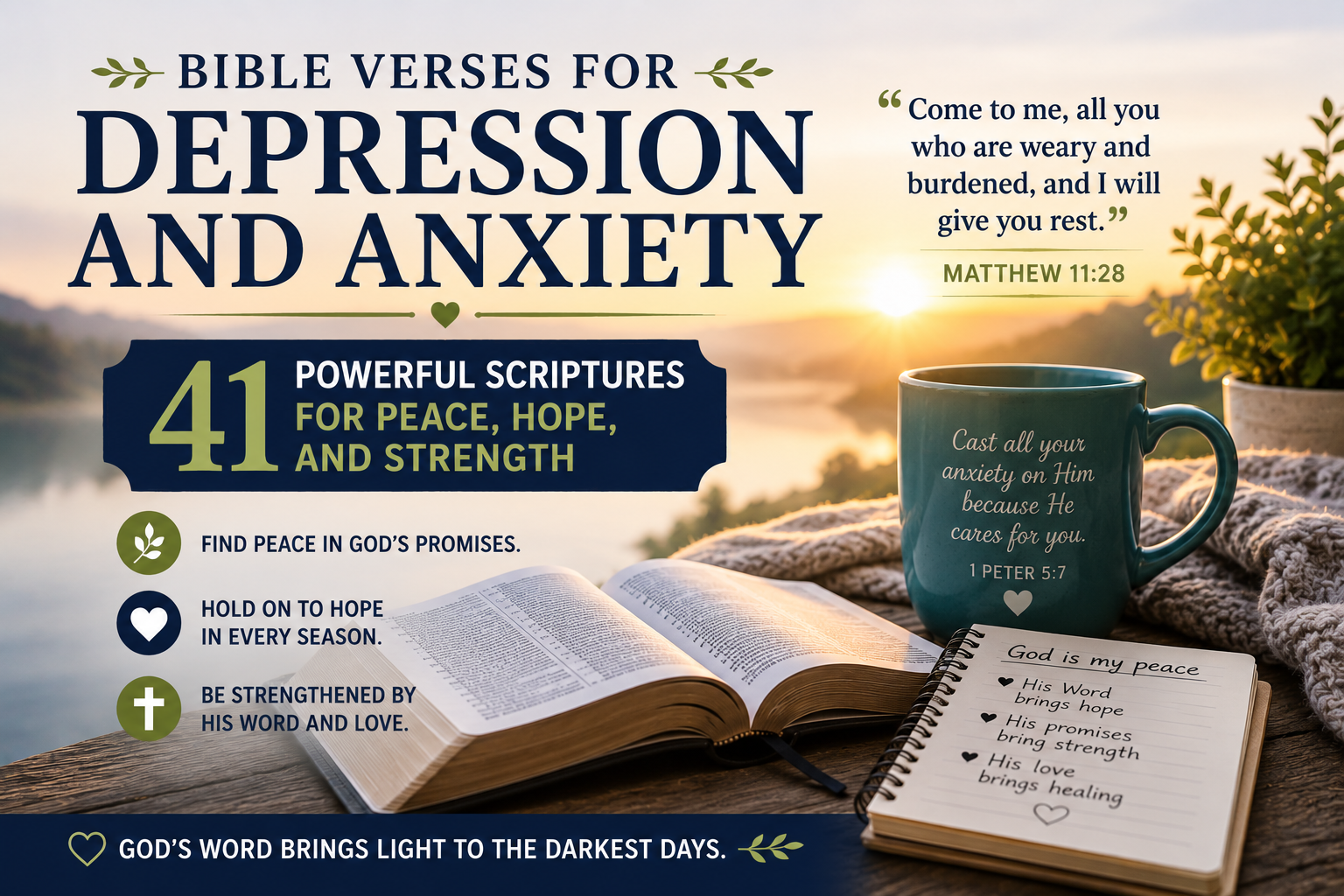
If you are searching for Bible verses for depression and anxiety, this collection of 41 Scriptures will help you find passages to read during difficult moments. You can use them for prayer, meditation, encouragement, journaling, personal Bible study, or to encourage someone who is struggling.
“Why art thou cast down, O my soul? and why art thou disquieted within me? hope thou in God.” — Psalm 42:11
Can Bible Verses Help With Depression and Anxiety?
Bible verses can offer spiritual encouragement, help redirect your thoughts toward God’s character, and give you words when you do not know how to pray.
However, Scripture should not be used to shame someone for experiencing depression or anxiety. These struggles can be complex and may require support beyond personal prayer.
You can pray, read Scripture, talk with trusted Christians, and seek professional mental-health care at the same time.
If you are in immediate danger, thinking about harming yourself, or unable to keep yourself safe, please contact local emergency services, go to the nearest emergency department, or tell someone you trust immediately.
The purpose of these verses is to give you biblical encouragement—not to suggest that reading a verse alone will automatically remove depression or anxiety.
41 Bible Verses for Depression and Anxiety
1. Psalm 34:18 — God Is Near the Brokenhearted
“The LORD is nigh unto them that are of a broken heart.”
When depression makes you feel isolated, Psalm 34:18 offers a beautiful reminder: God is near to people who are hurting.
You do not have to hide your pain from Him.
Prayer: “Lord, stay close to me in this difficult season and help me remember that I am not alone.”
2. Psalm 42:11 — Hope When Your Soul Is Downcast
“Why art thou cast down, O my soul? … hope thou in God.”
The writer of Psalm 42 openly acknowledges that his soul is discouraged.
This is important because biblical faith does not require pretending that everything is fine.
You can recognize your pain while still choosing to place your hope in God.
3. Philippians 4:6-7 — Bring Anxiety to God
“Be careful for nothing; but in every thing by prayer and supplication with thanksgiving let your requests be made known unto God.”
This is one of the most well-known Bible verses about anxiety.
Paul encourages believers to bring their concerns to God through prayer.
The passage points toward God’s peace—not necessarily as an instant removal of every problem, but as God’s presence guarding the heart and mind.
4. 1 Peter 5:7 — God Cares About Your Burdens
“Casting all your care upon him; for he careth for you.”
Sometimes anxiety becomes overwhelming because we try to carry everything alone.
Peter gives believers a simple invitation: give those cares to God.
The reason is deeply personal:
He cares for you.
5. Isaiah 41:10 — Do Not Be Afraid
“Fear thou not; for I am with thee.”
Anxiety often focuses on what might happen next.
Isaiah 41:10 redirects your attention to the One who is with you now.
God’s promise of presence can become an anchor when fear begins to dominate your thoughts.
6. Psalm 23:4 — God Is With You in the Valley
“Yea, though I walk through the valley of the shadow of death, I will fear no evil: for thou art with me.”
Psalm 23 does not deny that valleys exist.
Instead, it emphasizes the Shepherd’s presence within them.
If you are experiencing a difficult emotional season, remember that walking through a valley does not mean you have been abandoned.
7. Matthew 11:28 — Come to Jesus When You Are Weary
“Come unto me, all ye that labour and are heavy laden, and I will give you rest.”
Jesus invites weary and burdened people to come to Him.
This verse can be especially meaningful when emotional exhaustion has made life feel heavier than you can manage.
8. Psalm 46:1 — God Is Your Refuge and Strength
“God is our refuge and strength, a very present help in trouble.”
When everything feels unstable, God remains a refuge.
This verse does not promise an absence of trouble. Instead, it reminds believers where they can turn during trouble.
9. Psalm 55:22 — Give Your Burden to the Lord
“Cast thy burden upon the LORD, and he shall sustain thee.”
You may not be able to solve every problem today.
But you can bring today’s burden to God.
This verse encourages dependence on God’s sustaining strength.
10. Psalm 61:2 — When Your Heart Is Overwhelmed
“When my heart is overwhelmed: lead me to the rock that is higher than I.”
This may be one of the most relatable prayers for someone experiencing anxiety.
The psalmist does not deny being overwhelmed.
He asks God to lead him to a place of security.
11. John 14:27 — Jesus Gives Peace
“Peace I leave with you, my peace I give unto you.”
Jesus spoke these words to His disciples during a period of uncertainty.
His peace is not presented as depending on perfect circumstances.
For believers, Christ’s peace can become an anchor when circumstances are difficult.
12. Psalm 56:3 — When I Am Afraid, I Will Trust
“What time I am afraid, I will trust in thee.”
Notice David’s honesty.
He does not say, “If I am afraid.”
He says, “When I am afraid.”
Fear can happen. Faith gives us somewhere to turn when it does.
13. Isaiah 26:3 — A Mind Focused on God
“Thou wilt keep him in perfect peace, whose mind is stayed on thee.”
An anxious mind can repeatedly replay frightening possibilities.
This Scripture encourages believers to deliberately focus their thoughts on God.
It can be a useful verse for meditation during stressful moments.
14. Psalm 94:19 — When Thoughts Multiply
“In the multitude of my thoughts within me thy comforts delight my soul.”
This verse speaks directly to the experience of having many troubling thoughts.
Instead of condemning the struggling mind, the psalm points toward God’s comfort.
15. Psalm 121:1-2 — Where Does My Help Come From?
“My help cometh from the LORD, which made heaven and earth.”
When you feel helpless, this passage provides a simple question and answer.
Your circumstances may be beyond your control, but you can still turn toward God for help.
16. Psalm 91:1-2 — God Is a Place of Refuge
Psalm 91 describes God as a refuge, fortress, and shelter.
For someone struggling with fear, reading the entire chapter slowly can become a meaningful prayer of trust.
Rather than focusing only on what threatens you, Psalm 91 encourages you to remember who God is.
17. Romans 8:38-39 — Nothing Separates You From God’s Love
Paul teaches that nothing in creation can separate believers from the love of God in Christ.
Depression may tell you that you are forgotten.
Anxiety may tell you that everything is falling apart.
This passage reminds Christians that God’s love is stronger than their circumstances.
18. Lamentations 3:22-23 — New Mercies Every Morning
“It is of the LORD’S mercies that we are not consumed.”
Lamentations was written in a context of tremendous suffering.
Yet the writer remembers God’s mercy and faithfulness.
This is a powerful reminder that you do not have to solve your entire future today.
There is mercy for today.
19. Psalm 30:5 — Joy Can Come After Weeping
“Weeping may endure for a night, but joy cometh in the morning.”
This verse should not be used to minimize someone’s pain.
Its message is that sorrow does not have to be the final chapter.
20. Psalm 40:1-2 — God Can Lift You From the Pit
Psalm 40 describes waiting for God and being lifted from a pit.
The imagery is powerful for anyone who feels trapped in an emotional struggle.
The psalm reminds us that God can establish our steps again.
21. Isaiah 43:2 — God Is With You Through Deep Waters
“When thou passest through the waters, I will be with thee.”
God does not tell His people that they will never experience deep waters.
He promises His presence when they do.
That distinction matters.
You can be going through something difficult without being abandoned by God.
22. Joshua 1:9 — Courage for Difficult Days
“Be strong and of a good courage; be not afraid, neither be thou dismayed.”
Joshua faced a major transition and an uncertain future.
God reminded him that courage could be grounded in divine presence.
When anxiety tells you that you cannot face tomorrow, remember that you can take life one step at a time.
23. Deuteronomy 31:8 — God Goes Before You
“He will not fail thee, neither forsake thee.”
Uncertainty about the future can fuel anxiety.
This verse reminds believers that they do not walk into the unknown alone.
God goes before them.
24. Hebrews 13:5 — God Will Not Forsake You
“I will never leave thee, nor forsake thee.”
Feeling abandoned can intensify depression.
This promise points to God’s faithfulness and continuing presence.
Your feelings are real, but they do not determine whether God is present.
25. Romans 15:13 — The God of Hope
“Now the God of hope fill you with all joy and peace in believing.”
Paul describes God as the God of hope.
When hopelessness becomes part of your daily thinking, this verse gives you a biblical truth to meditate on.
Hope begins with God.
26. 2 Corinthians 4:8-9 — Pressed but Not Forsaken
Paul writes about being troubled, perplexed, persecuted, and struck down without being destroyed or abandoned.
This passage recognizes that believers can experience severe hardship.
It also emphasizes resilience through God’s grace.
27. 2 Corinthians 12:9 — God’s Grace in Weakness
“My grace is sufficient for thee: for my strength is made perfect in weakness.”
You do not have to pretend to be strong every moment.
This passage reminds believers that God’s grace meets them in weakness.
28. Psalm 147:3 — God Heals the Brokenhearted
“He healeth the broken in heart, and bindeth up their wounds.”
Emotional wounds matter.
This verse portrays God as compassionate toward those who are hurting.
Healing can take time, and receiving help from others can be part of that journey.
29. Psalm 31:24 — Let God Strengthen Your Heart
“Be of good courage, and he shall strengthen your heart.”
Courage does not mean that you never feel afraid.
Sometimes courage means continuing forward while trusting God.
30. Nahum 1:7 — God Is Good in Trouble
“The LORD is good, a strong hold in the day of trouble.”
This verse provides a simple truth to remember when circumstances are confusing:
God is good, even when life is difficult.
31. Psalm 27:1 — The Lord Is Your Light
“The LORD is my light and my salvation; whom shall I fear?”
Depression can make life feel dark.
Psalm 27 points toward God as light and salvation.
32. Psalm 73:26 — God Is the Strength of Your Heart
“My flesh and my heart faileth: but God is the strength of my heart.”
The psalmist acknowledges human weakness.
Sometimes the heart becomes exhausted.
The answer is not pretending otherwise but recognizing God’s strength.
33. Matthew 6:25-34 — Do Not Let Tomorrow Consume You
Jesus teaches His followers not to be consumed by worry about tomorrow.
He points them toward God’s care and encourages them to focus on the responsibilities of the present.
This passage is especially useful for people whose anxiety constantly jumps ahead to future possibilities.
34. Proverbs 3:5-6 — Trust God With Your Direction
“Trust in the LORD with all thine heart; and lean not unto thine own understanding.”
Anxiety often grows when we demand certainty about everything.
Proverbs 3:5-6 encourages us to trust God even when we do not understand the entire path.
35. Psalm 138:7 — God Preserves You in Trouble
The psalmist acknowledges walking through trouble while trusting God’s continued care.
The message is encouraging: difficult circumstances do not automatically mean that God has stopped working.
36. Psalm 62:5-6 — God Is Your Rock
Psalm 62 describes God as a rock, salvation, defense, and refuge.
When your emotions feel unstable, God’s character provides a firm foundation.
37. 3 John 1:2 — Prayer for Well-Being
The opening of 3 John includes a prayer expressing a desire for well-being.
While this passage should not be turned into a simplistic promise of perfect health, it demonstrates the biblical practice of caring about another person’s well-being.
38. Matthew 5:4 — Comfort for Those Who Mourn
“Blessed are they that mourn: for they shall be comforted.”
Jesus acknowledges mourning rather than telling people to hide it.
There is room in Christian faith for grief, tears, and the need for comfort.
39. Psalm 16:8 — Keep the Lord Before You
“I have set the LORD always before me.”
This verse presents a practice of intentionally keeping God at the center of one’s attention.
It can serve as a short prayer throughout the day.
40. Psalm 37:5 — Commit Your Way to God
“Commit thy way unto the LORD; trust also in him; and he shall bring it to pass.”
When you do not know what to do next, surrendering your path to God can become an act of faith.
41. Revelation 21:4 — A Future Without Sorrow
“And God shall wipe away all tears from their eyes.”
The Bible’s ultimate hope is not simply temporary emotional relief.
Revelation points toward God’s future restoration, where death, mourning, crying, and pain will no longer have the final word.
For Christians, this is a powerful reminder that present suffering is not the end of the story.
Bible Verses for Depression
If you are specifically looking for Bible verses for depression, begin with Scriptures that acknowledge emotional pain while pointing toward God’s presence and hope.
Some of the most relevant include:
- Psalm 34:18 — God is near the brokenhearted.
- Psalm 42:11 — Hope in God when your soul is discouraged.
- Psalm 40:1-2 — God can lift you from the pit.
- Psalm 73:26 — God is the strength of your heart.
- Psalm 147:3 — God cares about emotional wounds.
- Lamentations 3:22-23 — God’s mercies are new every morning.
- Romans 15:13 — God is the source of hope.
- Revelation 21:4 — God promises an ultimate end to sorrow.
Bible Verses for Anxiety
For anxiety and excessive worry, these passages are especially helpful:
Philippians 4:6-7
Bring your worries to God through prayer.
1 Peter 5:7
Give your cares to God because He cares for you.
Matthew 6:25-34
Jesus teaches about worry and God’s care.
Psalm 56:3
Trust God when fear arises.
Isaiah 41:10
Remember God’s presence when you are afraid.
Psalm 61:2
Ask God to lead you when your heart is overwhelmed.
Proverbs 3:5-6
Trust God when you do not understand what comes next.
Bible Verses for Depression and Anxiety at Night
Nighttime can be particularly challenging because distractions become fewer and anxious thoughts may become louder.
Try reading one or more of these passages before bed:
- Psalm 4:8
- Psalm 23
- Psalm 91
- Psalm 121
- Psalm 127:2
- Matthew 11:28
- Philippians 4:6-7
You can create a simple nighttime routine:
Read → breathe → pray → release your worries → rest.
For example:
“Lord, I cannot solve everything tonight. I give You my worries and ask You to give me peace for this moment. Help me rest in Your care.”
Bible Verses for When You Feel Hopeless
Hopelessness can make the future seem closed.
When that happens, focus on Scriptures that remind you that your present circumstances are not the entire story.
Romans 15:13
God is the God of hope.
Lamentations 3:22-23
God’s mercy is renewed.
Psalm 42:11
Hope can be placed in God.
Jeremiah 29:11
God speaks of hope and a future to His people in exile.
Revelation 21:4
God promises a future without sorrow and pain.
Biblical hope is not pretending that everything is easy.
It is trusting that God remains faithful even when the present is difficult.
Bible Verses for a Broken Heart
Depression and anxiety can sometimes accompany grief, rejection, relationship problems, or major loss.
These Scriptures may bring comfort:
- Psalm 34:18 — God is near the brokenhearted.
- Psalm 147:3 — God binds up wounds.
- Psalm 61:2 — God can lead you when your heart is overwhelmed.
- Matthew 5:4 — Those who mourn can receive comfort.
- Psalm 23 — God remains present in the valley.
Do not feel pressured to rush through grief.
Healing is often a process.
What Does the Bible Say About Depression?
The Bible does not use modern clinical terminology in the same way contemporary medicine does, but it contains many accounts of profound emotional distress.
David repeatedly wrote about fear, sorrow, loneliness, and a downcast soul.
Elijah experienced intense discouragement in 1 Kings 19.
Job experienced devastating loss and grief.
Jeremiah expressed deep sorrow in Lamentations.
These accounts remind us that God’s people can experience profound emotional suffering.
The Bible’s response is not simply, “Pretend you are happy.”
Instead, Scripture gives people language for:
- lament;
- prayer;
- fear;
- grief;
- hope;
- dependence on God;
- community;
- perseverance;
- and trust.
That makes Scripture especially valuable for honest conversations about emotional struggles.
Does Depression Mean Your Faith Is Weak?
No.
Experiencing depression or anxiety does not automatically mean that someone lacks faith.
The Bible contains faithful people who experienced intense emotional distress.
Faith does not mean that you never experience fear or sadness.
Faith can mean continuing to turn toward God while experiencing those emotions.
You can say:
“God, I am afraid, but I trust You.”
“God, I am hurting, but I believe You are near.”
“God, I do not understand this, but I need Your help.”
Honest prayer is still prayer.
How to Use Bible Verses When You Are Struggling
Reading Scripture can become more meaningful when you turn it into a practical routine.
1. Choose one verse
You do not need to read dozens of verses at once.
Choose one passage that speaks directly to what you are experiencing.
2. Read it slowly
Read the verse several times.
Ask yourself:
- What does this teach me about God?
- What does this reveal about my situation?
- What truth can I remember today?
3. Turn the Scripture into prayer
Using 1 Peter 5:7, you could pray:
“Father, I give You the worries I am carrying today. Thank You that You care for me. Help me trust You with the things I cannot control.”
4. Write the verse down
Put it on your phone, notebook, mirror, desk, or bedside table.
5. Memorize short verses
Verses such as Psalm 56:3 are short enough to repeat when anxiety begins:
“What time I am afraid, I will trust in thee.”
6. Talk to someone
Scripture encourages community.
Do not isolate yourself when you are struggling.
Talk with someone you trust.
7. Seek appropriate professional help
Prayer and professional support can exist together.
Getting help is not a failure of faith.
A Simple 7-Day Bible Reading Plan for Depression and Anxiety
If you want a structured way to begin, try this seven-day plan.
Day 1 — Psalm 34
Focus:
God is near the brokenhearted.
Day 2 — Psalm 42
Focus:
Hope when your soul is discouraged.
Day 3 — Philippians 4
Focus:
Prayer, thanksgiving, and peace.
Day 4 — Psalm 23
Focus:
God’s presence in difficult valleys.
Day 5 — Matthew 6:25-34
Focus:
Trusting God instead of being consumed by tomorrow.
Day 6 — Romans 8
Focus:
God’s love and lasting hope.
Day 7 — Psalm 91
Focus:
Finding refuge in God.
After reading each passage, spend a few minutes answering:
“What is God inviting me to trust Him with today?”
A Powerful Prayer for Depression and Anxiety
Heavenly Father,
I come before You with the thoughts, fears, sadness, and burdens that I am carrying.
You know what I cannot always explain to other people.
You know when my heart is overwhelmed and when my mind will not rest.
Lord, remind me that You are near.
When I feel discouraged, give me hope.
When I am anxious, help me surrender my worries to You.
When I feel weak, strengthen my heart.
When I feel alone, remind me of Your presence.
Give me wisdom to know when I need help and courage to reach out to people who can support me.
Surround me with people who will listen without judgment and encourage me with compassion.
Help me take one day at a time.
Give me grace for today rather than fear about everything that might happen tomorrow.
Thank You for Your mercy.
Thank You for Your love.
Thank You that my present struggle does not define my entire future.
Help me keep trusting You one step at a time.
In Jesus’ name, Amen.
When You Need More Than a Bible Verse
Bible verses can encourage your faith, but depression and anxiety sometimes require additional care.
Consider speaking with a qualified healthcare or mental-health professional if emotional symptoms are persistent, severe, or interfering with everyday life.
You may also benefit from talking with:
- a trusted family member;
- a close friend;
- a pastor or mature Christian;
- a counselor;
- a doctor;
- a licensed mental-health professional.
You do not have to choose between faith and treatment.
Prayer can be part of your support system while you receive appropriate care.
If you are thinking about suicide or self-harm, do not remain alone. Tell someone immediately and seek emergency or crisis support in your location.
Frequently Asked Questions
What is a good Bible verse for depression?
Psalm 34:18
is one of the most comforting Scriptures because it says that God is near to the brokenhearted.
Psalm 42:11 is another excellent choice because it openly acknowledges a discouraged soul while calling it to hope in God.
What is the best Bible verse for anxiety?
Philippians 4:6-7
is one of the clearest passages because it encourages believers to bring their worries to God through prayer and points toward God’s peace.
1 Peter 5:7 is also powerful because it reminds us that God cares for us.
What does the Bible say when you feel hopeless?
Scripture repeatedly points people toward hope in God. Romans 15:13, Psalm 42:11, Lamentations 3:22-23, and Revelation 21:4 are particularly encouraging passages.
What Psalm should I read when I feel depressed?
Start with Psalm 23, Psalm 34, Psalm 42, Psalm 46, Psalm 55, Psalm 61, Psalm 73, Psalm 91, or Psalm 147.
Choose a passage that reflects what you are experiencing and read it slowly.
What Bible verse helps with fear?
Psalm 56:3
is short and easy to memorize:
“What time I am afraid, I will trust in thee.”
Isaiah 41:10
is another powerful Scripture for fear.
Does God care when I am depressed?
Yes. Scripture repeatedly demonstrates God’s compassion toward people who are hurting.
Psalm 34:18 says that the Lord is near to the brokenhearted, while 1 Peter 5:7 reminds believers that God cares for them.
Can Christians seek therapy for anxiety and depression?
Yes. Seeking professional support is not inherently opposed to Christian faith.
A person can pray, read Scripture, receive pastoral support, and seek qualified professional care when necessary.
Conclusion
The most meaningful Bible verses for depression and anxiety are not merely inspirational quotes. They remind us of biblical truths we can return to when emotions become overwhelming.
Psalm 34:18 reminds you that God is near the brokenhearted.
Psalm 42:11 teaches you to place hope in God when your soul feels discouraged.
Philippians 4:6-7 invites you to bring your worries to God through prayer.
1 Peter 5:7 reminds you that God cares about your burdens.
Isaiah 41:10 points you toward God’s presence when fear rises.
And Romans 8:38-39 reminds Christians that nothing can separate them from God’s love in Christ.
You do not have to pretend that everything is fine.
You can cry and pray.
You can feel afraid and still trust God.
You can have faith and still ask for help.
You can read Scripture while receiving professional care.
If depression or anxiety is affecting your life, please do not suffer in silence. Reach out to someone you trust and seek the appropriate support you need.
Take today one step at a time. Hold onto God’s Word, remain open to help, and remember that your present struggle is not the whole story. God is near, His grace is sufficient, and there is still hope.