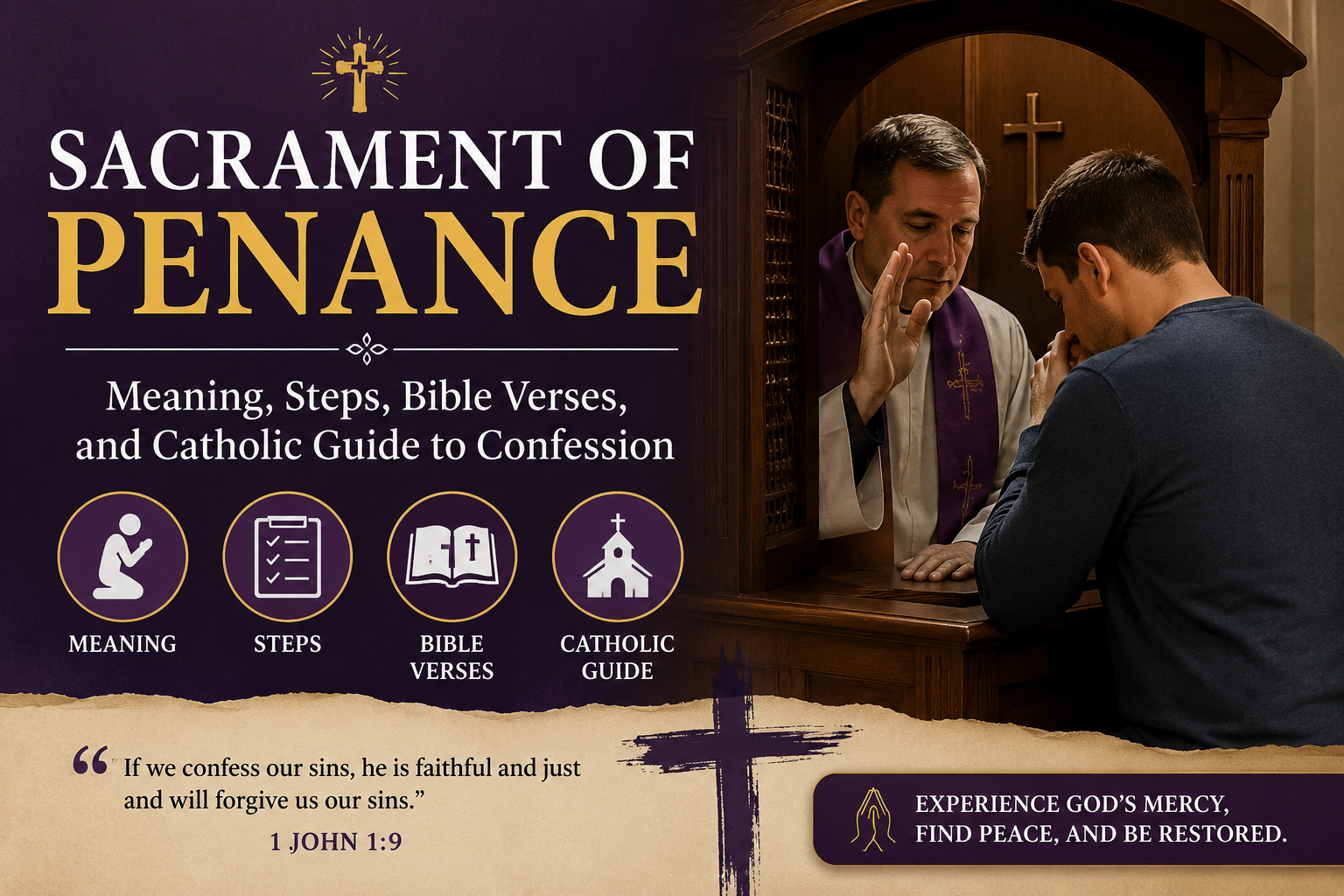
The Sacrament of Penance, also called the Sacrament of Reconciliation or Confession, is one of the seven sacraments of the Catholic Church. Through this sacrament, Catholics who sincerely repent of their sins receive God’s forgiveness and are reconciled with Him and with the Church.
Jesus gave His apostles the ministry of forgiving sins, and the Church continues this ministry through ordained priests.
For Catholics who have fallen into sin, the Sacrament of Penance is an invitation to return to God with humility, repentance, and trust in His mercy.
“Whose sins ye remit, they are remitted unto them; and whose sins ye retain, they are retained.” — John 20:23 KJV
What Is the Sacrament of Penance?
The Sacrament of Penance is the Catholic sacrament through which a baptized person who has sinned turns back to God, confesses sins to a priest, receives absolution, and performs the assigned penance.
It is commonly called:
- Sacrament of Penance
- Sacrament of Reconciliation
- Sacrament of Confession
- Sacrament of Forgiveness
These names emphasize different aspects of the same sacrament.
Penance emphasizes conversion and the work of repentance.
Reconciliation emphasizes restored communion with God and the Church.
Confession emphasizes acknowledging and confessing one’s sins.
Forgiveness emphasizes God’s mercy received through the sacrament.
What Is the Purpose of the Sacrament of Penance?
The Sacrament of Penance has several important purposes.
1. Reconciliation With God
Sin damages our relationship with God.
Through genuine repentance and sacramental absolution, Catholics are reconciled with God.
2. Forgiveness of Sins
The sacrament provides God’s forgiveness to the repentant sinner through the ministry of the priest.
3. Reconciliation With the Church
Because sin also harms communion with the Church, reconciliation restores the person’s relationship with the Christian community.
4. Spiritual Healing
Confession is not merely about admitting mistakes.
It is an encounter with God’s mercy that can bring spiritual healing and renewed strength.
5. Strength Against Future Sin
The sacrament also gives grace to help Catholics resist temptation and grow in holiness.
What Are the Four Parts of the Sacrament of Penance?
Catholic teaching commonly identifies four acts of the penitent that are important in the celebration of the sacrament:
- Contrition
- Confession
- Penance
- Absolution
Let’s look at each one.
1. Contrition
Contrition means genuine sorrow for sin together with the desire to turn away from sin and return to God.
A person approaching confession should not simply be sorry because they were caught or because sin caused inconvenience.
True repentance involves recognizing that sin is wrong and desiring to change.
Psalm 51 expresses this spirit beautifully:
“Create in me a clean heart, O God; and renew a right spirit within me.” — Psalm 51:10 KJV
2. Confession
The penitent honestly confesses sins to the priest.
A good confession should be truthful, humble, and clear.
There is no need to provide unnecessary details or lengthy explanations.
The purpose is to acknowledge one’s sins honestly before God through the ministry of the Church.
3. Penance
After confession, the priest assigns a penance.
This may involve prayers, an act of charity, Scripture reading, or another appropriate spiritual practice.
Penance helps express repentance and encourages the penitent to continue turning toward God.
4. Absolution
The priest gives absolution, through which the Church announces God’s forgiveness to the repentant sinner.
The priest’s words and ministry point beyond the priest himself to Christ’s mercy.
Who Instituted the Sacrament of Penance?
Catholic teaching understands Jesus Christ as the institution’s source.
After His resurrection, Jesus appeared to His apostles and said:
“Peace be unto you: as my Father hath sent me, even so send I you.” — John 20:21 KJV
He then spoke about the forgiveness and retention of sins.
“Whose sins ye remit, they are remitted unto them.” — John 20:23 KJV
Catholics understand this passage as part of the biblical foundation for the Church’s ministry of reconciliation.
Sacrament of Penance Bible Verses
Several passages are especially important when discussing Catholic confession and reconciliation.
John 20:22–23
“Receive ye the Holy Ghost: Whose sins ye remit, they are remitted unto them…”
This is one of the principal Scriptures associated with the sacrament.
James 5:16
“Confess your faults one to another, and pray one for another, that ye may be healed.”
This passage emphasizes confession, prayer, and spiritual healing.
1 John 1:9
“If we confess our sins, he is faithful and just to forgive us our sins, and to cleanse us from all unrighteousness.”
God’s mercy is available to those who sincerely confess and repent.
Luke 15:18
The prodigal son says:
“I will arise and go to my father…”
The parable illustrates repentance and the Father’s welcoming mercy.
Psalm 51:17
“The sacrifices of God are a broken spirit: a broken and a contrite heart…”
God desires sincere repentance rather than empty religious actions.
2 Corinthians 5:18
Paul speaks of God giving believers:
“the ministry of reconciliation.”
This helps illustrate the Christian calling to reconciliation.
How to Go to Confession: Step-by-Step
If you haven’t been to confession for a long time, you may feel nervous.
The process is simpler than you might expect.
Step 1: Examine Your Conscience
Before confession, prayerfully reflect on your life.
Ask yourself:
- Have I deliberately turned away from God?
- Have I failed to love others?
- Have I lied?
- Have I acted unjustly?
- Have I allowed hatred or resentment to grow?
- Have I deliberately neglected my responsibilities?
- Have I committed sins against purity?
- Have I misused money or possessions?
- Have I knowingly participated in wrongdoing?
For Catholics, an examination of conscience can be based on the Ten Commandments, the Beatitudes, and the teachings of the Church.
Step 2: Be Sorry for Your Sins
Ask God for genuine contrition.
You might pray:
“Lord, give me a humble and contrite heart. Help me recognize my sins honestly and give me the grace to turn away from them.”
Step 3: Go to the Priest
When you enter the confessional or reconciliation room, greet the priest and begin according to the local practice.
If you’re unsure what to say, simply tell the priest:
“Father, it’s been a long time since my last confession, and I need some guidance.”
The priest can help you.
Step 4: Confess Your Sins Honestly
Speak honestly and clearly.
Don’t intentionally hide a serious sin.
If you don’t remember something, don’t panic. Tell the priest what you remember.
Step 5: Listen to the Priest
The priest may offer advice or encouragement.
He will then assign a penance.
Step 6: Make an Act of Contrition
You will normally be invited to express sorrow for your sins.
One traditional form is:
“O my God, I am heartily sorry for having offended Thee…”
Step 7: Receive Absolution
The priest gives the prayer of absolution.
Receive it with faith and gratitude.
Step 8: Complete Your Penance
After leaving confession, complete the assigned penance as soon as reasonably possible.
Use the moment to thank God for His mercy and ask for grace to live differently.
What Is an Examination of Conscience?
An examination of conscience is a prayerful reflection on your thoughts, words, actions, and omissions in order to recognize where you have sinned and where you need God’s mercy.
Before confession, you might ask:
Relationship With God
- Do I make time for prayer?
- Do I deliberately neglect God?
- Do I trust God?
- Have I treated sacred things disrespectfully?
Relationship With Others
- Have I treated my family with love?
- Have I deliberately hurt someone?
- Have I refused to forgive?
- Have I spread gossip or false information?
- Have I been dishonest?
Personal Conduct
- Have I acted selfishly?
- Have I allowed anger to control me?
- Have I deliberately engaged in sinful behavior?
- Have I failed to fulfill serious responsibilities?
The purpose is not to become obsessed with guilt.
It is to become honest before God.
What Is an Act of Contrition?
An Act of Contrition is a prayer expressing sorrow for sin and the intention to turn back to God.
A traditional Catholic form is:
O my God, I am heartily sorry for having offended Thee, and I detest all my sins because I dread the loss of Heaven and the pains of Hell, but most of all because they have offended Thee, my God, Who art all-good and deserving of all my love. I firmly resolve, with the help of Thy grace, to confess my sins, to do penance, and to amend my life. Amen.
There are also other approved forms of the Act of Contrition.
If your parish provides a particular form, follow its guidance.
What Happens After Confession?
After receiving absolution, the Catholic should strive to live differently.
Confession is not intended to become a cycle of repeatedly committing the same sin without any desire for change.
God’s grace calls us toward conversion.
If you fall again, don’t despair.
Return to God.
Ask for forgiveness.
Seek the sacrament again when appropriate.
Christian growth is a lifelong journey.
How Often Should Catholics Go to Confession?
Catholic practice encourages regular confession and requires Catholics conscious of grave sin to seek sacramental reconciliation before receiving Holy Communion.
The Church also encourages frequent confession because it can help believers grow in holiness, even when they are not conscious of grave sin.
Your parish priest can help you establish an appropriate confession routine.
Can I Go to Confession If I Haven’t Been for Years?
Yes.
If you have been away from confession for months or years, don’t let embarrassment keep you away.
Priests regularly encounter people who have been away from the sacrament for a long time.
Simply tell the priest:
“Father, I haven’t been to confession for several years, and I don’t remember exactly what to do.”
The priest can guide you through the process.
God’s mercy is greater than your past.
What If I Forget My Sins During Confession?
Don’t panic.
Confess the sins you sincerely remember.
You should not deliberately hide a serious sin, but an honest failure of memory is different from intentionally concealing something.
If you remember something important after confession, speak with a priest about what you should do.
Can Confession Bring Peace?
Yes.
One of the beautiful fruits of reconciliation can be a renewed sense of peace.
When we sincerely repent, receive forgiveness, and entrust ourselves to God’s mercy, we can stop carrying the same burden alone.
Psalm 32:5 says:
“I acknowledged my sin unto thee… and thou forgavest the iniquity of my sin.”
The sacrament directs the sinner away from despair and toward God’s mercy.
A Prayer Before Going to Confession
Merciful Father,
I come before You with humility.
Help me examine my conscience honestly.
Show me the sins I need to confess.
Give me genuine sorrow for my sins.
Remove my fear and shame.
Help me trust Your mercy.
Give me courage to speak honestly to the priest.
Help me receive the Sacrament of Penance with a sincere heart.
After confession, give me the grace to avoid sin and grow closer to Jesus.
Create in me a clean heart and renew a right spirit within me.
Amen.
A Prayer After Confession
Lord Jesus,
Thank You for Your mercy.
Thank You for forgiving me and giving me another opportunity to walk faithfully with You.
Help me remember the grace I have received.
Give me strength when temptation comes.
Help me avoid the situations that lead me into sin.
Teach me to love You more deeply.
Help me forgive others and live with humility.
May my life reflect the mercy You have shown me.
Amen.
Sacrament of Penance vs. Confession vs. Reconciliation
These terms are often used interchangeably, but they highlight different aspects of the sacrament.
| Term | Emphasis |
|---|---|
| Penance | Repentance and conversion |
| Confession | Admitting and confessing sins |
| Reconciliation | Restored relationship with God and the Church |
| Forgiveness | Receiving God’s mercy |
They refer to the same sacramental celebration.
Why Should Catholics Go to Confession?
Catholics go to confession because Christ calls His followers to repentance and reconciliation.
Confession can help you:
- Receive God’s forgiveness.
- Reconcile with God.
- Reconcile with the Church.
- Examine your life honestly.
- Develop humility.
- Fight temptation.
- Receive spiritual guidance.
- Experience God’s mercy.
- Begin again after falling into sin.
The goal is not merely to “check a religious box.”
The goal is conversion and deeper relationship with Christ.
Frequently Asked Questions About the Sacrament of Penance
What is the Sacrament of Penance?
The Sacrament of Penance is a Catholic sacrament through which repentant sinners confess their sins to a priest, receive absolution, and are reconciled with God and the Church.
What are the four parts of the Sacrament of Penance?
The four commonly identified acts are contrition, confession, penance, and absolution.
What Bible verse supports the Sacrament of Penance?
John 20:23 is one of the principal passages associated with the sacrament:
“Whose sins ye remit, they are remitted unto them.”
Is confession the same as penance?
Confession and penance are names associated with the same sacrament, but they emphasize different aspects. Confession emphasizes acknowledging sins, while penance emphasizes repentance and conversion.
What should I say during confession?
Confess your sins honestly and clearly. If you are unsure what to do, tell the priest that you need guidance. He can walk you through the process.
What if I am embarrassed about my sins?
Remember that confession is intended to be an encounter with God’s mercy. Priests hear many different kinds of sins and are there to help people return to God.
Can I go to confession after many years?
Yes. You can return to the Sacrament of Penance even if you have been away for a long time. Tell the priest that it has been a long time and ask for guidance.
What prayer do Catholics say after confession?
A Catholic may pray a prayer of thanksgiving, such as:
“Thank You, Lord Jesus, for Your mercy and forgiveness. Help me remain faithful and avoid sin. Amen.”
Conclusion
The Sacrament of Penance is a beautiful expression of God’s mercy and the Church’s ministry of reconciliation. Through sincere repentance, confession, penance, and absolution, Catholics are invited to return to God and receive His forgiveness.
If you have been away from confession, don’t allow fear or shame to keep you away. God calls His children back to Himself with mercy.
Remember the words of Psalm 51:10:
“Create in me a clean heart, O God; and renew a right spirit within me.”
Approach the sacrament with humility, honesty, and trust.
God’s mercy is greater than your sin, and His invitation to return remains open.