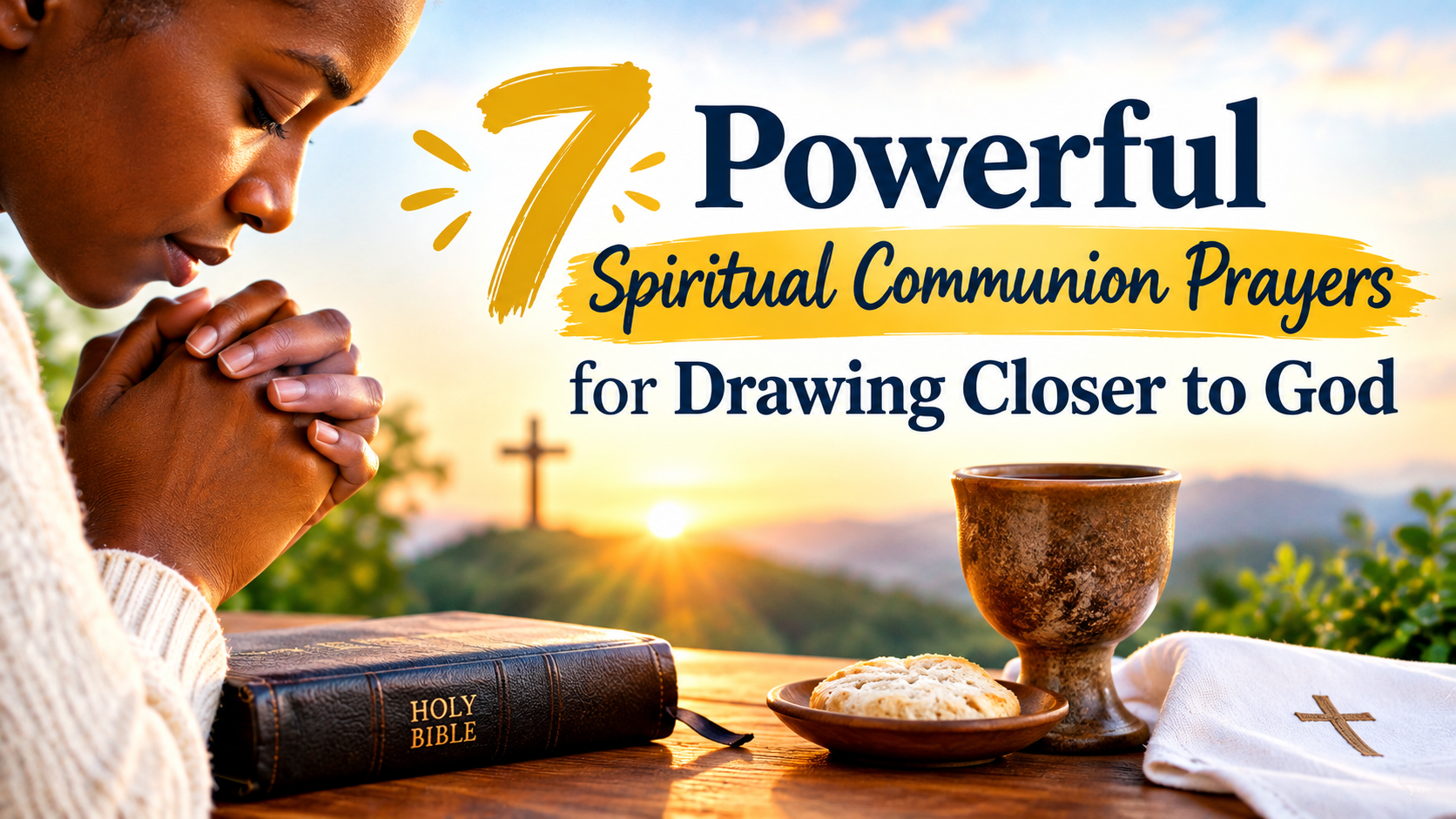
A spiritual communion prayer is a prayer of longing for Jesus and communion with Him when a person cannot receive the Eucharist sacramentally. It is especially associated with Catholic devotion, though Christians from different traditions may also use the broader idea of spiritually seeking Christ’s presence through prayer.
For Catholics, spiritual communion does not replace receiving Holy Communion when one is properly able to do so. Rather, it expresses a sincere desire for Christ and can help cultivate faith, repentance, gratitude, and deeper love for God.
This guide offers 7 spiritual communion prayers for different circumstances, explains what spiritual communion means, and provides Scripture passages that can enrich your prayer.
What Is Spiritual Communion?
Spiritual communion is an act of prayer in which a person expresses a sincere desire to receive Jesus spiritually when sacramental reception of the Eucharist is not possible.
A person may make a spiritual communion when:
- They cannot attend Mass.
- They are unable to receive Holy Communion at a particular time.
- They are participating in Eucharistic adoration without receiving Communion.
- They are praying privately and desire deeper union with Christ.
- They are separated from the church community because of circumstances beyond their control.
The central idea is desire for communion with Christ.
For Catholics, the Eucharist remains the sacramental celebration in which Christ is received under the appearances of bread and wine. Spiritual communion should therefore be understood as an expression of longing for that sacramental union rather than as an equivalent replacement.
1. A Simple Spiritual Communion Prayer
This prayer is suitable when you want a short and focused prayer expressing your desire for Jesus.
Prayer:
Lord Jesus,
I believe that You are truly present in the Holy Eucharist.
I love You and desire to receive You into my heart. Although I cannot receive You sacramentally at this moment, I ask You to come spiritually into my heart.
Unite me more closely to You.
Increase my faith, strengthen my hope, and deepen my love.
Help me live today in a way that honors Your presence.
Jesus, remain with me and guide me always.
Amen.
2. Spiritual Communion Prayer When You Cannot Receive the Eucharist
There may be times when a person sincerely desires Holy Communion but cannot receive it. This prayer focuses on trust, longing, and spiritual closeness to Christ.
Prayer:
Jesus, my Lord and Savior,
I come before You with a sincere desire to receive You.
I am unable to receive Holy Communion at this moment, but I ask You not to let this separation keep my heart distant from You.
Come spiritually into my heart.
Strengthen my relationship with You and help me remain faithful to Your teachings.
Let my desire for the Eucharist deepen my appreciation for Your sacrifice and Your love.
Prepare my heart for the next opportunity to receive You worthily.
Amen.
3. Spiritual Communion Prayer for Deepening Faith
Spiritual communion can become an opportunity to ask Christ to strengthen one’s faith rather than simply focusing on the inability to receive Communion.
Prayer:
Lord Jesus,
strengthen my faith when I feel weak.
Help me believe Your promises even when I cannot see the answers to my prayers. Draw me closer to You and teach me to trust Your presence in every circumstance.
I desire to know You more deeply and love You more faithfully.
Remove distractions that keep my heart from You. Give me a greater hunger for Your Word, a deeper love for prayer, and a sincere desire to follow Your will.
May my faith become stronger through every season of my life.
Amen.
4. Spiritual Communion Prayer of Repentance
A sincere desire for Christ naturally invites examination of the heart. This prayer combines spiritual communion with repentance and a request for renewal.
Prayer:
Merciful Jesus,
I come before You with humility.
You know my heart and every part of my life. Forgive me for the sins and failures that have drawn me away from You.
I am sorry for the times I have chosen my own desires instead of Your will.
Cleanse my heart and renew my spirit. Help me reject sin and grow in holiness.
Though I cannot receive You sacramentally at this moment, I ask You to draw near to me spiritually and transform my heart.
Help me live with greater love, humility, purity, patience, and obedience.
Amen.
5. Spiritual Communion Prayer for Eucharistic Adoration
When praying before the Blessed Sacrament, a person can use spiritual communion as an expression of love and adoration.
Prayer:
Jesus, truly present in the Blessed Sacrament,
I adore You and place myself before You with love.
I believe in Your presence and desire to become more closely united with You.
You know everything about me—my joys, fears, weaknesses, hopes, and struggles.
Receive my heart and teach me to remain close to You.
Help me become quiet enough to hear Your voice and humble enough to follow Your guidance.
May this time of prayer deepen my love for the Eucharist and increase my desire for holiness.
Jesus, I trust in You.
Amen.
6. Spiritual Communion Prayer for Healing and Peace
A person can also bring emotional burdens and personal struggles into prayer while seeking deeper communion with Christ.
Prayer:
Lord Jesus,
I bring my troubled heart before You.
You know the burdens I carry and the things that cause me pain. Please fill me with Your peace and strengthen me when I feel overwhelmed.
Come spiritually into my heart and help me remember that I am never beyond Your care.
Heal the wounds within me that need Your grace. Give me courage to face difficult circumstances and wisdom to make faithful decisions.
Help me surrender what I cannot control and trust You with my future.
Remain close to me and teach me to rest in Your love.
Amen.
7. Spiritual Communion Prayer of Thanksgiving and Surrender
Spiritual communion can also become an opportunity to thank Jesus for His love and surrender your life more completely to Him.
Prayer:
Lord Jesus,
thank You for loving me and calling me into deeper communion with You.
Thank You for Your sacrifice, Your mercy, and the gift of salvation.
I surrender my plans, desires, worries, and future into Your hands.
Teach me to love You above everything else. Let my choices reflect Your teachings and let my life become an offering of gratitude.
I desire to receive You with a sincere heart and to remain united with You throughout my day.
Take everything that I am and help me use my life for Your glory.
Jesus, I give myself to You.
Amen.
Bible Verses That Can Enrich a Spiritual Communion Prayer
Scripture provides a strong foundation for prayer and helps us understand the Christian desire for communion with Christ.
John 6:35
“I am the bread of life: he that cometh to me shall never hunger.”
Jesus describes Himself as the Bread of Life, pointing believers toward the nourishment and life found in Him.
John 6:51
“I am the living bread which came down from heaven.”
This passage is particularly significant in Eucharistic theology and helps explain why the Eucharist occupies such an important place in Catholic faith.
John 15:4
“Abide in me, and I in you.”
Spiritual communion can be understood as an expression of the Christian desire to remain deeply united with Christ.
John 15:5
“He that abideth in me, and I in him, the same bringeth forth much fruit.”
Union with Christ should influence the way we live. Prayer is not merely about experiencing a moment of comfort but about becoming more faithful disciples.
Luke 22:19
“This is my body which is given for you: this do in remembrance of me.”
Jesus’ words at the Last Supper provide an important biblical foundation for Christian Eucharistic remembrance and devotion.
1 Corinthians 10:16
Paul speaks of the cup and bread in terms of communion with Christ. The passage highlights the profound relationship between the Eucharist and Christian participation in Christ.
Psalm 42:1
“As the hart panteth after the water brooks, so panteth my soul after thee, O God.”
This verse beautifully expresses the longing for God that can accompany spiritual communion.
What Is the Difference Between Spiritual Communion and Holy Communion?
The terms are related but should not be treated as identical.
Holy Communion is the sacramental reception of the Eucharist during the celebration of Mass or according to the Church’s sacramental practice.
Spiritual communion is an act of desire and prayer in which a person seeks spiritual union with Christ when sacramental reception is not taking place.
For Catholics, spiritual communion therefore points toward and deepens one’s desire for sacramental communion; it does not turn a private prayer into the sacrament itself.
This distinction is important because it prevents spiritual communion from being misunderstood as simply an alternative way of receiving the Eucharist.
When Can You Make a Spiritual Communion?
There is no need to wait for a special occasion to express your desire for Christ.
You may pray a spiritual communion:
- During personal prayer.
- While watching or listening to Mass when you cannot attend.
- During Eucharistic adoration.
- When circumstances prevent you from receiving Communion.
- During a quiet morning devotion.
- Before going to sleep.
- During a difficult season when you particularly desire God’s presence.
The prayer can be long or short. What matters is the sincerity of the heart.
How to Make a Spiritual Communion
A simple structure can help you focus.
1. Become aware of God’s presence
Take a moment to become quiet and turn your attention toward Christ.
2. Express your faith
Acknowledge who Jesus is and what you believe about Him.
3. Express your desire
Tell Jesus sincerely that you desire to receive Him and grow closer to Him.
4. Invite spiritual union
Ask Christ to enter more deeply into your heart and transform your life.
5. Remain in prayer
Spend a few moments in silence, thanksgiving, Scripture reading, or adoration.
6. Respond through your life
Allow your prayer to influence how you treat God and other people throughout the day.
Can Children Make a Spiritual Communion?
Children can be taught simple forms of prayer that express love for Jesus and a desire to remain close to Him.
For a young child, a parent might pray:
“Jesus, I love You. I want to be close to You. Please come into my heart spiritually and help me love You more. Amen.”
The language can become deeper as the child grows and understands the Eucharist more fully.
Spiritual Communion and Daily Christian Life
Spiritual communion should not remain an isolated prayer. Its purpose is to deepen the believer’s relationship with Christ.
After praying, consider asking:
- How can I show Christ’s love today?
- Is there something I need to surrender to God?
- Is there someone I need to forgive?
- What teaching of Jesus do I need to practice?
- How can I become more attentive to God’s presence?
- What can I thank God for today?
These questions help connect prayer with everyday discipleship.
A 3-Minute Spiritual Communion Routine
If you have limited time, you can use a simple three-minute pattern.
Minute 1 — Faith:
“Jesus, I believe in You and trust in Your presence.”
Minute 2 — Desire:
“Jesus, I love You and desire to receive You into my heart.”
Minute 3 — Surrender:
“Jesus, transform my heart and help me live according to Your will.”
Then remain quietly in God’s presence for a few moments.
What Spiritual Communion Should Produce
A meaningful spiritual communion should not simply leave you with a temporary emotional experience. It should encourage a deeper relationship with Christ.
Over time, this prayer can help cultivate:
- Greater love for Jesus.
- Deeper appreciation for the Eucharist.
- More frequent prayer.
- Greater awareness of God’s presence.
- A stronger desire for holiness.
- Greater repentance and humility.
- Increased love for others.
- A more faithful Christian life.
The ultimate purpose is not merely to feel close to God for a few minutes but to allow that closeness to shape the whole of life.
Conclusion
A spiritual communion prayer is a beautiful way to express your desire for Jesus and deepen your relationship with Him when you cannot receive Holy Communion sacramentally. It can be a prayer of longing, faith, repentance, thanksgiving, surrender, or adoration.
For Catholics, spiritual communion should be understood in harmony with the sacramental life of the Church: it expresses a desire for Christ and spiritual union with Him, while Holy Communion remains the sacramental reception of the Eucharist.
Whether you are praying during Eucharistic adoration, unable to receive Communion, or simply seeking a deeper relationship with Christ, approach the prayer with sincerity rather than complicated words.
Jesus, I love You. I desire You. Draw me closer to You, transform my heart, and help me remain united with You. Amen.