The Lord’s Prayer is one of the most beloved Christian prayers in the world. Jesus taught this prayer to His disciples as a model for approaching God with reverence, trust, humility, and confidence. For Spanish-speaking Christians, praying the Lord’s Prayer en español can be a meaningful way to worship God and reflect on the teachings of Jesus.
Whether you grew up praying in Spanish, are learning Spanish, or simply want to deepen your understanding of this foundational Christian prayer, the Spanish version offers the same timeless message: God is our Father, His kingdom matters, His will is good, and we can bring our daily needs, forgiveness, and struggles before Him.
The Lord’s Prayer in Spanish
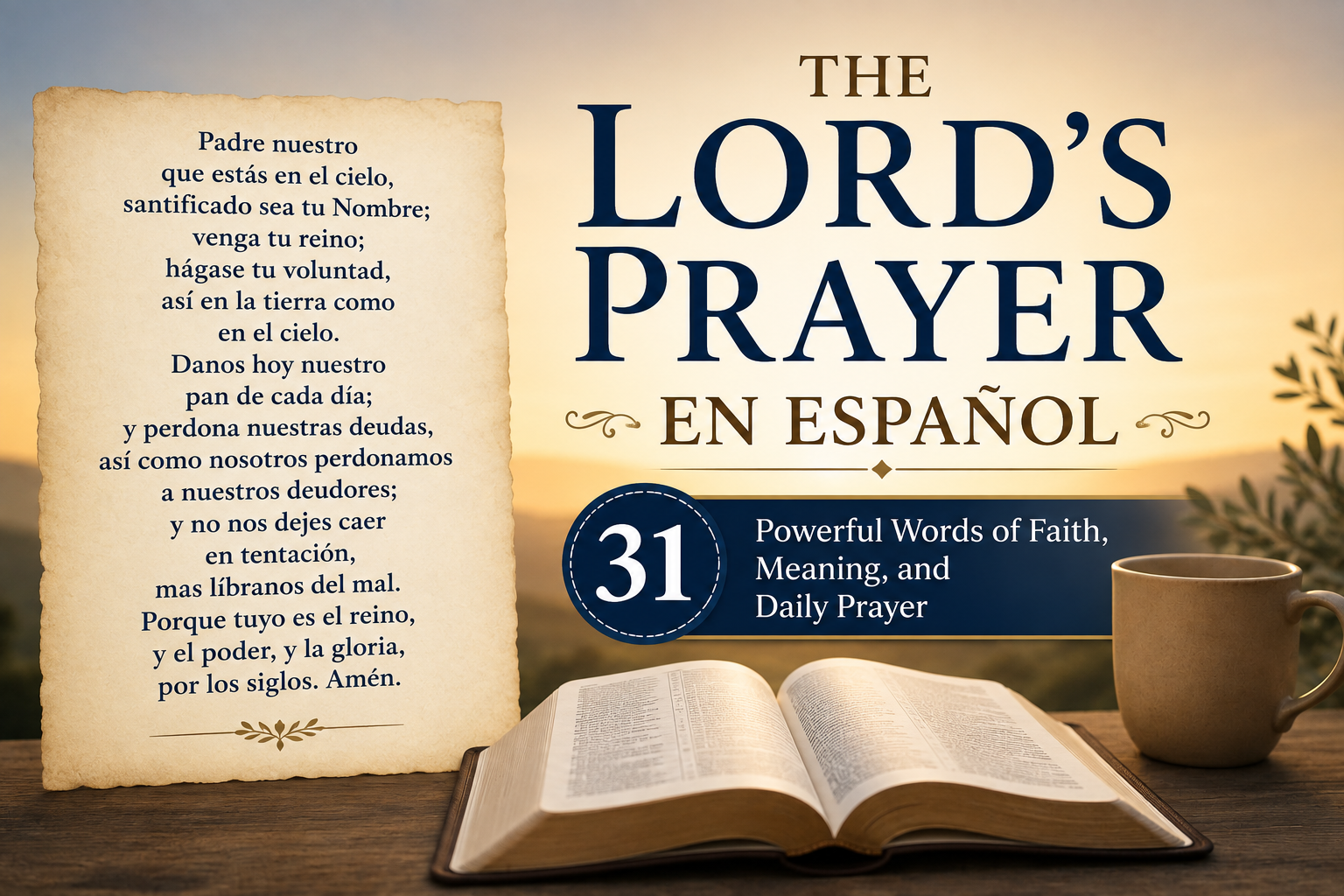
A widely used Spanish version of the Lord’s Prayer is:
Padre nuestro que estás en los cielos,
santificado sea tu nombre.
Venga tu reino.
Hágase tu voluntad,
como en el cielo, así también en la tierra.
Danos hoy nuestro pan de cada día.
Y perdónanos nuestras deudas,
como también nosotros perdonamos a nuestros deudores.
Y no nos metas en tentación,
mas líbranos del mal.
Porque tuyo es el reino,
y el poder,
y la gloria,
por todos los siglos. Amén.
The wording can vary slightly among Spanish-speaking Christian traditions and Bible translations. Some versions use “ofensas” instead of “deudas,” while others use expressions such as “no nos dejes caer en la tentación.” The central meaning remains the same.
What Is the Lord’s Prayer?
The Lord’s Prayer is the prayer Jesus taught His disciples in response to their request to be taught how to pray. It appears in Matthew 6:9–13, within Jesus’ Sermon on the Mount.
A shorter version also appears in Luke 11:2–4.
Rather than simply giving His disciples words to repeat, Jesus provided a model showing important priorities in prayer. The prayer begins with God—His name, kingdom, and will—before moving to human needs such as daily provision, forgiveness, and protection.
This makes the Lord’s Prayer both a prayer and a pattern for a healthy relationship with God.
Padre Nuestro: Understanding the Spanish Prayer
The opening words, “Padre nuestro que estás en los cielos,” mean:
“Our Father who art in heaven.”
This introduction reminds believers that God is not distant or insignificant. Jesus invites His followers to approach God as Father while maintaining reverence for His heavenly authority.
The word “nuestro”—our—is also important. The prayer is not focused only on individual needs. It reminds Christians that they belong to a community of faith and should care about others as well.
“Santificado sea tu nombre”
This means:
“Hallowed be Your name.”
To hallow something is to treat it as holy or greatly honored.
When we pray these words, we are expressing a desire for God’s name to be honored in our lives and throughout the world.
This part of the prayer encourages us to ask:
- Does my life reflect my faith?
- Do my words honor God?
- Do my decisions demonstrate love and integrity?
- Am I treating God’s name with reverence?
Prayer is therefore connected to daily conduct, not just words spoken during a devotional moment.
“Venga tu reino”
This means:
“Your kingdom come.”
God’s kingdom represents His rule, purposes, righteousness, peace, and authority.
When Christians pray for God’s kingdom to come, they express a desire for God’s purposes to be accomplished. It encourages believers to look beyond personal ambitions and seek what is consistent with God’s character and teaching.
“Hágase tu voluntad”
This means:
“Your will be done.”
These words express surrender.
There are times when we know exactly what we want from God. Yet the Lord’s Prayer teaches us to place God’s will above our own.
Praying this sincerely can help develop humility and trust, especially when circumstances are uncertain.
“Danos hoy nuestro pan de cada día”
This means:
“Give us this day our daily bread.”
The request for daily bread represents our dependence on God for our needs.
Bread was a basic necessity in the world of Jesus, so the expression naturally points toward daily provision.
This part of the prayer can remind us to bring practical concerns to God, including:
- Food and basic necessities
- Work and financial responsibilities
- Strength for each day
- Wisdom for important decisions
- Help during difficult circumstances
- Provision for our families
The wording “hoy”—today—also emphasizes daily dependence rather than anxious obsession about the future.
Jesus later taught His followers not to be consumed by worry about tomorrow (Matthew 6:34).
“Perdónanos nuestras deudas”
This means:
“Forgive us our debts.”
In the biblical context, the language of debt points to wrongdoing and our need for God’s forgiveness.
This is a deeply important part of Christian prayer because it acknowledges that we need God’s mercy.
It also leads immediately to a challenging responsibility:
“Como también nosotros perdonamos a nuestros deudores.”
In other words, those who ask God for forgiveness are called to extend forgiveness to others.
Forgiveness does not mean pretending that wrongdoing never happened or ignoring serious harm. Instead, Christian forgiveness involves releasing personal vengeance and entrusting justice to God while responding with wisdom and grace.
“No nos metas en tentación”
This line is traditionally translated as:
“Lead us not into temptation.”
Many contemporary Spanish translations express the idea as:
“No nos dejes caer en la tentación.”
The emphasis is on asking God for help when facing temptation and spiritual testing.
Every Christian encounters situations that can challenge faith, character, patience, honesty, or self-control. This part of the prayer reminds believers that they should not rely entirely on their own strength.
Instead, they can seek God’s help to recognize temptation, resist it, and choose what is right.
“Líbranos del mal”
This means:
“Deliver us from evil.”
It is a request for God’s protection and deliverance from evil.
The words can be understood broadly, including a desire for protection from sinful influences, destructive choices, spiritual opposition, and circumstances that threaten our faith and well-being.
Rather than encouraging fear, this prayer points believers toward trust in God’s power.
“Tuyo es el reino, el poder y la gloria”
This closing declaration means:
“Yours is the kingdom, and the power, and the glory.”
It turns the prayer back toward God.
After presenting needs, asking for forgiveness, and seeking protection, the prayer concludes by recognizing God’s authority.
This is an important spiritual principle: prayer is not merely about getting something from God. It is also about worshiping God.
Why Pray the Lord’s Prayer in Spanish?
Praying the Lord’s Prayer in Spanish can be meaningful for many reasons.
1. It connects faith with language
For Spanish-speaking Christians, praying in Spanish can make the words feel especially personal and familiar.
2. It helps families pray together
Families who speak Spanish can use the prayer as a simple foundation for family devotion.
3. It teaches biblical priorities
The prayer moves through worship, God’s kingdom, daily provision, forgiveness, and protection.
4. It encourages dependence on God
The request for daily bread reminds us that we need God’s provision each day.
5. It teaches forgiveness
The prayer connects receiving forgiveness with extending forgiveness to others.
6. It encourages spiritual protection
The final requests remind believers to seek God’s help when facing temptation and evil.
7. It can become a daily spiritual habit
Because the prayer is concise and deeply biblical, it can be incorporated into morning, evening, or family prayer.
The Lord’s Prayer in Spanish With English Meaning
| Spanish | English meaning |
|---|---|
| Padre nuestro | Our Father |
| que estás en los cielos | who art in heaven |
| santificado sea tu nombre | hallowed be Your name |
| venga tu reino | Your kingdom come |
| hágase tu voluntad | Your will be done |
| danos hoy nuestro pan de cada día | give us this day our daily bread |
| perdónanos nuestras deudas | forgive us our debts |
| como también nosotros perdonamos | as we also forgive |
| a nuestros deudores | those who owe us |
| no nos metas en tentación | lead us not into temptation |
| líbranos del mal | deliver us from evil |
| Amén | Amen |
This comparison can be especially helpful for people learning Spanish or teaching children the Lord’s Prayer.
How to Pray the Lord’s Prayer With Understanding
The Lord’s Prayer becomes even more meaningful when we slow down and reflect on each section.
Begin with worship
Before listing your needs, recognize who God is.
“Padre nuestro que estás en los cielos.”
Remember God’s greatness, authority, and love.
Submit your desires to God
Pray:
“Hágase tu voluntad.”
Ask God to guide your plans instead of assuming that your own desires are always best.
Bring your daily needs
Tell God what you need for today.
Trust Him with your work, family, responsibilities, decisions, and circumstances.
Examine your heart
When praying for forgiveness, honestly acknowledge your sins and ask God to help you change.
Choose forgiveness
Ask God to help you release bitterness and respond wisely toward those who have wronged you.
Seek strength against temptation
Recognize areas where you are vulnerable and ask God for wisdom and self-control.
End with confidence
Remember that God’s kingdom, power, and glory belong to Him.
A Simple Lord’s Prayer Reflection in Spanish
After praying the traditional prayer, you can spend a few moments reflecting on its message:
Padre celestial, ayúdame a honrar tu nombre con mi vida. Enséñame a buscar tu voluntad y confiar en tus planes. Provee lo que necesito cada día y dame un corazón dispuesto a perdonar. Ayúdame a resistir la tentación, caminar en obediencia y permanecer firme en la fe. Protégeme del mal y guíame por el camino correcto. Que mi vida refleje tu amor, tu verdad y tu gracia. Amén.
This is a personal reflection inspired by the themes of the Lord’s Prayer rather than a replacement for the biblical text.
Bible Verses Related to the Lord’s Prayer
Several passages help explain the principles found in the Lord’s Prayer.
Matthew 6:9–13
This is the primary passage containing Jesus’ teaching on the Lord’s Prayer.
Luke 11:1–4
Luke records another occasion when Jesus taught His disciples how to pray.
Matthew 6:33
Jesus emphasizes seeking God’s kingdom and righteousness.
Matthew 6:34
Jesus teaches His followers not to become consumed with anxiety about tomorrow.
Philippians 4:6–7
Paul encourages believers to bring their requests to God with prayer and thanksgiving.
1 John 1:9
This passage emphasizes God’s faithfulness and forgiveness when believers confess their sins.
Psalm 23:1
The declaration that the Lord is our shepherd beautifully complements the Lord’s Prayer’s emphasis on trusting God for provision and guidance.
Frequently Asked Questions About the Lord’s Prayer en Español
What is the Lord’s Prayer called in Spanish?
It is commonly called “El Padre Nuestro” or simply “El Padrenuestro.”
What is “Our Father” in Spanish?
“Our Father” is “Padre nuestro.”
Where is the Lord’s Prayer found in the Bible?
The Lord’s Prayer is found most prominently in Matthew 6:9–13 and also in Luke 11:2–4.
Is there only one Spanish version of the Lord’s Prayer?
No. Spanish-speaking Christian traditions and Bible translations can use slightly different wording. For example, some versions say “perdona nuestras ofensas,” while others use “perdónanos nuestras deudas.”
What does “Padre nuestro” mean?
It means “Our Father.” It expresses both a personal relationship with God and a recognition that believers belong to a wider community of faith.
Can I pray the Lord’s Prayer every day?
Yes. Christians can pray it regularly as an expression of worship and as a reminder of Jesus’ teaching about prayer. It can also serve as a framework for personal prayer.
What does “hágase tu voluntad” mean?
It means “Your will be done.” It expresses a willingness to trust God’s purposes rather than placing personal desires above God’s will.
What does “líbranos del mal” mean?
It means “deliver us from evil.” It is a request for God’s protection and help in the presence of evil and temptation.
How the Lord’s Prayer Can Shape Your Daily Life
The Lord’s Prayer is short, but its principles reach into almost every area of Christian life.
It teaches worship by beginning with God’s name.
It teaches submission by asking for God’s will.
It teaches dependence by asking for daily bread.
It teaches repentance by asking for forgiveness.
It teaches forgiveness toward others by connecting God’s mercy with our treatment of people.
It teaches spiritual vigilance by asking for help with temptation.
And it teaches confidence in God by ending with His kingdom, power, and glory.
This makes the prayer more than a collection of familiar words. It provides a biblical pattern for approaching God with humility, trust, and faith.
Conclusion: Pray the Padre Nuestro With Faith and Understanding
The Lord’s Prayer en español
, commonly known as El Padre Nuestro, is a powerful biblical prayer that continues to guide Christians around the world. Its message covers some of the most important foundations of faith: honoring God, seeking His kingdom, trusting Him for daily needs, receiving forgiveness, forgiving others, resisting temptation, and seeking protection from evil.
Whether you pray it in Spanish every morning, teach it to your children, use it during family devotion, or meditate on each phrase during personal prayer, the Lord’s Prayer can continually redirect your heart toward God.
Do not rush through its familiar words. Pause and consider what Jesus taught through each request. Let “Padre nuestro” remind you that God is worthy of reverence and trust. Let “hágase tu voluntad” teach surrender. Let “danos hoy” encourage daily dependence. Let “perdónanos” lead you toward repentance and mercy. And let “líbranos del mal” remind you to seek God’s strength and guidance.
Padre nuestro, que estás en los cielos, santificado sea tu nombre. Que tu reino venga y tu voluntad se haga en nuestras vidas. Danos hoy lo que necesitamos, perdona nuestros pecados y ayúdanos a perdonar. Guíanos lejos de la tentación, líbranos del mal y ayúdanos a vivir para tu gloria. En el nombre de Jesús. Amén.