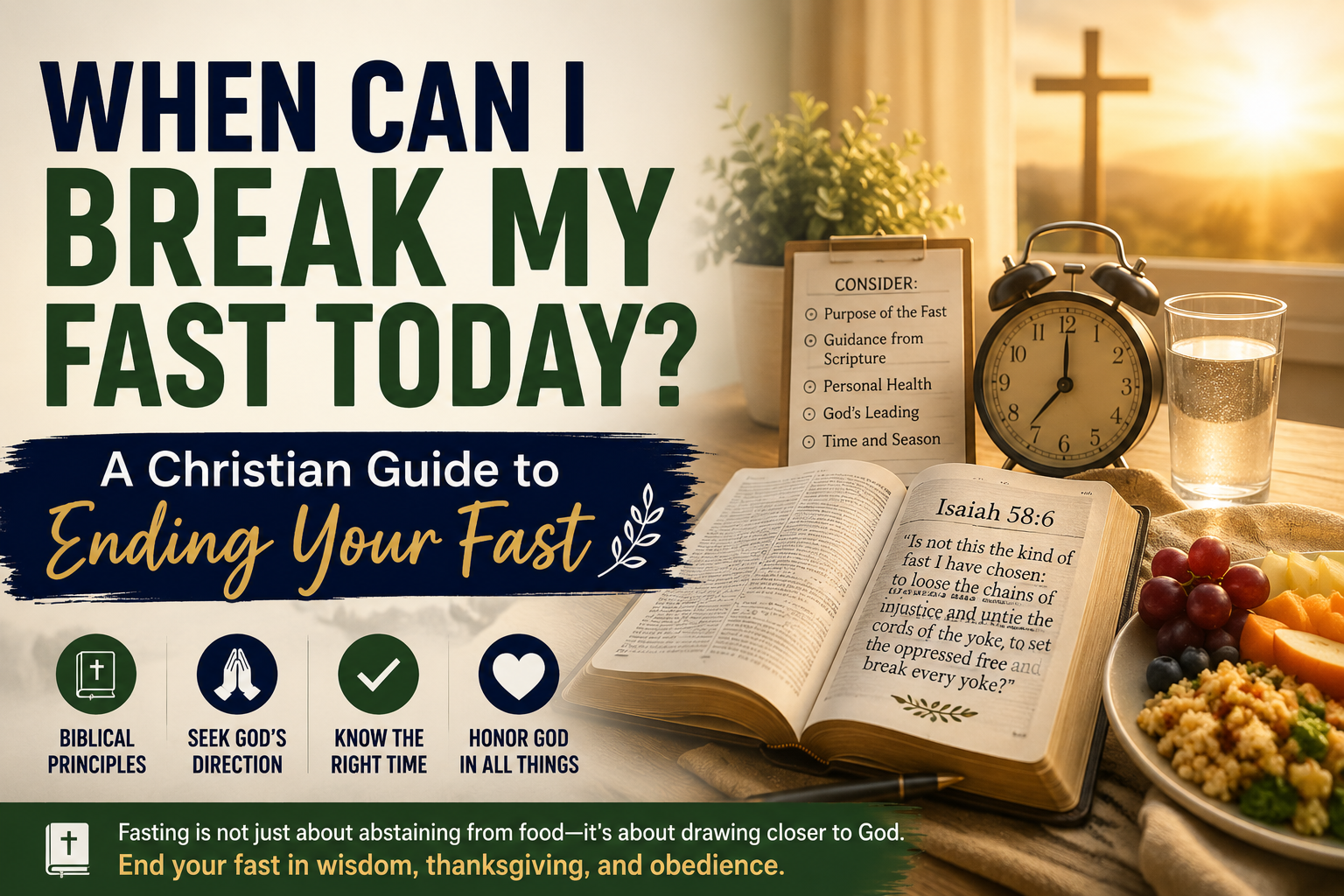
If you are fasting today, you may be asking, “When can I break my fast today?”
The answer depends on the type of fast you are observing. Some Christians fast until a specific time of day, such as noon or 3 p.m. Others fast until sunset, while some choose to fast for an entire day or follow a specific fasting plan.
The Bible does not give one universal clock time that every Christian must use to break a fast. What matters is approaching fasting with sincerity, prayer, self-control, and a desire to draw closer to God.
This guide explains common Christian fasting schedules, when you can break your fast, what to eat afterward, Bible verses about fasting, and how to end your fast prayerfully.
Quick Answer: When Can I Break My Fast Today?
You can break your fast at the time you intentionally set for your fast.
For example:
- Morning-to-noon fast: Break your fast at noon.
- Morning-to-3 p.m. fast: Break your fast at 3 p.m.
- Sunrise-to-sunset fast: Break your fast after sunset.
- One-day fast: Break it when your planned fasting period ends.
- Meal-skipping fast: Break the fast when the next planned meal arrives.
- Partial fast: Follow the schedule and food restrictions you intentionally established.
If you are following a church, ministry, or group fasting program, use the instructions provided by that program.
The important thing is not simply the clock. Christian fasting is intended to help you seek God through prayer, Scripture, repentance, worship, and dependence on Him.
What Does It Mean to Break a Fast?
To break a fast means to intentionally end the period during which you have abstained from food, certain foods, or another normal activity for spiritual purposes.
Breaking a fast does not mean that your spiritual activity has to stop.
You can continue praying, reading Scripture, worshiping, and seeking God after eating.
The physical fast ends, but your relationship with God continues.
For example, if you decided to fast until 3 p.m., you can pray before eating at 3 p.m., thank God for sustaining you, eat a moderate meal, and continue spending time with Him.
Does the Bible Give a Specific Time to Break a Fast?
No single Bible verse establishes a universal time of day when every Christian must break a fast.
Biblical fasting took different forms.
Some people fasted for periods of a day, while other fasts lasted longer. The circumstances and purposes also differed.
For example, Esther called for a three-day fast:
“Fast ye for me, and neither eat nor drink three days, night or day.” — Esther 4:16 KJV
Daniel also practiced a partial fast in Daniel 10:2–3.
Jesus fasted for forty days in Matthew 4:1–2.
These examples show that fasting can take different forms.
Therefore, you should not assume that every Christian must break a fast at exactly noon, 3 p.m., sunset, or midnight.
Common Times to Break a Christian Fast
1. Breaking a Fast at Noon
Some Christians choose to fast from the morning until noon.
For example:
6:00 a.m. → 12:00 p.m.
This can be a practical schedule for people who need to work, attend school, care for children, or manage other responsibilities.
If you intentionally chose a noon fast, you can break your fast at noon.
Before eating, spend a few minutes thanking God and praying.
2. Breaking a Fast at 3 p.m.
Some Christians choose to fast until 3 p.m.
The time is sometimes associated with the traditional Christian remembrance of Jesus’ crucifixion, although the Bible does not command Christians to fast until 3 p.m. every day.
If you chose this fasting schedule, you can break your fast at 3 p.m.
Use the moment to pray and thank God before eating.
3. Breaking a Fast at Sunset
Some Christians fast from sunrise until sunset.
If this is your chosen fasting schedule, your fast ends after sunset.
The exact sunset time changes depending on your location and date.
If you need the precise sunset time for your location today, check a reliable local sunrise-and-sunset source or weather service rather than relying on a generic time.
4. Breaking a Fast After 24 Hours
A 24-hour fast involves abstaining from food for a full day.
For example, someone may finish dinner at 6 p.m. on Monday and decide not to eat again until 6 p.m. Tuesday.
In that situation, the fast ends at the planned 24-hour mark.
Because longer fasts can be physically demanding, people should consider their health, medications, hydration needs, and individual circumstances.
5. Breaking a Partial Fast
A partial fast does not necessarily mean abstaining from all food.
For example, a person may choose to avoid certain foods or drinks while continuing to eat simple meals.
Daniel’s fasting experience in Daniel 10 is often referenced when discussing this type of fast.
If you are following a partial fast, you should follow the restrictions you intentionally established.
What Time Should I Break My Fast Today?
If you are asking because you are currently fasting, start by identifying what kind of fast you chose.
Ask yourself:
“What time did I decide my fast would end?”
If you planned to fast until noon, break it at noon.
If you planned to fast until 3 p.m., break it at 3 p.m.
If you planned to fast until sunset, break it after sunset.
If you are following a specific church or ministry fasting schedule, follow that schedule.
If you did not establish an end time, you do not necessarily need to continue fasting simply because you feel you have to reach a particular hour.
You can prayerfully decide when to end the fast.
Should I Break My Fast at 12 Noon?
Yes, if noon was the fasting period you intentionally chose.
There is nothing inherently wrong with ending a Christian fast at noon.
You can spend the morning praying, reading Scripture, worshiping, and seeking God’s guidance, then break the fast at noon.
The spiritual value of fasting is not determined by whether you break your fast at noon, 3 p.m., sunset, or another time.
Should I Break My Fast at 3 p.m.?
You can if that is the fasting schedule you chose.
Many Christians find 3 p.m. meaningful because the Gospels associate the ninth hour with significant events surrounding Jesus’ crucifixion.
However, Christians should distinguish between a meaningful devotional practice and a biblical command.
The Bible does not require every Christian to fast until 3 p.m.
Should I Break My Fast at Sunset?
If you intentionally chose a sunrise-to-sunset fast, then yes.
The exact time of sunset depends on where you live and the date.
For this reason, someone in Nigeria may break a sunset fast at a different clock time from someone in the United States, Europe, or another part of the world.
Use your local sunset time.
Can I Break My Fast Earlier Than Planned?
Sometimes circumstances may require you to end your fast earlier.
For example, you may become physically unwell, need to take medication with food, experience significant weakness, or discover that continuing the fast is unsafe for you.
Fasting should not become an exercise in harming yourself.
If you have a medical condition, are pregnant or breastfeeding, take medication, have a history of eating disorders, are underweight, or have another health concern, seek appropriate medical guidance before undertaking a food fast.
For children and teenagers, fasting should also be approached carefully with appropriate parental and medical guidance.
Ending a fast when necessary does not mean that you have failed spiritually.
You can continue seeking God through prayer and Scripture even when you are no longer abstaining from food.
What Should I Pray Before Breaking My Fast?
Before breaking your fast, you can pause and thank God for helping you through the fasting period.
Prayer Before Breaking a Fast
Heavenly Father, thank You for sustaining me throughout this fast.
Thank You for giving me strength and helping me seek You.
I surrender my worries, desires, plans, and burdens to You.
Please help me remember what You have taught me during this time of prayer and fasting.
Give me wisdom to apply Your Word to my life.
Guide my decisions and strengthen my faith.
As I end this fast, help me continue walking closely with You.
May the purpose of this fast produce good fruit in my life.
In Jesus’ name, Amen.
What Should I Do Before Breaking My Fast?
Before you eat, consider taking a few quiet moments to reflect.
1. Thank God
Thank God for life, strength, provision, and the opportunity to seek Him.
2. Pray
Bring the purpose of your fast before God.
If you were praying about a specific situation, continue to surrender it to Him.
3. Read Scripture
Read a short Bible passage before eating.
This can help you end the fast with your attention still focused on God.
4. Reflect
Ask yourself what you learned during the fast.
Did you become more aware of your dependence on God?
Did you identify something you need to change?
Did you experience greater clarity about a decision?
5. Eat Carefully
If you have gone without food for an extended period, avoid immediately eating a very large or heavy meal.
What Should I Eat After Breaking a Fast?
What you eat after fasting depends on the length and type of your fast.
For a short fast, a normal balanced meal may be appropriate for many people.
After a longer fast, it may be better to begin with something light and easy to tolerate.
Possible choices include:
- Water
- Fruits
- Vegetables
- Soup
- Oatmeal
- Rice
- Yogurt
- Eggs
- Other simple, balanced foods
Avoid assuming that one specific food is spiritually required.
The purpose of breaking the fast is to resume nourishment responsibly, not to follow a special religious menu.
If you have completed a prolonged fast, medical advice may be appropriate before resuming normal eating.
Bible Verses About Fasting
Matthew 6:16–18
Jesus taught His followers about fasting and emphasized that fasting should be sincere rather than performed to impress other people.
The passage encourages believers to focus on God rather than seeking human recognition.
Isaiah 58:6
Isaiah 58 challenges believers to understand fasting as more than simply abstaining from food.
True devotion should influence how we treat other people and how we live.
Joel 2:12
God calls His people to return to Him with fasting, weeping, and mourning.
This demonstrates that fasting can be connected with repentance and seeking God wholeheartedly.
Ezra 8:21
Ezra proclaimed a fast to seek God’s direction and protection.
This is an excellent reminder that fasting can accompany prayer when we need wisdom and guidance.
Matthew 4:2
Jesus fasted for forty days and nights before being tempted in the wilderness.
This demonstrates the seriousness of fasting within His earthly ministry.
Acts 13:2–3
The early Christians fasted and prayed while seeking God’s direction concerning ministry.
This shows that fasting can be connected with spiritual discernment and important decisions.
What Is the Purpose of Christian Fasting?
Christian fasting is not simply about going without food.
Its purpose can include:
Seeking God
Fasting can create intentional space for prayer and spiritual reflection.
Repentance
Throughout Scripture, fasting sometimes accompanied repentance and returning to God.
Seeking Direction
People may fast when asking God for wisdom about important decisions.
Spiritual Focus
Temporarily setting aside normal activities can remind us to depend on God.
Intercession
Some believers fast while praying for family members, communities, churches, or difficult circumstances.
Humility
Fasting can remind us that our ultimate dependence is on God rather than material things.
What If I Am Still Hungry When It Is Time to Break My Fast?
Hunger is a normal physical response to not eating.
When your planned fasting period ends, you can break your fast.
You do not need to continue fasting simply to prove your spiritual commitment.
If you feel unusually weak, dizzy, confused, faint, or unwell, prioritize your safety and seek appropriate medical help when needed.
Fasting should be approached with wisdom.
Can I Drink Water While Fasting?
This depends on the type of fast you have chosen.
Some people practice a water-only fast, while others abstain from both food and liquids for a specific period.
However, fasting without water can create significant health risks, especially in hot environments or during physical activity.
For many people, maintaining hydration is an important safety consideration.
If you are unsure what is appropriate for you, particularly if you have health conditions or take medication, seek medical advice.
Can I Take Medication While Fasting?
Do not stop prescribed medication simply because you are fasting.
Some medications need to be taken with food, while others may require a specific schedule.
If fasting affects how or when you should take medication, consult your healthcare professional.
Your health should not be placed at unnecessary risk in an attempt to maintain a fasting schedule.
Is Breaking a Fast a Sin?
No.
Ending a fast at the appropriate time is not a sin.
Christian fasting is a spiritual discipline, not a competition to see who can endure the longest without food.
The purpose is to seek God.
If you intentionally chose to fast until a particular time, you can end the fast when that time arrives.
If circumstances require you to end it earlier, you can still pray, worship, study Scripture, and continue seeking God.
What If I Accidentally Eat During My Fast?
Do not allow guilt to overwhelm you.
If you accidentally ate something during a fast, acknowledge what happened and decide whether to continue according to your original intention or end the fast.
The Christian life is not based on perfection.
Bring your heart before God and continue seeking Him sincerely.
Can I Break My Fast With Prayer?
Yes.
Prayer is an excellent way to conclude a fast.
You can thank God, surrender your concerns, ask for wisdom, and commit yourself to continuing in faith after the fast ends.
The end of a fast should not necessarily mean the end of prayer.
How Long Should a Christian Fast?
There is no single fasting duration required for every Christian.
Biblical examples include different periods and different forms of fasting.
Some fasts were short, while others lasted much longer.
Your fasting schedule can depend on your purpose, spiritual maturity, health, responsibilities, and circumstances.
If you are new to fasting, beginning with a manageable period may be more appropriate than immediately attempting a prolonged fast.
A Simple Fasting Schedule for Beginners
If you are new to Christian fasting, you might start with a simple schedule.
Morning
Begin with prayer and Scripture.
During the Fast
Use some of the time you would normally spend eating to pray or meditate on God’s Word.
Midday
Pause for prayer and reflection.
End of Fast
Thank God and break the fast responsibly.
Evening
Reflect on what you learned and continue your normal devotional routine.
The goal is not simply to endure hunger.
The goal is to seek God.
Prayer to Say After Breaking Your Fast
Father, thank You for bringing me through this time of fasting.
I am grateful for Your strength, mercy, and faithfulness.
Help me carry the lessons from this fast into my everyday life.
Help me obey Your Word, make wise decisions, love others, and remain faithful.
Continue to guide me concerning the things I have prayed about.
Give me patience when answers take time.
Give me wisdom when I need to act.
Help me trust You regardless of what happens.
In Jesus’ name, Amen.
When Should You Stop Fasting?
There are situations where ending a fast is appropriate.
You should consider stopping and seeking appropriate help if you experience concerning symptoms such as:
- Severe weakness
- Fainting
- Confusion
- Severe dizziness
- Difficulty staying awake
- Significant dehydration
- Other serious or unusual symptoms
People with certain medical conditions, those taking medications, pregnant or breastfeeding women, children, older adults with health concerns, and anyone with a history of eating disorders should approach fasting carefully and seek appropriate professional advice.
Spiritual devotion should never be used as a reason to ignore serious health concerns.
Fasting and Prayer Should Work Together
One common mistake is treating fasting as merely going without food.
Christian fasting is most meaningful when connected with prayer and seeking God.
Instead of simply thinking:
“I am not eating today.”
Think:
“I am intentionally setting aside normal habits so I can focus more deliberately on God.”
Use your fasting period to:
- Pray.
- Read Scripture.
- Worship.
- Repent.
- Give thanks.
- Seek wisdom.
- Intercede for others.
- Reflect on your relationship with God.
Final Answer: When Can I Break My Fast Today?
If you are wondering when you can break your fast today, the simplest answer is this:
Break your fast when the fasting period you intentionally chose has ended.
If you planned to fast until noon, break it at noon.
If you planned to fast until 3 p.m., break it at 3 p.m.
If you planned to fast until sunset, break it after sunset.
If you are following a specific church or ministry fasting schedule, follow its instructions.
There is no universal Christian rule requiring everyone to break a fast at the same time.
More important than watching the clock is what happens in your heart.
Use fasting to seek God, pray sincerely, study His Word, and grow in dependence on Him.
When it is time to eat, thank God for sustaining you, break your fast responsibly, and continue walking with Him.
Prayer does not have to end when the fast ends.
May God give you wisdom, strength, discipline, and a deeper relationship with Him as you seek Him through prayer and fasting.
Amen.