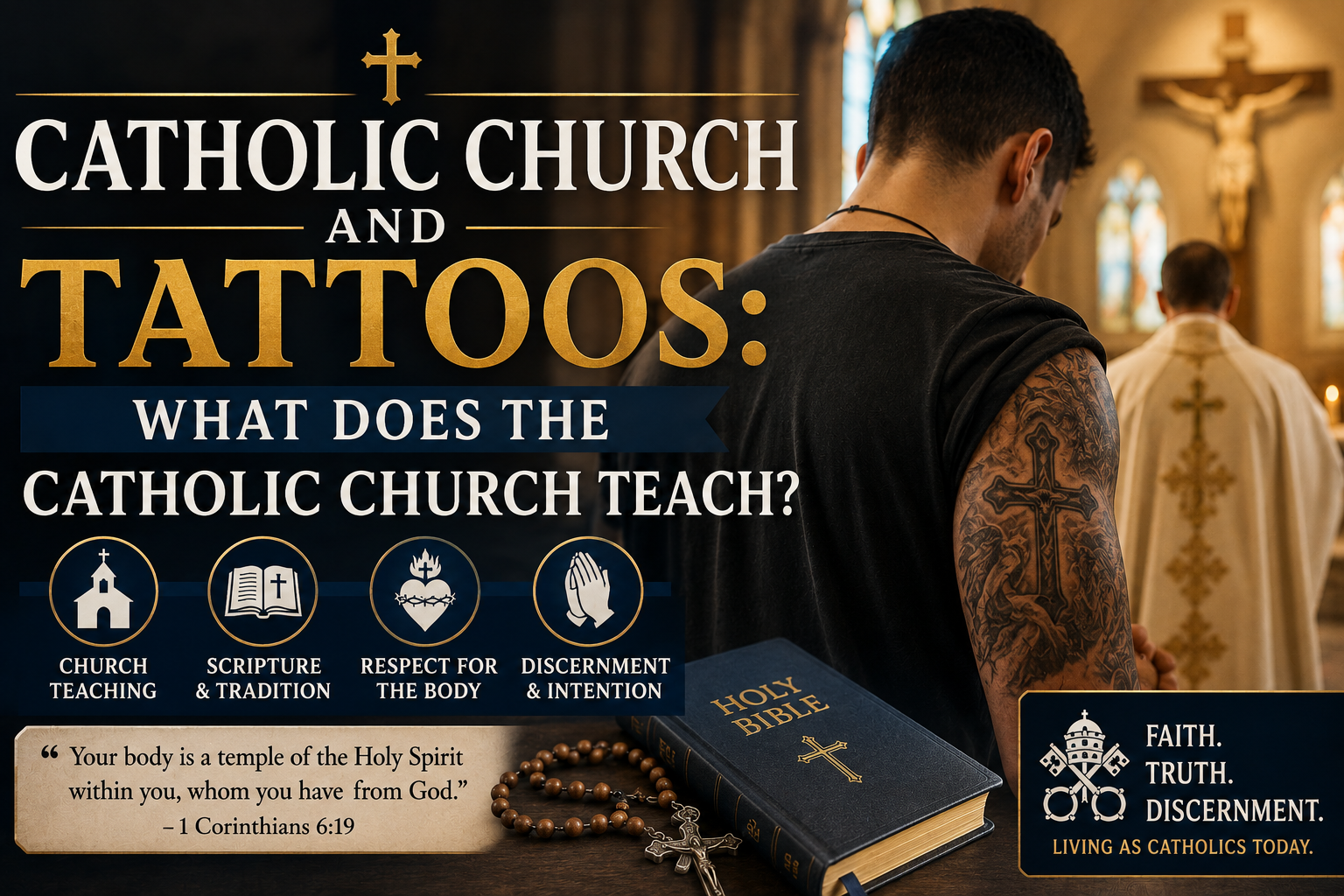
The relationship between the Catholic Church and tattoos is a common question among Catholics and people considering getting a tattoo. Does Catholicism forbid tattoos? Is having a tattoo a sin? Can a Catholic get a tattoo? What if someone already has one?
The short answer is that the Catholic Church does not have a blanket teaching that every tattoo is sinful or forbidden. However, Catholics are expected to consider the purpose, imagery, circumstances, and potential moral implications of getting a tattoo.
A frequently discussed Bible passage is Leviticus 19:28, which says, “Ye shall not make any cuttings in your flesh for the dead, nor print any marks upon you” (KJV). Catholics, however, do not generally interpret this Old Testament prohibition as a universal ban on all modern tattoos. Instead, Catholic moral reasoning considers the broader principles of Christian dignity, prudence, modesty, and responsible care for the body.
This guide explains what the Catholic Church teaches about tattoos, whether tattoos are a sin, what Leviticus 19:28 means, whether Catholics can get religious tattoos, and what to consider before getting one.
Does the Catholic Church Allow Tattoos?
Yes, the Catholic Church does not universally prohibit tattoos.
There is no general Catholic rule stating that a person commits a sin simply by having a tattoo.
However, that does not mean every tattoo or every reason for getting a tattoo is morally acceptable.
Catholic moral teaching asks believers to consider questions such as:
- What does the tattoo represent?
- Why do I want it?
- Is the image sinful, obscene, hateful, or blasphemous?
- Am I acting responsibly?
- Am I unnecessarily harming my body?
- Is vanity or peer pressure driving the decision?
- Could the tattoo cause serious scandal or harm?
- Am I treating my body with appropriate dignity?
Therefore, the question is not simply “Are tattoos allowed?”
A better Catholic question is:
“Is this particular tattoo and the reason for getting it consistent with Christian faith and moral living?”
Is Getting a Tattoo a Sin for Catholics?
Not necessarily.
Getting a tattoo is not automatically a mortal or venial sin simply because it involves permanently marking the skin.
The morality of the decision depends on the circumstances and intention.
For example, a tattoo depicting an obscene image or celebrating something seriously contrary to Christian morality would raise obvious concerns.
On the other hand, a person might have a tattoo that has no immoral meaning and was obtained responsibly.
The Catholic Church therefore does not treat every tattoo as morally identical.
What Does the Bible Say About Tattoos?
The passage most frequently discussed is:
Leviticus 19:28
“Ye shall not make any cuttings in your flesh for the dead, nor print any marks upon you.”
At first glance, this may appear to be a direct prohibition against modern tattoos.
However, understanding the historical and religious context is important.
The verse appears within the Old Testament Law given to ancient Israel. The prohibition is connected with practices involving mourning, ritual markings, and pagan customs.
Catholics do not generally interpret every Old Testament ceremonial or ritual regulation as a direct prohibition against every modern practice.
This is similar to how Christians distinguish between moral principles that continue to apply and particular ceremonial regulations belonging to the Old Covenant.
Does Leviticus 19:28 Mean Catholics Cannot Get Tattoos?
The Catholic Church does not generally interpret Leviticus 19:28 as an absolute prohibition against all tattoos today.
The verse should be understood within its ancient context.
The Israelites were surrounded by pagan cultures whose religious practices sometimes involved bodily markings and rituals connected with the dead.
The concern in Leviticus was therefore not simply modern tattooing as we understand it today.
Catholics also read the Old Testament in light of Christ and the New Covenant.
That does not mean the Old Testament is irrelevant. Rather, Christians interpret Old Testament laws within the fullness of Christian revelation.
Are Tattoos Mentioned in the Catechism?
The Catechism of the Catholic Church does not contain a specific general prohibition against tattoos.
Instead, Catholic moral teaching provides broader principles concerning the dignity of the human person and the responsible care of the body.
For example, the Catechism teaches that life and bodily health are valuable gifts entrusted to us.
This means Catholics should avoid deliberately damaging their bodies without a proportionate reason.
Therefore, the Catholic approach is primarily one of moral discernment rather than a simple tattoo ban.
Can Catholics Get Religious Tattoos?
A Catholic may choose to get a tattoo with religious imagery, but the fact that something is religious does not automatically make it a good decision.
Possible religious tattoos might include:
- A cross
- A Bible verse
- The name of Jesus
- A Christian symbol
- A depiction of a saint
- A Sacred Heart image
- A rosary design
- A dove
- An angel
- A Christian prayer
However, Catholics should still consider the reason for getting the tattoo and whether the design treats sacred things with appropriate reverence.
A religious tattoo should not become a substitute for actually living the faith.
Is a Cross Tattoo Acceptable for Catholics?
A cross tattoo is not automatically sinful.
The cross is the central Christian symbol of Christ’s Passion and salvation.
However, Catholics should treat sacred imagery respectfully.
For example, placing a cross in a deliberately obscene or degrading context would be very different from receiving a cross tattoo as a sincere reminder of Christian faith.
The intention and context matter.
Can Catholics Get Bible Verse Tattoos?
There is no general Catholic rule prohibiting Bible verse tattoos.
Someone might choose a verse that reminds them of God’s faithfulness, such as:
“The LORD is my shepherd; I shall not want.” — Psalm 23:1
or:
“I can do all things through Christ which strengtheneth me.” — Philippians 4:13
A Catholic considering such a tattoo should still ask whether getting it is wise and whether the motivation is consistent with Christian humility.
Can Catholics Get a Tattoo of Jesus?
A Catholic may choose a tattoo depicting Jesus, but religious artwork should be treated respectfully.
Ask yourself:
- Why do I want this image?
- Does the image reflect Christian belief?
- Am I treating it respectfully?
- Could the placement or context be offensive?
- Am I making this decision carefully rather than impulsively?
A tattoo of Jesus is not automatically sinful simply because it is a tattoo.
Can Catholics Get Tattoos of Saints?
Similarly, there is no blanket Catholic prohibition against tattoos depicting saints.
Some Catholics choose images of:
- St. Jude
- St. Thérèse of Lisieux
- St. Michael the Archangel
- The Virgin Mary
- St. Joseph
- Other saints
The important issue is that Catholics understand the proper role of saints.
Catholics do not worship the saints.
Rather, they honor them and ask for their intercession.
A tattoo of a saint should therefore be understood as a personal reminder of Christian faith, not as a magical object that automatically provides protection.
Is It a Sin to Get a Tattoo of a Demon or Occult Symbol?
This raises much greater moral concerns.
A tattoo associated with:
- Satanism
- occult practices
- demonic worship
- witchcraft
- hatred
- blasphemy
- pornography
- racial hatred
- violence
could conflict seriously with Catholic Christian teaching.
The issue is no longer simply the presence of ink on the skin.
The meaning and intention behind the tattoo matter.
A tattoo deliberately expressing rejection of God or participation in occult practices would be fundamentally different from a neutral decorative tattoo.
Can Catholics Have Tattoos They Got Before Becoming Christian?
Yes.
A person who becomes Catholic does not generally need to remove an existing tattoo simply because it is a tattoo.
If the tattoo itself represents something seriously contrary to Christian faith or contains offensive imagery, the person can discuss the situation with a priest and consider appropriate steps.
But Catholic conversion does not mean someone must automatically erase every tattoo from their body.
God’s mercy is not limited by someone’s past.
What If My Tattoo Has an Offensive Meaning?
If you already have a tattoo that represents something contrary to your Christian faith, do not panic.
Talk with a Catholic priest if the tattoo is causing you serious spiritual concern.
Depending on the situation, you might consider:
- Covering the tattoo
- Having it modified
- Having it removed
- Repenting of the behavior or belief represented by it
- Seeking appropriate pastoral guidance
The important issue is not merely removing ink.
The deeper issue is conversion of the heart.
What Does Catholicism Say About the Body?
Catholic Christianity teaches that the human body has dignity.
The body is not worthless or something that can be treated carelessly.
St. Paul writes:
“Know ye not that your body is the temple of the Holy Ghost?” — 1 Corinthians 6:19
This passage is often mentioned when discussing tattoos.
However, Catholics should be careful not to use the verse as though it were a direct statement about modern tattooing.
Paul’s teaching concerns sexual morality, holiness, and the dignity of the body.
Nevertheless, the broader principle—that Christians should treat their bodies with dignity—can reasonably inform decisions about tattoos.
Does “Your Body Is a Temple” Mean Tattoos Are Sinful?
No, not automatically.
The phrase “your body is a temple” does not establish a universal Catholic ban on tattoos.
Instead, it reminds Christians that the body should be treated with dignity.
This principle can lead to questions such as:
- Am I deliberately harming myself?
- Am I making a reckless decision?
- Is the tattoo associated with something immoral?
- Am I becoming excessively obsessed with appearance?
- Am I acting because of unhealthy pressure?
These are more useful Catholic questions than simply asking whether ink itself is sinful.
Are Tattoos a Form of Vanity?
They can be, but not necessarily.
A person may get a tattoo for many different reasons.
Some motivations may involve excessive concern about appearance or social approval.
Others may involve:
- Remembering a loved one
- Expressing artistic creativity
- Marking an important life event
- Expressing cultural identity
- Displaying a meaningful religious symbol
Catholic moral teaching does not say that every form of personal appearance or decoration is sinful.
The question is whether a person’s concern with appearance becomes disordered or excessive.
Should Catholics Ask a Priest Before Getting a Tattoo?
It can be helpful, particularly if you are uncertain about the morality of a specific tattoo.
A priest can help you consider:
- The tattoo’s meaning
- Your motivation
- Your circumstances
- Whether the design conflicts with Christian teaching
- Whether you have serious moral concerns
You do not necessarily need formal permission from a priest before getting a normal tattoo.
But if you are seriously unsure about whether your particular situation is morally acceptable, speaking with a priest is a wise step.
Questions Catholics Should Ask Before Getting a Tattoo
Before making a permanent decision, consider these questions.
1. Why do I want this tattoo?
Be honest about your motivation.
2. What does the image mean?
Know exactly what the symbol represents.
3. Does it contradict Catholic teaching?
Avoid imagery that celebrates serious wrongdoing, hatred, blasphemy, or occultism.
4. Am I acting impulsively?
A permanent decision deserves careful consideration.
5. Am I being pressured?
Don’t get a tattoo simply because friends or social media encourage you.
6. Am I taking reasonable care of my health?
Choose a reputable, hygienic professional and understand the risks.
7. Will I regret this later?
Think beyond the present moment.
8. Is vanity controlling my decision?
Ask whether the tattoo reflects a healthy choice or excessive concern with appearance.
9. Would I be comfortable explaining it to my family and priest?
This can be a useful test of your motivation.
10. Have I prayed about the decision?
Bring the decision before God before making it permanent.
What Tattoos Should Catholics Avoid?
Although there is no universal Catholic tattoo list, Catholics should avoid designs that clearly conflict with Christian morality.
Examples include tattoos celebrating:
- Satanism
- Blasphemy
- Hatred
- Racism
- Pornography
- Violence for its own sake
- Occult worship
- Serious sinful behavior
The moral problem comes from what the tattoo communicates and represents, not simply from the presence of ink.
Can Catholics Get Tattoos of Mary?
There is no blanket Catholic prohibition against a tattoo depicting the Blessed Virgin Mary.
However, sacred imagery deserves respect.
If someone chooses such a tattoo, it should not be treated as a magical charm.
Catholics honor Mary because of her unique role in salvation history and her relationship to Jesus.
A Marian tattoo can serve as a personal reminder of faith, but Christian devotion should ultimately lead the believer toward Christ.
Can Catholics Get Tattoos of the Rosary?
A rosary tattoo is not automatically sinful.
However, Catholics should understand that a tattoo of a rosary is not itself a sacramental.
A physical rosary blessed by the Church has a different role in Catholic devotional life.
A tattoo does not become spiritually powerful merely because a religious image is placed on the skin.
The value of Catholic prayer comes from faith in God, not from treating an object or tattoo as a magical source of protection.
Can a Tattoo Be a Sin If It Is Permanent?
Permanence by itself does not make something sinful.
Many morally neutral decisions are permanent.
The relevant questions are:
- What is being done?
- Why is it being done?
- What does it communicate?
- Is there unnecessary harm?
- Is there a serious moral problem involved?
Therefore, Catholics should avoid simplistic claims such as “all tattoos are sinful because they are permanent.”
That is not the Catholic Church’s general position.
What About Tattooing for Cultural Reasons?
A tattoo connected to cultural tradition is not automatically sinful.
Catholic moral evaluation still depends on the particular practice and its meaning.
If the practice involves occult worship or another serious conflict with Christian faith, that would raise different concerns.
But cultural body art itself cannot simply be classified as sinful solely because it is cultural.
Can Catholics Get Tattoos for Their Children or Family?
A person may choose a tattoo commemorating a family member or child.
For example, someone might tattoo:
- A child’s name
- A meaningful date
- A family symbol
- A Bible verse
- A small religious symbol
Again, the Catholic Church does not teach that such tattoos are automatically sinful.
The person should still consider whether the decision is prudent and whether the tattoo will remain meaningful over time.
Catholic Church and Tattoos: What Is the Final Answer?
The Catholic Church does not teach that every tattoo is a sin.
Instead, Catholics should evaluate tattoos using broader principles of Christian morality.
A tattoo may be morally acceptable when it does not express something contrary to Christian faith, does not involve seriously irresponsible behavior, and is chosen for a reasonable purpose.
However, tattoos that deliberately express blasphemy, hatred, pornography, occultism, or serious rejection of God can present significant moral problems.
The key question is therefore not:
“Is tattooing always a sin?”
but:
“What is the tattoo, why am I getting it, and does this decision respect God, my neighbor, and the dignity of my body?”
Frequently Asked Questions About the Catholic Church and Tattoos
Does the Catholic Church forbid tattoos?
No. The Catholic Church does not have a universal rule forbidding all tattoos.
Is getting a tattoo a mortal sin?
Getting a tattoo is not automatically a mortal sin. The morality depends on the tattoo, intention, circumstances, and other relevant factors.
Can Catholics have tattoos?
Yes. Catholics can have tattoos. Having a tattoo does not automatically prevent someone from practicing the Catholic faith.
Does Leviticus 19:28 forbid Catholic tattoos?
Catholics do not generally interpret Leviticus 19:28 as a universal prohibition against all modern tattoos. The passage must be understood within its ancient covenantal and cultural context.
Can Catholics get a cross tattoo?
Yes. A cross tattoo is not automatically sinful. Catholics should treat the image of the cross with appropriate reverence.
Can Catholics get Bible verse tattoos?
Yes. There is no general Catholic prohibition against Bible verse tattoos.
Can Catholics get tattoos of saints?
Yes. A tattoo depicting a saint is not automatically sinful. However, sacred images should be treated respectfully.
Can Catholics get tattoos of Mary?
There is no blanket prohibition against Marian tattoos. However, Catholics should treat images of Mary respectfully and understand that a tattoo is not a magical object.
Can Catholics get a rosary tattoo?
Yes. A rosary tattoo is not automatically sinful, but it should not be treated as a magical source of protection.
Can a Catholic get a tattoo of Jesus?
There is no general prohibition against a tattoo depicting Jesus. The image should be approached with reverence.
What tattoos should Catholics avoid?
Catholics should avoid tattoos that celebrate or promote serious evils such as blasphemy, hatred, pornography, racism, Satanism, or occult worship.
What if I already have a tattoo?
Having an existing tattoo does not automatically make you sinful or require you to leave the Catholic Church. If its imagery or meaning seriously conflicts with Christian faith, consider discussing it with a priest.
Should I confess getting a tattoo?
Getting a tattoo is not automatically a sin that must be confessed. If the circumstances involved a genuinely sinful act, discuss the matter honestly with a priest.
Final Thoughts
The question of Catholic Church and tattoos cannot be answered simply with “yes” or “no.”
The Catholic Church does not impose a blanket prohibition on tattoos. Instead, Catholics are called to make prudent moral decisions that respect the dignity of the human body and remain consistent with Christian faith.
Before getting a tattoo, consider its meaning, your motivation, the potential risks, and whether the decision reflects the values you want to live by.
If you already have a tattoo, do not assume that having it automatically separates you from God or the Church.
Ultimately, the Christian life is about more than what is written on your skin. It is about what is written on your heart.
“Create in me a clean heart, O God; and renew a right spirit within me.” — Psalm 51:10 (KJV)
May every Catholic seek to honor God not only through external symbols but through faith, love, holiness, humility, and the way we treat others.