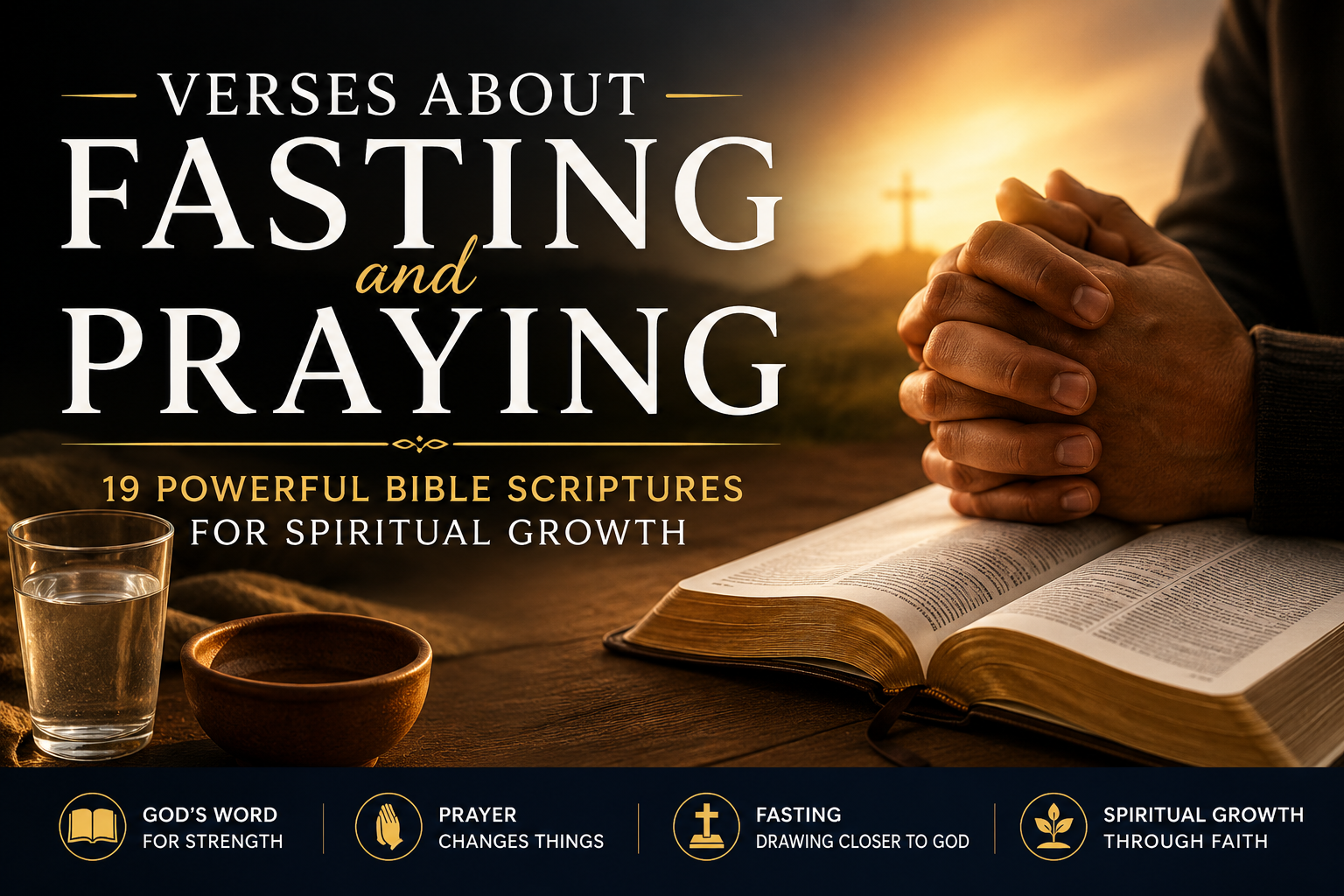
Fasting and praying
are important spiritual practices found throughout the Bible. God’s people fasted and prayed during times of repentance, worship, grief, guidance, spiritual preparation, and urgent need.
If you are looking for Bible verses about fasting and praying, Scripture provides many examples of people who deliberately set aside normal activities to seek God more deeply.
Fasting does not mean trying to force God to answer a prayer. Instead, biblical fasting is a way of humbling ourselves before God, seeking His direction, strengthening our dependence on Him, and giving focused attention to prayer.
This collection of 19 Bible verses about fasting and praying includes Old and New Testament passages that can encourage you before, during, and after a fast.
What Does the Bible Say About Fasting and Prayer?
The Bible presents fasting as a practice that can accompany prayer, repentance, worship, mourning, and seeking God’s direction.
Fasting can help a believer deliberately set aside something important for a period of time in order to focus more intentionally on God.
However, Jesus warned against fasting merely to impress other people.
In Matthew 6:16–18, Jesus taught His followers not to make their fasting a public performance.
The purpose of fasting is therefore not to gain human praise.
It is about seeking God with sincerity.
19 Powerful Bible Verses About Fasting and Praying
1. Matthew 6:16–18 — Fast Sincerely Before God
Jesus teaches about fasting during His Sermon on the Mount.
He warns His followers not to fast merely to appear spiritual before other people.
The important principle is that fasting should be directed toward God rather than human recognition.
Key lesson: Fast sincerely, not for attention or praise.
2. Matthew 4:1–2 — Jesus Fasted for Forty Days
Matthew records that Jesus fasted for forty days and nights in the wilderness before beginning His public ministry.
“And when he had fasted forty days and forty nights, he was afterward an hungred.”
Jesus’ experience demonstrates that fasting can be connected with spiritual preparation and dependence upon God.
Key lesson: Fasting can accompany seasons of spiritual preparation.
3. Joel 2:12 — Return to God With Fasting
“Therefore also now, saith the LORD, turn ye even to me with all your heart, and with fasting, and with weeping, and with mourning.”
This verse connects fasting with returning to God wholeheartedly.
Fasting is not merely changing what we eat. It should be connected with a heart that genuinely seeks God.
Key lesson: Fasting can accompany sincere repentance and spiritual renewal.
4. Ezra 8:21 — Fasting for God’s Guidance
Ezra proclaimed a fast so the people could humble themselves before God and seek His protection and direction.
“Then I proclaimed a fast there… that we might afflict ourselves before our God, to seek of him a right way for us…”
This is one of the clearest biblical examples of fasting while seeking God’s guidance.
Key lesson: You can fast and pray when seeking God’s direction.
5. Acts 13:2–3 — Fasting Before Ministry Decisions
The early church fasted and prayed while worshiping God.
The Holy Spirit directed the believers to set apart Barnabas and Saul for the work to which God had called them.
The believers then continued fasting and praying before sending them out.
Key lesson: Fasting and prayer can accompany important decisions and ministry.
6. Daniel 9:3 — Seeking God Through Fasting
Daniel wrote:
“And I set my face unto the Lord God, to seek by prayer and supplications, with fasting…”
Daniel deliberately devoted himself to seeking God through prayer and fasting.
Key lesson: Fasting can help express serious, focused prayer.
7. Daniel 10:2–3 — Daniel’s Partial Fast
Daniel describes a period in which he mourned and practiced a restricted diet.
He continued this practice for three weeks.
This passage shows that biblical fasting did not always look exactly the same.
Key lesson: Biblical fasting can take different forms.
8. Esther 4:16 — Fasting During Crisis
Esther asked the Jewish people to fast for her before she approached the king.
“Fast ye for me, and neither eat nor drink three days…”
The people joined her in fasting during a serious national crisis.
Key lesson: Fasting can be used during seasons of urgent prayer and serious concern.
9. 2 Chronicles 20:3 — Fasting When Facing Danger
King Jehoshaphat responded to a threatening situation by seeking the Lord and proclaiming a fast throughout Judah.
Instead of depending only on military strength, the people turned to God.
Key lesson: When facing overwhelming circumstances, prayer and fasting can help redirect our hearts toward God.
10. Jonah 3:5 — Fasting and Repentance
After Jonah preached to Nineveh, the people believed God and proclaimed a fast.
The fast was connected with humility and repentance.
Key lesson: Fasting can accompany genuine repentance.
11. Nehemiah 1:4 — Fasting and Grief
After hearing about Jerusalem’s difficult condition, Nehemiah sat down, wept, mourned, fasted, and prayed before God.
His response shows how fasting can accompany grief and deep concern.
Key lesson: You can bring grief and serious burdens to God through prayer and fasting.
12. Psalm 35:13 — Fasting in Intercession
David describes humbling himself with fasting while praying for others.
“I humbled my soul with fasting; and my prayer returned into mine own bosom.”
This verse shows fasting connected with intercessory prayer.
Key lesson: Fasting can accompany prayer on behalf of other people.
13. Psalm 69:10 — Fasting and Humility
David speaks about humbling himself through fasting.
The passage shows that fasting can involve genuine humility before God.
Key lesson: Biblical fasting should produce humility rather than pride.
14. Isaiah 58:6 — The Fast God Desires
Isaiah 58 challenges people who were fasting while continuing to live unjustly.
God explains that the kind of fasting He desires involves freeing people from oppression, sharing with the hungry, and caring for those in need.
Key lesson: Genuine fasting should affect how we treat other people.
15. Acts 14:23 — Fasting and Leadership
Paul and Barnabas prayed and fasted as they appointed elders in the churches.
This demonstrates that fasting was practiced by early Christians during important spiritual decisions.
Key lesson: Prayer and fasting can accompany leadership and major responsibilities.
16. Luke 2:37 — Worship, Fasting, and Prayer
Anna, a prophetess, is described as serving God with fasting and prayers.
Her life demonstrates consistency and devotion.
Key lesson: Fasting can be part of a dedicated life of worship and prayer.
17. Mark 9:29 — Prayer and Spiritual Dependence
Jesus teaches about the importance of prayer in dealing with a difficult spiritual situation.
Some biblical manuscripts and translations include fasting alongside prayer in this passage, while others do not.
The broader lesson remains the importance of dependence upon God rather than human strength.
Key lesson: Prayer expresses dependence upon God’s power.
18. Zechariah 7:5 — Examine Why You Fast
God challenged the people about the motivation behind their fasting.
The issue was not simply whether they were fasting but whom they were fasting for.
Key lesson: God cares about the heart and motivation behind spiritual practices.
19. Matthew 9:14–15 — A Time for Fasting
Jesus’ disciples were questioned about fasting.
Jesus explained that His disciples would have a time to fast after He was taken away.
Key lesson: Jesus recognized fasting as an appropriate spiritual practice in its proper context.
What Is Biblical Fasting?
Biblical fasting is voluntarily abstaining from food or restricting food for a spiritual purpose, usually accompanied by prayer and seeking God.
However, fasting in Scripture appears in different forms.
Examples include:
- Complete food fasting for a limited period
- Partial fasting
- Abstaining from particular foods
- Fasting during times of mourning
- Fasting during repentance
- Fasting while seeking God’s direction
- Corporate fasting with a group of believers
The Bible does not present one single fasting method that every person must follow.
Why Do Christians Fast and Pray?
There are several biblical reasons for fasting and praying.
1. To Seek God
Fasting can help you deliberately focus your attention on God.
2. To Repent
Several biblical examples connect fasting with repentance and returning to God.
3. To Seek Guidance
Ezra and other biblical figures fasted while seeking God’s direction.
4. To Express Humility
Fasting can remind us that we depend upon God.
5. To Pray for Others
Scripture contains examples of fasting connected with intercession.
6. To Prepare Spiritually
Jesus fasted before beginning His public ministry.
7. To Respond to Serious Circumstances
Esther, Nehemiah, and Jehoshaphat provide examples of fasting during difficult situations.
How to Pray While Fasting
Fasting should be accompanied by sincere prayer.
Instead of simply thinking about food, use the time you would normally spend eating or preparing food to focus on God.
You can pray about:
- Your relationship with God
- Repentance
- Family
- Wisdom
- Protection
- Healing
- Spiritual growth
- Important decisions
- Other people’s needs
- Strength during difficult circumstances
You can also read Scripture and spend time quietly reflecting on God’s Word.
A Simple Prayer Before Fasting
Heavenly Father, I come before You with humility.
As I begin this fast, help me focus my heart on You.
Give me wisdom, self-control, and sincerity.
Keep me from fasting for attention or personal praise.
Help me use this time to pray, read Your Word, repent where necessary, and seek Your guidance.
May this fast draw me closer to You and help me become more obedient to Your will.
In Jesus’ name, Amen.
Prayer During a Fast
Lord, as I continue this fast, strengthen me spiritually.
Help me focus on You rather than simply thinking about what I am giving up.
Reveal areas of my life that need to change.
Give me wisdom concerning the decisions I am facing.
Strengthen my faith and help me remain disciplined.
Teach me to trust You without trying to manipulate the outcome of my prayers.
May this time of fasting produce genuine spiritual growth.
Amen.
Prayer After Fasting
Heavenly Father, thank You for helping me complete this period of fasting.
Thank You for the opportunity to seek You more intentionally.
Help me carry the lessons I have learned into my daily life.
Give me wisdom to act on what You have shown me through Scripture and prayer.
Help me continue seeking You even after the fast ends.
May my life demonstrate the humility, obedience, love, and faith that I have prayed for.
Amen.
What Should I Pray for While Fasting?
Your prayer focus depends on why you are fasting.
For spiritual growth
Ask God to deepen your faith and understanding.
For guidance
Ask for wisdom and discernment.
For repentance
Ask God to reveal areas where you need to change.
For family
Pray for your loved ones and relationships.
For difficult circumstances
Ask God for strength, wisdom, peace, and appropriate solutions.
For others
Intercede for people who are sick, grieving, struggling, or in need.
Remember that fasting is not a way to force God to give you exactly what you want.
Instead, approach God with humility and trust.
Does Fasting Make God Answer Prayer?
The Bible does not teach that fasting is a method for forcing God to answer prayer according to our demands.
Fasting is not a spiritual transaction:
“I fast, therefore God must give me what I request.”
Instead, biblical fasting involves humility, seeking God, repentance, worship, and dependence.
The goal is not to control God.
The goal is to draw closer to Him and align our hearts with His will.
What Is the Best Bible Verse for Fasting and Prayer?
There are many excellent passages, but Ezra 8:21 is especially relevant:
“Then I proclaimed a fast there… that we might afflict ourselves before our God, to seek of him a right way for us…”
This verse connects fasting, humility, and seeking God’s direction.
Another important passage is Joel 2:12, which connects fasting with returning to God wholeheartedly.
How Long Should a Christian Fast?
The Bible records different fasting periods, including:
- One day
- Several days
- Three weeks
- Forty days
However, biblical examples do not mean that every Christian should attempt a particular length of fast.
The appropriate approach depends on the purpose of the fast and your individual circumstances.
If you are considering a prolonged fast or a fast that significantly restricts food or fluids, consider obtaining appropriate medical guidance, especially if you have a medical condition, take medication, are pregnant or breastfeeding, or have other health considerations.
A fast should never become an excuse to harm your body.
Types of Fasting in the Bible
Complete Fast
A complete fast involves abstaining from food for a specified period.
Some biblical examples involved abstaining from both food and drink for a limited time.
Such extreme fasting should not be undertaken casually.
Partial Fast
Daniel’s experience provides an example of restricting certain foods rather than completely abstaining from all food.
Corporate Fast
A group of people may fast together while seeking God.
Esther 4 and several Old Testament passages provide examples of corporate fasting.
Private Fast
Jesus’ teaching in Matthew 6 emphasizes that fasting should not be performed for public recognition.
Fasting and Prayer for Spiritual Breakthrough
Many Christians use the phrase “spiritual breakthrough” when describing situations where they are seeking God’s help, direction, or intervention.
The Bible does contain examples of fasting during difficult circumstances.
However, it is important to avoid treating fasting as a guaranteed formula for receiving a particular result.
A healthier biblical approach is:
Pray with faith.
Fast with humility.
Seek God’s will.
Take wise action where appropriate.
Trust God with the outcome.
Fasting and Prayer for Guidance
If you are facing an important decision, you can use fasting to intentionally seek God.
Read passages such as:
- Proverbs 3:5–6
- James 1:5
- Psalm 32:8
- Ezra 8:21
- Acts 13:2–3
Then ask God for wisdom rather than simply asking Him to approve the decision you already want to make.
A useful prayer is:
“Lord, show me the wise path. Give me courage to follow it and humility to change direction when necessary.”
Fasting and Prayer for Family
You can dedicate a fast to praying for your family.
Ask God for:
- Wisdom for parents
- Protection
- Peace
- Healthy relationships
- Forgiveness
- Spiritual growth
- Provision
- Guidance for children
- Strength during difficult circumstances
Pray for your family without trying to control every outcome.
Fasting and Prayer for Repentance
Joel 2 and several other passages demonstrate the connection between fasting and repentance.
A repentance-focused fast should involve more than changing your eating habits.
Ask yourself:
What needs to change in my life?
What attitudes need to be surrendered?
Who have I hurt?
What habits are taking me away from God?
What steps can I take toward genuine change?
Fasting should lead to a heart that desires transformation.
Fasting and Prayer for God’s Will
One of the healthiest ways to approach fasting is to seek God’s will.
Instead of praying only:
“God, give me what I want.”
You can pray:
“God, help me want what is good and give me wisdom to follow Your will.”
This approach keeps fasting centered on God rather than making it a method for obtaining personal desires.
What Does Isaiah 58 Teach About Fasting?
Isaiah 58 is one of the most important biblical passages about fasting.
The people were fasting but continuing to practice injustice.
God challenged their understanding of what genuine fasting should look like.
The chapter connects acceptable fasting with practical righteousness, generosity, compassion, and care for people who are suffering.
This teaches an important principle:
Fasting should change more than our eating habits; it should influence our character and behavior.
If someone fasts while continuing to mistreat others, the outward religious practice is missing the heart of what God desires.
Fasting Should Lead to Action
Biblical fasting should not end when the fast ends.
If you fast for patience, look for opportunities to practice patience.
If you fast for forgiveness, take appropriate steps toward reconciliation.
If you fast for guidance, act wisely when you gain clarity.
If you fast for spiritual growth, continue praying and studying Scripture.
If you fast because you want to help people in need, look for practical ways to serve.
The purpose is transformation, not simply completion of a fasting schedule.
Common Mistakes to Avoid When Fasting
Fasting for attention
Jesus specifically warned against making fasting a performance for other people.
Treating fasting like a bargain with God
Fasting does not put God under an obligation to fulfill our requests.
Ignoring the heart
Changing your diet without seeking God does not automatically produce spiritual growth.
Neglecting Scripture and prayer
A fast should have a spiritual purpose.
Becoming proud
Completing a difficult fast does not make someone spiritually superior to another person.
Ignoring health
A person’s health and circumstances should be considered when choosing how to fast.
A 1-Day Fasting and Prayer Plan
If you are new to fasting, a simple one-day devotional structure can help.
Morning
Begin with prayer and Scripture.
Read a passage such as Matthew 6:16–18.
Ask God to guide your fast.
Midday
Spend time praying instead of focusing solely on what you are giving up.
Read another passage about fasting.
Pray for your specific concerns.
Afternoon
Take a few quiet minutes to reflect.
Ask God to reveal anything that needs to change in your life.
Evening
Thank God for the day.
Review what you have learned.
Pray for wisdom and strength.
If you are ending a food fast, resume eating responsibly.
19 Bible Verses About Fasting and Praying at a Glance
Here are the key passages covered in this guide:
- Matthew 6:16–18 — Fast sincerely.
- Matthew 4:1–2 — Jesus fasts for forty days.
- Joel 2:12 — Return to God with fasting.
- Ezra 8:21 — Fast for God’s guidance.
- Acts 13:2–3 — Fast before ministry decisions.
- Daniel 9:3 — Seek God through fasting.
- Daniel 10:2–3 — Daniel’s partial fast.
- Esther 4:16 — Fast during a crisis.
- 2 Chronicles 20:3 — Fast when facing danger.
- Jonah 3:5 — Fasting and repentance.
- Nehemiah 1:4 — Fasting during grief.
- Psalm 35:13 — Fasting and intercession.
- Psalm 69:10 — Fasting and humility.
- Isaiah 58:6 — The fast God desires.
- Acts 14:23 — Fasting and leadership.
- Luke 2:37 — Fasting and worship.
- Mark 9:29 — Prayer and dependence on God.
- Zechariah 7:5 — Examine your motives.
- Matthew 9:14–15 — A time for fasting.
Frequently Asked Questions
What are the best Bible verses about fasting and praying?
Some of the strongest passages include Matthew 6:16–18, Joel 2:12, Ezra 8:21, Daniel 9:3, Acts 13:2–3, Isaiah 58:6, and Esther 4:16.
What does the Bible say about fasting and prayer?
The Bible presents fasting and prayer as practices associated with seeking God, repentance, humility, guidance, worship, grief, and serious circumstances.
What is a powerful prayer while fasting?
A simple prayer is:
“Lord, help me seek You sincerely during this fast. Give me wisdom, strengthen my faith, reveal what needs to change in my life, and help me trust Your will rather than trying to control the outcome. Amen.”
Can I fast and pray for a specific request?
Yes. Biblical examples show people fasting during serious circumstances and while seeking God’s help. However, fasting should not be treated as a way to force God to give a particular answer.
How long should I fast and pray?
There is no single fasting period required for every Christian. Scripture contains examples of different fasting periods. Choose a responsible approach appropriate to your circumstances and seek medical guidance before prolonged or restrictive fasting if needed.
Can I fast without praying?
You can abstain from food for personal reasons, but biblical fasting is closely associated with seeking God. Prayer and Scripture help keep the fast spiritually focused.
What should I pray for during fasting?
You can pray for spiritual growth, repentance, wisdom, guidance, family, healing, protection, provision, strength, or other legitimate concerns. Most importantly, seek God’s will rather than treating fasting as a guarantee of a desired result.
What does Isaiah 58 say about fasting?
Isaiah 58 teaches that genuine fasting should be connected with righteousness, compassion, generosity, and care for people who are suffering. Religious practice should be accompanied by a life that reflects God’s character.
Final Thoughts
The Bible contains many powerful examples of people who fasted and prayed while seeking God.
Daniel fasted and prayed for understanding.
Esther called for fasting during a crisis.
Ezra fasted while seeking God’s direction.
Nehemiah fasted while grieving over Jerusalem.
The early church fasted and prayed before important ministry decisions.
Jesus Himself fasted during His time in the wilderness.
These examples show that fasting can be a meaningful spiritual discipline when approached with humility and sincerity.
But fasting is not a magic formula.
It is not a way to manipulate God.
It is not a competition.
It is not about impressing other people.
Biblical fasting is ultimately about seeking God.
As you fast, pray sincerely.
Read Scripture.
Examine your heart.
Repent where necessary.
Seek wisdom.
Pray for others.
Take responsible action when action is needed.
And trust God with the things you cannot control.
May your time of fasting draw you closer to God, strengthen your faith, deepen your prayer life, and help you live with greater humility, love, wisdom, and obedience.
“Seek the LORD and his strength, seek his face continually.” — 1 Chronicles 16:11